
Your Complete Guide to Chinese Measure Words
Quick answer: Chinese measure words (量词 liàngcí) are classifiers placed between a number (or demonstrative like 这/那) and a noun. The formula is always Number + Measure Word + Noun, for example 三本书 (sān běn shū) = ‘three books’.
Every countable noun in Mandarin requires one, and 个 (gè) is the safest general-purpose fallback while you learn the specific ones.
What Are Chinese Measure Words (量词 liàngcí)?

In Chinese grammar, a measure word is called 量词 (liàngcí). It sits between a number (or a demonstrative like 这/那) and a noun. You cannot count or point to most nouns in Chinese without one.
Think of English phrases like a slice of bread, a sheet of paper, a flock of birds. In English these only appear for certain nouns. In Chinese, every countable noun needs one, every single time.
So instead of saying ‘three books’, you say:
三 (sān) + 本 (běn) + 书 (shū) = three [volume] books
The formula is always: Number + Measure Word + Noun. Once 量词 (liàngcí) clicks, the rest is just vocabulary, and that’s exactly what this guide gives you. 💡
When learning Chinese, one thing that often surprises beginners is just how important, and unavoidable measure words are.
Whether you’re ordering two cups of tea, buying three books, or spotting five people in a room, Chinese requires a specific measure word to go between the number and the noun.
This guide covers the most commonly used Chinese measure words, the ones you’ll actually need in classrooms, restaurants, markets, and everywhere in between. Work through them category by category and you’ll speak more naturally, faster.
New to Chinese characters? Before working through the full list below, it helps to understand how Chinese characters combine. Many measure word characters contain visual clues (radicals) that hint at their meaning. 木 (mù / wood) appears in measure words for trees and wooden objects, for example. Spotting these patterns makes memorisation much faster.
You’ll get familiar with essentials like
个 (gè) for general items
本 (běn) for books
杯 (bēi) for drinks, plus dozens more you’ll encounter in everyday conversations!
Mastering measure words may seem tricky at first, but they do click, we promise. When Lilia first introduced measure words to a group of beginners at our Beijing school, she put it simply: ‘Don’t try to memorise them all at once. Learn the noun, learn its measure word at the same time, like a pair.’ That advice has stayed with hundreds of our students.
Maxime from France told us after his first month in Beijing: ‘I thought 个 was enough for everything. Then I tried to order a glass of wine and got blank stares, because there’s a different measure word for one glass and one bottle. That’s when I realised I needed to actually learn these.’ He had a point. 🤔
With the right framework, it becomes second nature.
You’ll notice that some measure words appear in more than one category as some can be used for a variety of objects.
Chinese Measure Words – 12 of the Most Common
Chinese Measure Words – People and Animals
Chinese Measure Words – Body Parts
Chinese Measure Words – Food
Chinese Measure Words – Plants, Fruit and Vegetables
Chinese Measure Words – Vehicles and Buildings
Chinese Measure Words – Household Items
Chinese Measure Words – Clothing and Jewellery
Chinese Measure Words – Time
Chinese Measure Words – Units of Measure
Chinese Measure Words – Pairs, Collections and Groups
FREE DOWNLOAD – Measure Words PDF
TEST YOURSELF – Chinese Measure Words Quiz

How to Use Chinese Measure Words // The Grammar Formula
Every time you want to say how many of something there is in Chinese, you follow one pattern:
Number + Measure Word + Noun
| Number | Measure Word | Noun | Meaning |
|---|---|---|---|
| 三 (sān) | 本 (běn) | 书 (shū) | Three books |
| 两 (liǎng) | 杯 (bēi) | 茶 (chá) | Two cups of tea |
| 一 (yī) | 条 (tiáo) | 鱼 (yú) | One fish |
It also works with demonstratives, 这 (zhè / this) and 那 (nà / that), in place of a number:
这/那 + Measure Word + Noun
| Demonstrative | Measure Word | Noun | Meaning |
|---|---|---|---|
| 这 (zhè) | 本 (běn) | 书 (shū) | This book |
| 那 (nà) | 条 (tiáo) | 路 (lù) | That road |
TIP💡 You’ll also see 两 (liǎng) used instead of 二 (èr) when it precedes a measure word. ‘两本书’ (two books), not ‘二本书’. This trips up a lot of beginners, you’re not alone if it catches you out.
TIP💡 Numbers are the other half of this formula. If you want to practice counting and numeral measure words for counting together, our Chinese numbers guide walks you through 一, 两, 三 and the tonal rules that affect them when paired with measure words.
Chinese Measure Words – 12 of The Most Common
Firstly, don’t let yourself be too overwhelmed by the concept of measure words. They do actually exist in other languages like English for certain nouns such as three glasses, or a bar of chocolate.
The only difference in Chinese is that all nouns must have a measure word before them
It may take a little bit of getting used to at first, but after a little while, including a measure word will just seem like second nature!
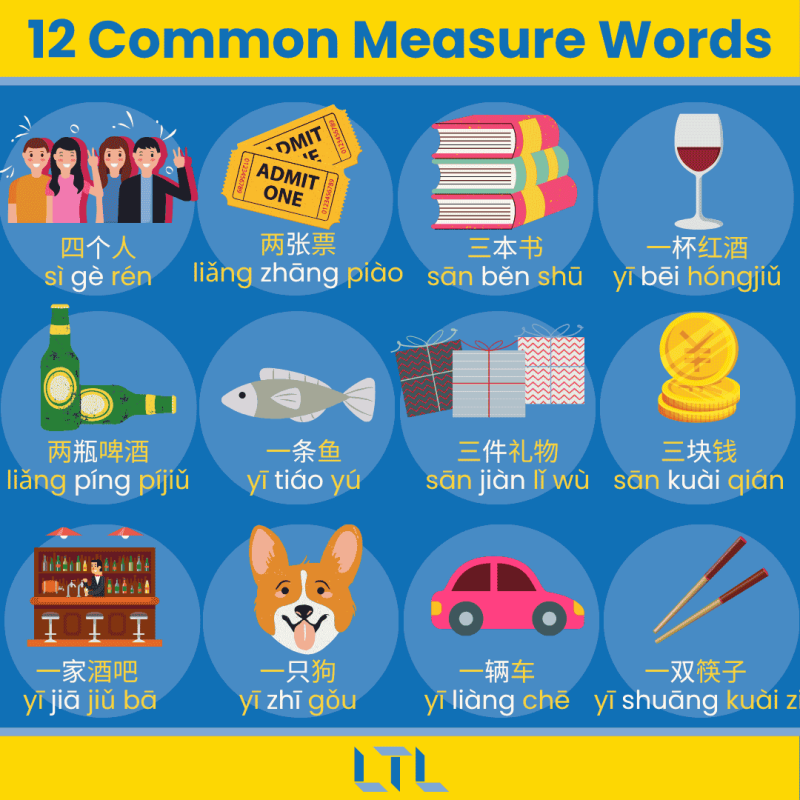
#1 – 个 gè

The safety-net measure word, and your best friend as a beginner.
个 (gè) is the most frequently used measure word in Mandarin and, crucially, it works as a fallback when you’re not sure which specific measure word to use. Native speakers will understand you, even if it sounds slightly informal.
However, it’s not a true universal. Overusing it does sound unnatural in certain contexts. You would not use 个 for books (use 本 běn), animals (use 只 zhī or 条 tiáo), or bound volumes. Use it freely while you’re learning, but aim to replace it as you build confidence.
TIP💡 Think of 个 as your training wheels. Every learner at LTL leans on it hard in the first few weeks, that’s completely normal. The goal is to swap it out progressively as you meet each noun category.
In general, 个 (gè) is the correct measure word for people and unspecified items:
| 一个朋友 | yí gè péngyou | A friend |
| 一个东西 | yī gè dōngxī | A thing |
In general, 个 (gè) is the standard measure word for people in everyday speech. However, Mandarin also has 位 (wèi), a polite, formal classifier used when you want to show respect.
| Context | Measure Word | Example | Meaning |
|---|---|---|---|
| Everyday | 个 (gè) | 两个朋友 (liǎng gè péngyou) | Two friends |
| Formal / polite | 位 (wèi) | 三位客人 (sān wèi kèrén) | Three guests |
| Formal / polite | 位 (wèi) | 一位老师 (yī wèi lǎoshī) | A teacher (respectful) |
TIP💡 In a restaurant, a host will ask ‘几位?’ (jǐ wèi? — how many in your party?) rather than ‘几个人?’. Using 位 in professional or hospitality settings immediately signals a higher level of Mandarin, it’s worth knowing early.
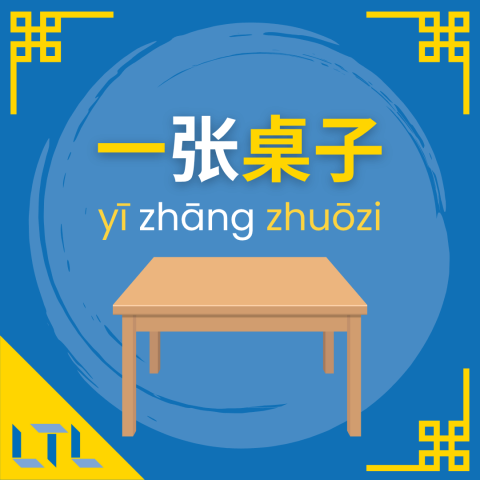
#2 – 张 zhāng
This is an important measure word to learn for anyone living or travelling in China as it is used for flat things such as pieces of paper.
For instance it would be used when buying train or plane tickets, something you’ll do a lot when travelling between LTL school cities like Beijing, Shanghai, Xi’an, and Chengdu:
| 两张火车票 | liǎng zhāng huǒchē piào | Two train tickets |
| 一张硬卧票 | yī zhāng yìng wò piào | One soft sleeper ticket |
This measure word is also used for other flat objects like certain furniture:
| 一张双人床 | yī zhāng shuāngrén chuáng | A double bed |
| 我想订一张桌子 | wǒ xiǎng dìng yī zhāng zhuōzi | I want to book a table |

#3 – 本 běn
This is another important one to learn, because here 个 really can’t be used as a replacement, or you’re going to get some strange looks!
本 běn is used for when you are talking about books, magazines, notebooks etc.
| 一本杂志 | yī běn zázhì | A magazine |
| 一本笔记本 | yī běn bǐjìběn | A notebook |
| 三本书 | sān běn shū | Three books |

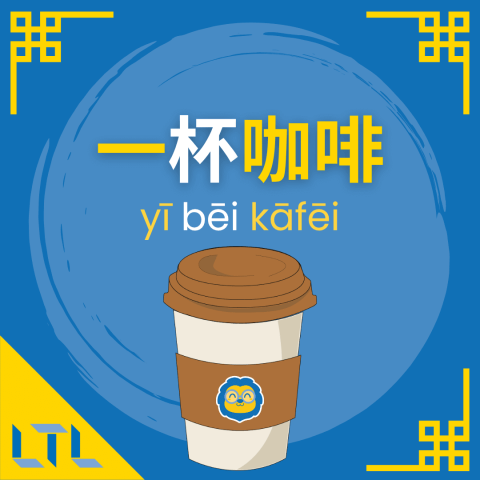
#4 – 杯 bēi
If you want to advance your Chinese ordering beyond pointing at the menu and saying 这个 zhège, then this is a good word to start with.
杯 bēi is the measure word used for glasses or cups. This is an easy one to get used to as we use glass as a measure word in other languages.
| HANZI | PINYIN | ENGLISH |
|---|---|---|
| 两杯红酒 | liǎng bēi hóngjiǔ | Two glasses of red wine |
| 三杯啤酒 | sān bēi píjiǔ | Three glasses of beer |
| 一杯茶 | yī bēi chá | A cup of tea |
To ask for a physical glass you need to add 子 zi at the end (杯子 bēizi).
#5 – 瓶 píng
Similar to 杯 bēi, 瓶 píng is a good measure word to learn for when ordering drinks in bars or restaurants.
瓶 píng is the quantifier for bottles, it’s helpful to learn so that you can distinguish between ordering a bottle or glass of something.
| HANZI | PINYIN | ENGLISH |
|---|---|---|
| 一瓶水 | yī píng shuǐ | A bottle of water |
| 一瓶白葡萄酒 | yī píng bái pútáojiǔ | A bottle of white wine |
| 两瓶啤酒 | liǎng píng píjiǔ | Two bottles of beer |

#6 – 条 tiáo
Now, we’ve come onto a slightly more tricky and obscure measure word because the connection between words it’s used for doesn’t seem immediately obvious.
| HANZI | PINYIN | ENGLISH |
|---|---|---|
| 两条鱼 | liǎng tiáo yú | Two fish |
| 一条路 | yī tiáo lù | A road |
| 这条河 | zhè tiáo hé | This river |
| 两条裤子 | liǎng tiáo kù zi | Two pairs of trousers |
| 一条领带 | yì tiáo lǐngdài | A necktie |
It may seem strange to have the same measure word for fish and road. What do they have in common?
However, it actually makes sense, in general this measure word is used for long, narrow or skinny objects and animals.
You’ll see that this measure word appears in quite a few different categories.


#7 – 件 jiàn

This is a measure word that has quite a few broad uses. 件 jiàn is used for some items of clothing, presents or problems/matters.
👕 一件 T 恤 Yī jiàn T xù A T-shirt
🎁 三件礼物 sān jiàn lǐ wù Three presents
❗[一件事] yī jiàn shì One matter or problem
Unlike 条 tiáo, it isn’t clear how these words are all connected!
#8 – 块 kuài
Most people will be familiar with the measure word 块 kuài which is used as the colloquial classifier for 元 yuán. However, it is also used for big pieces of something, portions and wristwatches.
| HANZI | PINYIN | ENGLISH |
|---|---|---|
| 三块钱 | sān kuài qián | Three yuan |
| 一块石头 | yī kuài shítou | A rock |
| 一块蛋糕 | yí kuài dàn gāo | A piece of cake |
| 一百块钱 | yì bǎi kuài qián | 100 yuan |


#9 – 家 jiā
This is another word that most people will be familiar with as it’s the word for home or family.
But, 家 jiā is also a measure word and is used for families or business establishments.
| HANZI | PINYIN | ENGLISH |
|---|---|---|
| 这家公司 | zhè jiā gōng sī | This company |
| 一家酒吧 | yī jiā jiǔ bā | A bar |
| 两家人家 | liǎng jiā rénjiā | Two families |
| 一家宾馆 | yì jiā bīnguǎn | A hotel |
#10 – 只 zhī
In general 只 zhī is the go to measure word for animals, although not all animals. (You can have a look at the animals section to see which).
It is also used for body parts that come in pairs, to mean “one of a pair”.
| HANZI | PINYIN | ENGLISH |
|---|---|---|
| 五只猫 | wǔ zhī māo | Five cats |
| 四只鸡 | sì zhī jī | Four chickens |
| 一只耳朵 | yì zhī ěr duo | An ear |
| 一只狗 | yì zhī gǒu | A dog |
| 一只手 | yī zhī shǒu | A hand |


#11 – 辆 liàng
The measure word 辆 liàng is used for vehicles with wheels, although not for trains (check out the transport section).
| HANZI | PINYIN | ENGLISH |
|---|---|---|
| 一辆摩托车 | yī liàng mótuō chē | A motorbike |
| 三辆自行车 | sān liàng zì xíng chē | Three bicycles |
| 五辆车 | wǔ liàng chē | Five cars |
| 辆汽车 | yí liàng qìchē | A car |
#12 – 双 shuāng
This is the measure word for pairs. However, 双 shuāng is not used for all things you would say pair for in English. For example as we saw earlier the measure word for a pair of trousers is actually 条 tiáo.
| HANZI | PINYIN | ENGLISH |
|---|---|---|
| 一双筷子 | yī shuāng kuàizi | A pair of chopsticks |
| 一双鞋 | yī shuāng xié | A pair of shoes |
| 两双手套 | liǎng shuāng shǒutào | Two pairs of gloves |
| 一双鞋 | yì shuāng xié | A pair of shoes |


PRO TIP: If you select a word in Pleco many words will have the appropriate measure word at the bottom of the page
Chinese Measure Words – People and Animals
First up in our categories is people and animals. Some of these measure words we’ve already covered in the most common measure words section.
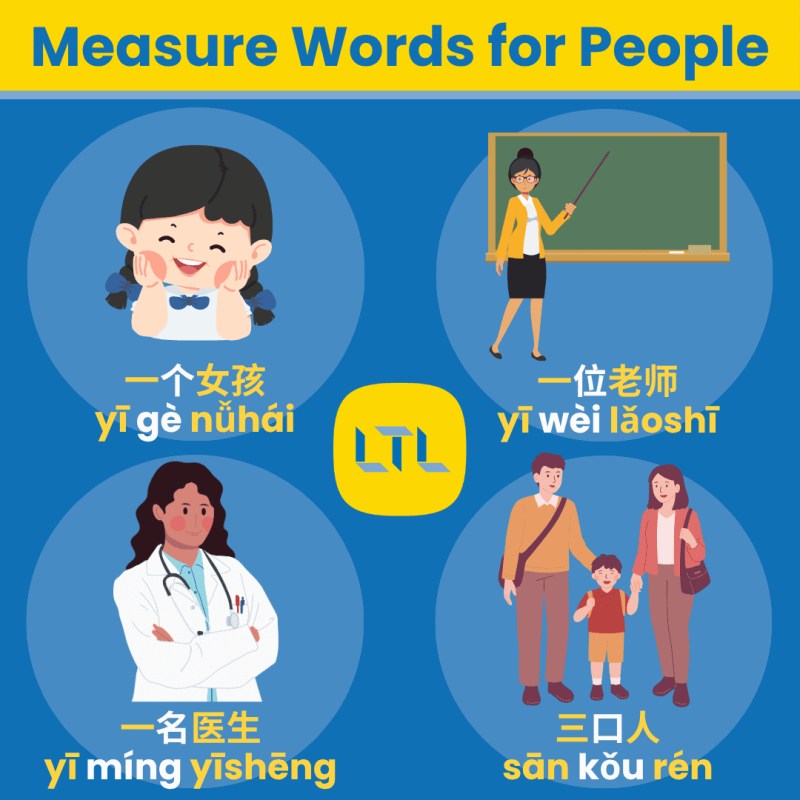
People
| Hanzi | Pinyin | Meaning | Example Sentence |
|---|---|---|---|
| 个 | gè | Person, general measure word | 一个人 yī gè rén A person |
| 位 | wèi | More respectful than 个, and used only for people | 三位老师 sān wèi lǎoshī Three teachers |
| 名 | míng | People with status, typically used for a person’s occupation | 一名医生 yī míng yīshēng A doctor |
| 口 | kǒu | Family members, household (rarely used in speech) | 三口人 sān kǒu rén Three persons |
Animals
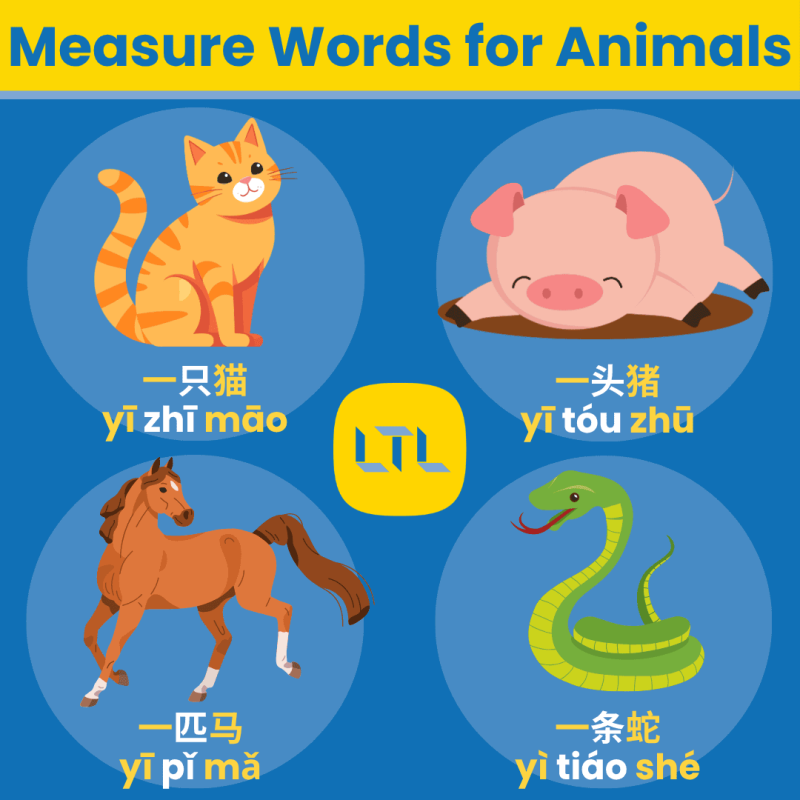
There are four different measure words used for animals in Chinese.
🐦🐕🐘 只 zhī – Used for most animals including birds
| HANZI | PINYIN | ENGLISH |
|---|---|---|
| 一只鸟 | yī zhī niǎo | A bird |
| 一只狗 | yī zhī gǒu | A dog |
| 一只大象 | yī zhī dà xiàng | An elephant |
🐖🐄 头 tóu – Bigger animals, normally livestock
| HANZI | PINYIN | ENGLISH |
|---|---|---|
| 一头猪 | yī tóu zhū | A pig |
| 一头牛 | yī tóu niú | A cow |
🐎 匹 pǐ – Horses, mules etc.
| HANZI | PINYIN | ENGLISH |
|---|---|---|
| 一匹马 | yī pǐ mǎ | A horse |
🐟🐍🐉 条 tiáo – Fish, snakes
| HANZI | PINYIN | ENGLISH |
|---|---|---|
| 一条蛇 | yì tiáo shé | A snake |
| 一条鱼 | yì tiáo yú | A fish |
| 一条龙 | yì tiáo lóng | A dragon |
Chinese Measure Words – Body Parts
Here are the six Chinese measure words used for classifying body parts in Chinese.
😀👄 张 zhāng – Measure word for face, mouth
| HANZI | PINYIN | ENGLISH |
|---|---|---|
| 一张脸 | yì zhāng liǎn | A face |
| 一张嘴 | yì zhāng zuǐ | A mouth |
👆🏼 根 gēn – Thin, slender body parts e.g. finger, a hair
| HANZI | PINYIN | ENGLISH |
|---|---|---|
| 一根手指 | yì gēn shǒu zhǐ | A finger |
| 一根头发 | yì gēn tóu fa | A hair |
➡️🖐🏼🤚🏼只 zhī – For body parts, this means “one of a pair”.
| HANZI | PINYIN | ENGLISH |
|---|---|---|
| 一只耳朵 | yì zhī ěr duo | An ear |
| 一只手 | yì zhī shǒu | A hand |
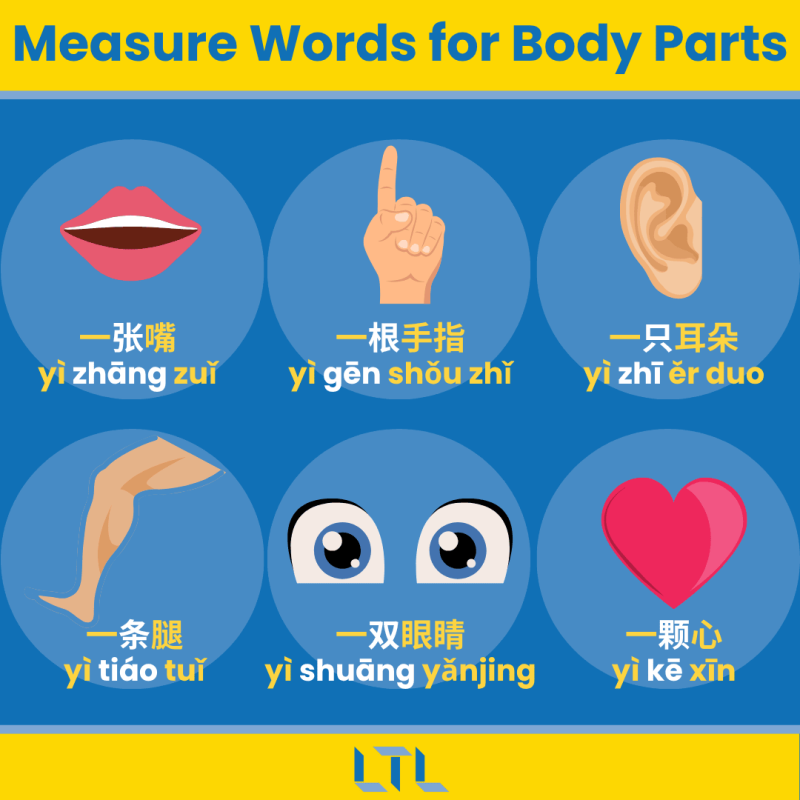
🦵🏼 条 tiáo – Long, narrow body parts
| HANZI | PINYIN | ENGLISH |
|---|---|---|
| 一条腿 | yì tiáo tuǐ | A leg |
👀 双 shuāng – A pair of body parts
| HANZI | PINYIN | ENGLISH |
|---|---|---|
| 一双眼睛 | yì shuāng yǎnjing | A pair of eyes |
| 一双手 | yì shuāng shǒu | A pair of hands |
🦷❤️ 颗 kē – Small, normally round body parts
| HANZI | PINYIN | ENGLISH |
|---|---|---|
| 一颗牙齿 | yì kē yá chǐ | A tooth |
| 一颗心 | yì kē xīn | A heart |
Chinese Measure Words – Food
This is the must read category for anyone who wants to improve their restaurant ordering skills.
碗 wǎn – For food in bowl
| HANZI | PINYIN | ENGLISH |
|---|---|---|
| 一碗面 | yì wǎn miàn | A bowl of noodles |
| 一碗汤 | yì wǎn tāng | A bowl of soup |
份 fèn – For one portion of a fixed menu in a restaurant
| HANZI | PINYIN | ENGLISH |
|---|---|---|
| 一份米饭 | yí fèn mǐfàn | An order of rice |
串 chuàn – Skewer
| HANZI | PINYIN | ENGLISH |
|---|---|---|
| 一串肉 | yī chuàn ròu | A skewer of meat |
盘 pán – dish, and can be used for a plate of food
| HANZI | PINYIN | ENGLISH |
|---|---|---|
| 一盘菜 | yì pán cài | A dish |
| 一盘饺子 | yì pán jiǎozi | A plate of dumplings |
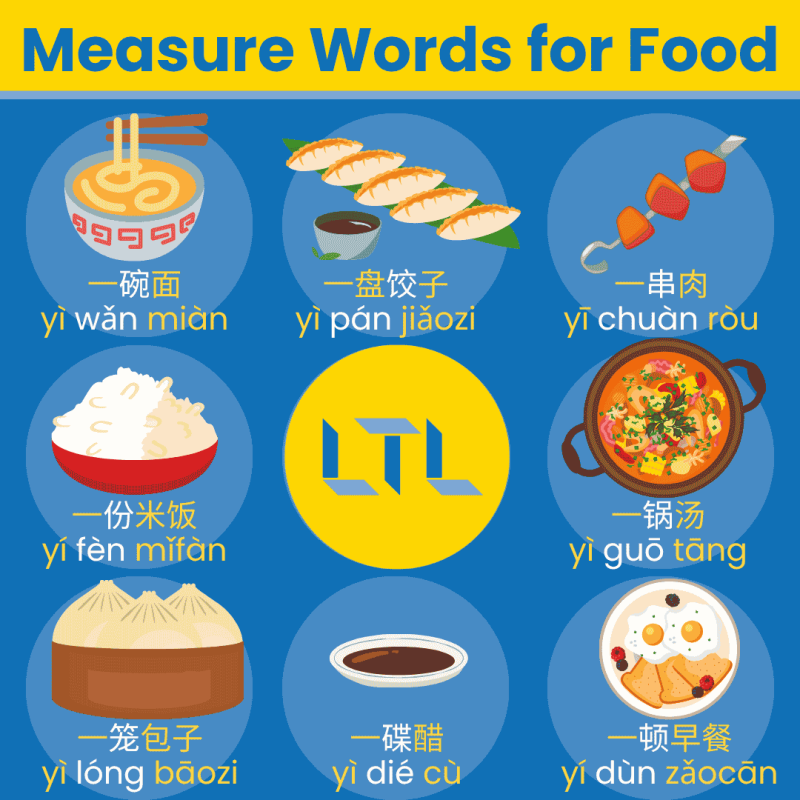
锅 guō – Pot, pan, boiler
| HANZI | PINYIN | ENGLISH |
|---|---|---|
| 一锅粥 | yì guō zhōu | A pot of porridge |
| 一锅汤 | yì guō tāng | A pot of soup |
笼 lóng – Bamboo or wooden utensil for steaming food
| HANZI | PINYIN | ENGLISH |
|---|---|---|
| 一笼包子 | yì lóng bāozi | An order of steamed stuffed buns |
| 一笼蒸饺 | yì lóng zhēngjiǎo | An order of steamed dumplings |
碟 dié – Small plate
| HANZI | PINYIN | ENGLISH |
|---|---|---|
| 一碟醋 | yì dié cù | A dish of vinegar |
| 一碟花生米 | yì dié huāshēngmǐ | A dish of peanuts |
顿 dùn – Meal
| HANZI | PINYIN | ENGLISH |
|---|---|---|
| 一顿饭 | yí dùn fàn | A meal |
| 一顿早餐 | yí dùn zǎocān | A breakfast |
片 piàn – Thin slice of food
| HANZI | PINYIN | ENGLISH |
|---|---|---|
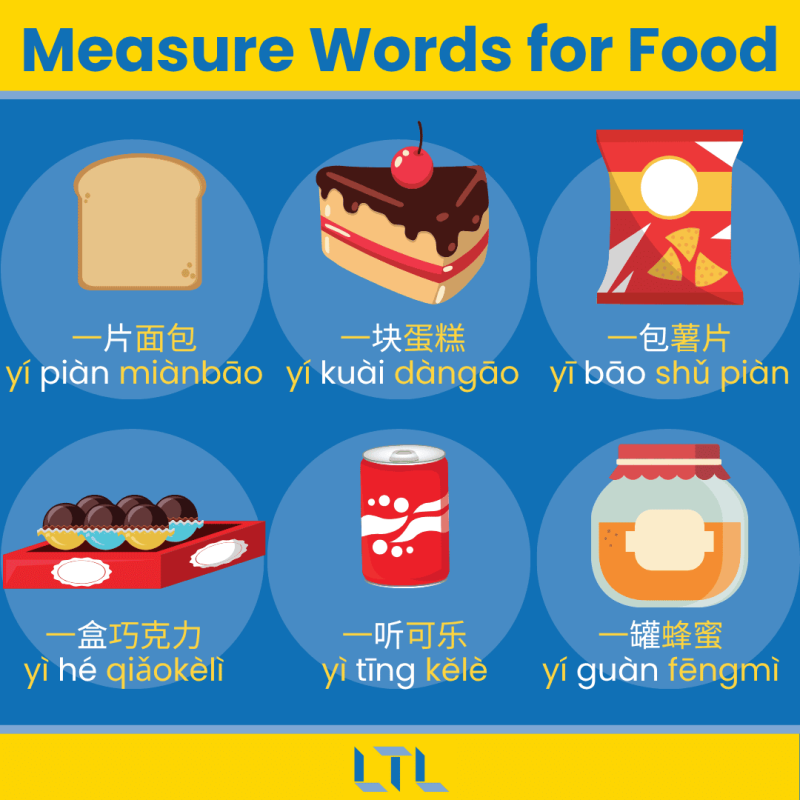
| 一片面包 | yí piàn miànbāo | A slice of bread |
| 一片培根 | yí piàn péigēn | A slice of bacon |
块 kuài – A portion, piece or thick slice of food
| HANZI | PINYIN | ENGLISH |
|---|---|---|
| 一块蛋糕 | yí kuài dàngāo | A piece of cake |
| 一块西瓜 | yí kuài xīguā | A slice of watermelon |
包 bāo – Pack, packet or bag
| HANZI | PINYIN | ENGLISH |
|---|---|---|
| 一包糖果 | yì bāo tángguǒ | A pack of candies |
| 一包饼干 | yì bāo bǐnggān | A pack of biscuits |
盒 hé – Box or carton
| HANZI | PINYIN | ENGLISH |
|---|---|---|
| 一盒牛奶 | yì hé niúnǎi | A carton of milk |
| 一盒巧克力 | yì hé qiǎokèlì | A box of chocolate |
In our most common measure words we already saw the words for bottle (瓶 píng) and glass (杯 bēi), here are a couple more…
听 tīng – Can
| HANZI | PINYIN | ENGLISH |
|---|---|---|
| 一听可乐 | yì tīng kělè | A can of cola |
罐 guàn – Jar, pot, tin
| HANZI | PINYIN | ENGLISH |
|---|---|---|
| 一罐蜂蜜 | yí guàn fēngmì | A jar of honey |
Make sure to have a look at guide to reading a Chinese menu, for more tips on ordering food at restaurants.
Chinese Measure Words – Plants, Fruit and Vegetables
Plants
There are three Chinese measure words used for plants.
| Hanzi | Pinyin | Meaning | Example Sentence |
|---|---|---|---|
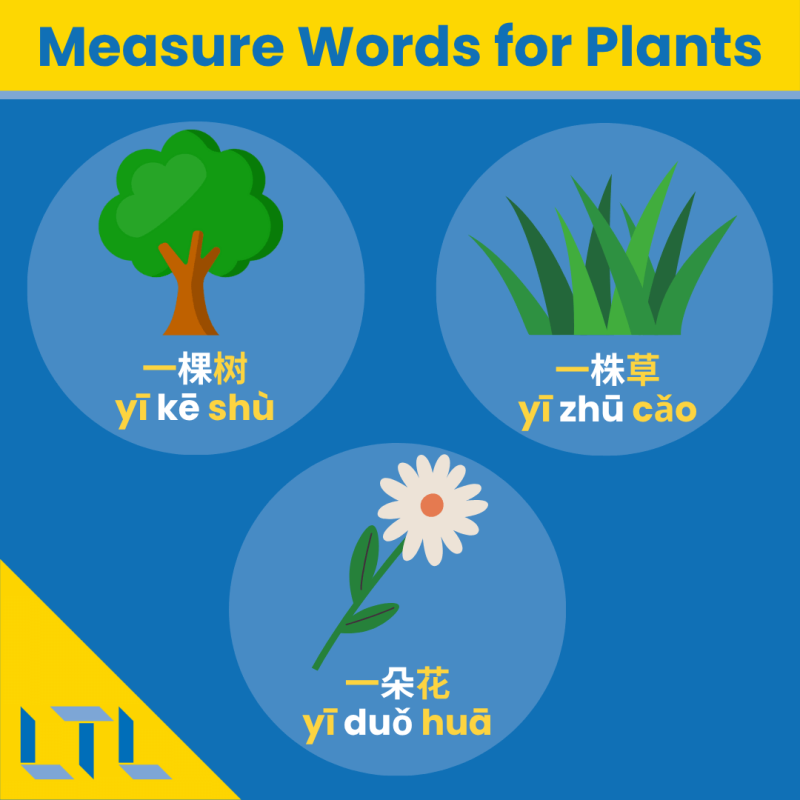
| 棵 | kē | classifier for trees, grass etc. (also includes cabbages) | 一棵树 yī kē shù A tree |
| 株 | zhū | smaller trees/plants, flower still in the ground | 一株花 yī zhū huā A flower |
| 朵 | duǒ | for flowers, clouds or things similar to them | 一朵玫瑰 yī duǒ méigu A stem of rose |
Fruit and Vegetables
The measure words for fruit and vegetables tend to describe the size and shape of them. There are also some fruit or vegetables such as apples or aubergines, where you can just use 个 gè.
根 gēn – Long slender objects; thin, flexible strands
| HANZI | PINYIN | ENGLISH |
|---|---|---|
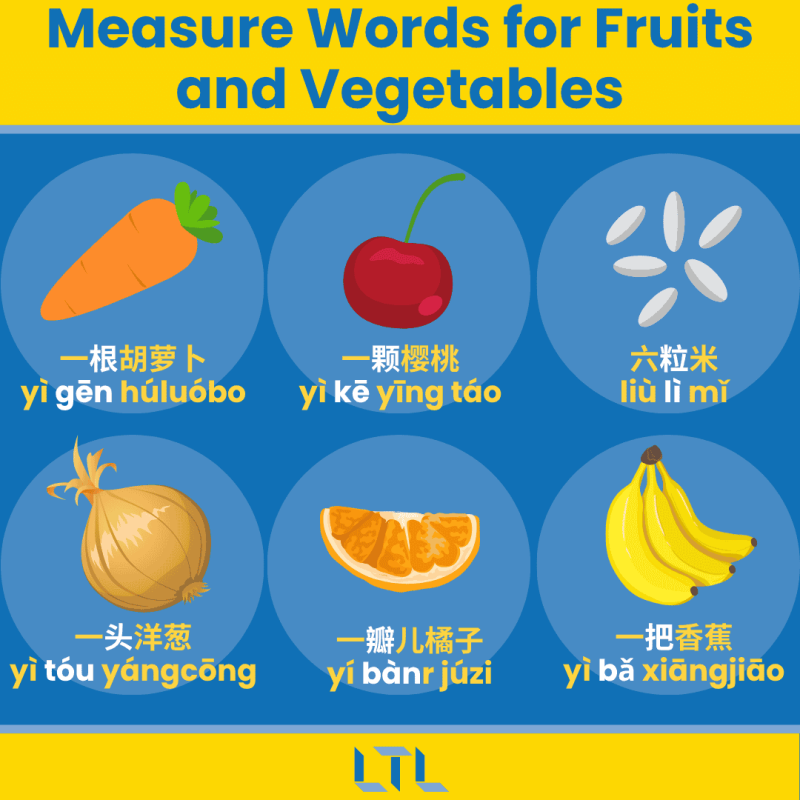
| 一根胡萝卜 | yì gēn húluóbo | A carrot |
| 一根黄瓜 | yì gēn huángguā | A cucumber |
颗 kē – Small objects, objects appearing small (hearts, pearls, diamonds, teeth, satellites, etc.)
| HANZI | PINYIN | ENGLISH |
|---|---|---|
| 一颗葡萄 | yì kē pú tao | A grape |
| 一颗樱桃 | yì kē yīng táo | A cherry |
粒 lì – Grain; classifier for small round things (seeds, peas, bullets, peanuts, pills, grains etc.)
| HANZI | PINYIN | ENGLISH |
|---|---|---|
| 一粒大米 | yí lì dà mǐ | A grain of rice |
| 一粒黄豆 | yì lì huáng dòu | A soya bean |
头 tóu – Bulb
| HANZI | PINYIN | ENGLISH |
|---|---|---|
| 一头蒜 | yì tóu suàn | A bulb of garlic |
| 一头洋葱 | yì tóu yángcōng | An onion |
瓣 bàn – For segment, section, clove (normally 儿 is added)
| HANZI | PINYIN | ENGLISH |
|---|---|---|
| 一瓣儿蒜 | yí bànr suàn | A clove of garlic |
| 一瓣儿橘子 | yí bànr júzi | A slice of orange |
把 bǎ – For a quantity of things that can be held in one hand
| HANZI | PINYIN | ENGLISH |
|---|---|---|
| 一把香蕉 | yì bǎ xiāngjiāo | A bunch of bananas |
| 一把青菜 | yì bǎ qīngcài | A bunch of green vegetables |
Chinese Measure Words – Vehicles and Buildings
Vehicles
We already saw the measure word for most wheeled vehicles in our most common measure words sections.
But what about the measure words for other modes of transport in Chinese?
| Hanzi & Pinyin | PINYIN | Meaning | Example Sentence |
|---|---|---|---|
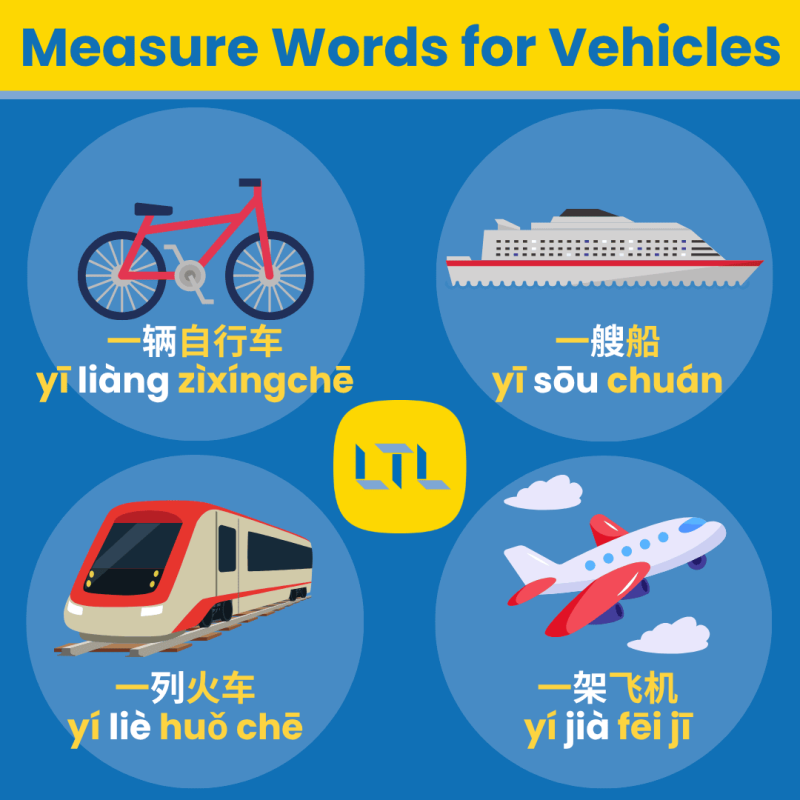
| 辆 | liàng | Used for most wheeled vehicles | 一辆汽车 yí liàng qì chē A car |
| 艘 | sōu | Used for ships and vessels | 一艘轮船 yì sōu lún chuán A steamer |
| 列 | liè | Used for trains etc. (列 is used for a series or row of things) | 一列火车 yí liè huǒ chē A train |
| 架 | jià | Used for airplanes (also used for pianos and machines) | 一架飞机 yí jià fēi jī An aeroplane |
Buildings
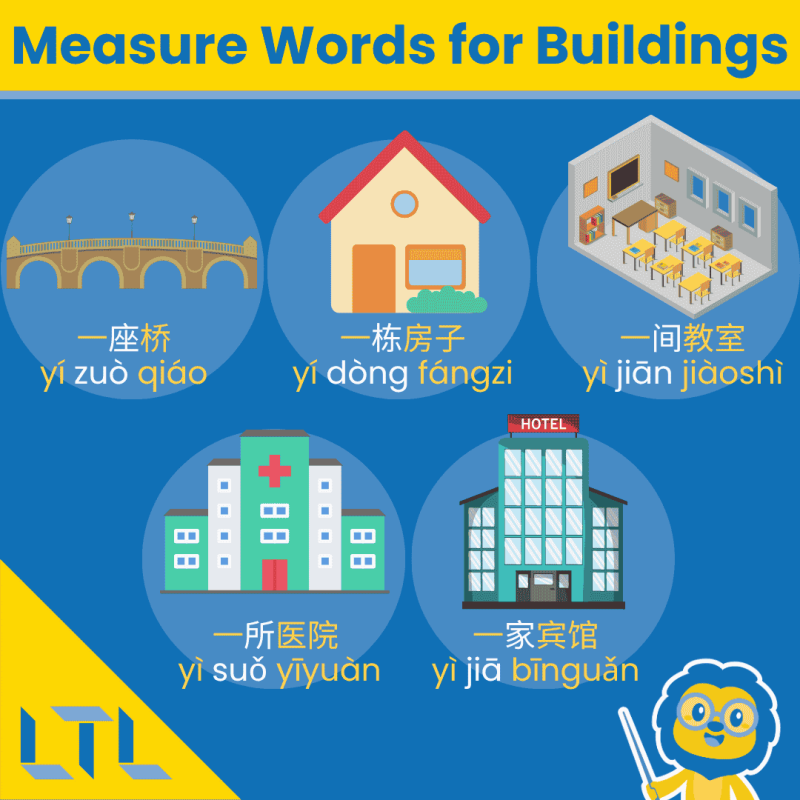
If you’ve ever written put your address in Chinese for a food delivery app or Taobao, then you may have seen some of these measure words for buildings included in your address.
座 zuò – Measure word for big buildings, mountains, bridges
| 一座大厦 | yí zuò dà shà | A mansion |
| 一座桥 | yí zuò qiáo | A bridge |
| 一座寺庙 | yí zuò sìmiào | A temple |
栋 dòng – Measure word for buildings
| 一栋房子 | yí dòng fángzi | A house |
| 一栋别墅 | yí dòng biéshù | A villa |
间 jiān – Room
| 一间屋子 | yì jiān wūzi | A room |
| 一间教室 | yì jiān jiàoshì | A classroom |
所 suǒ – For buildings whose purposes are explicitly stated
| 一所学校 | yì suǒ xuéxiào | A school |
| 一所医院 | yì suǒ yīyuàn | A hospital |
家 jiā – As seen in our most common words this is the measure word for families or businesses
| 一家宾馆 | yì jiā bīnguǎn | A hotel |
| 一家公司 | yì jiā gōngsī | A company |
| 一家电影院 | yì jiā diànyǐngyuàn | A cinema |
Chinese Measure Words – Household Items
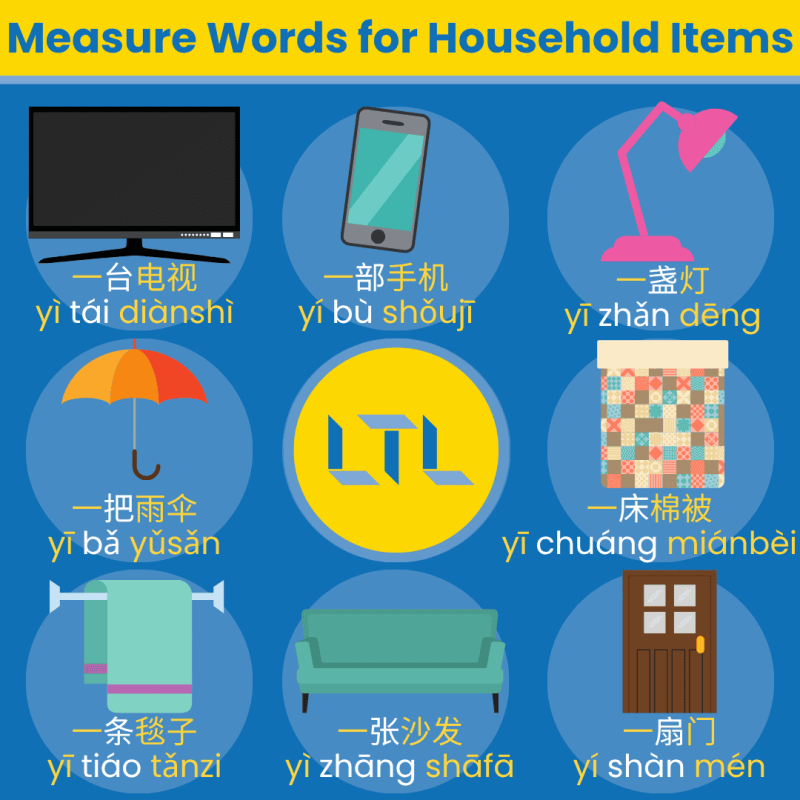
Appliances/Electronics
台 tái – Heavy objects (TVs, computers, etc.)
| 一台电脑 | yì tái diànnǎo | A computer |
| 一台电视 | yì tái diànshì | A television |
部 bù – Measure word for small devices, films, machines, dictionaries, etc.
| 一部手机 | yí bù shǒujī | A mobile phone |
盏 zhǎn – Lamp
| 一盏台灯 | yī zhǎn táidēng | A standing lamp |
Daily use items
把 bǎ – Most commonly used to quantify objects that can be grasped or objects with a handle
| 一把椅子 | yì bǎ yǐzi | A chair |
| 一把勺子 | yì bǎ sháozi | A spoon |
床 chuáng – Used for bedsheets (床 chuáng is also the word for bed)
| 一床棉被 | yī chuáng miánbèi | A cotton blanket |
条 tiáo – Towel, tablecloth
| 一条毯子 | yī tiáo tǎnzi | A blanket |
Furniture
张 zhāng – Rectangular or flat objects (we saw this one earlier in the most common Chinese measure words list)
| 一张饭桌 | yì zhāng fànzhuō | A dining table |
| 一张沙发 | yì zhāng shāfā | A sofa |
扇 shàn – Door or window: open and close on hinges
| 一扇门 | yí shàn mén | A door |
| 一扇窗 | yí shàn chuāng | A window |
扇 shàn – Door or window: open and close on hinges
Some furniture uses the generic 个 as well
| 一个衣柜 | yí gè yīguì | A wardrobe |
| 一个书架 | yí gè shūjià | A bookshelf |
Chinese Measure Words – Clothing and Jewellery
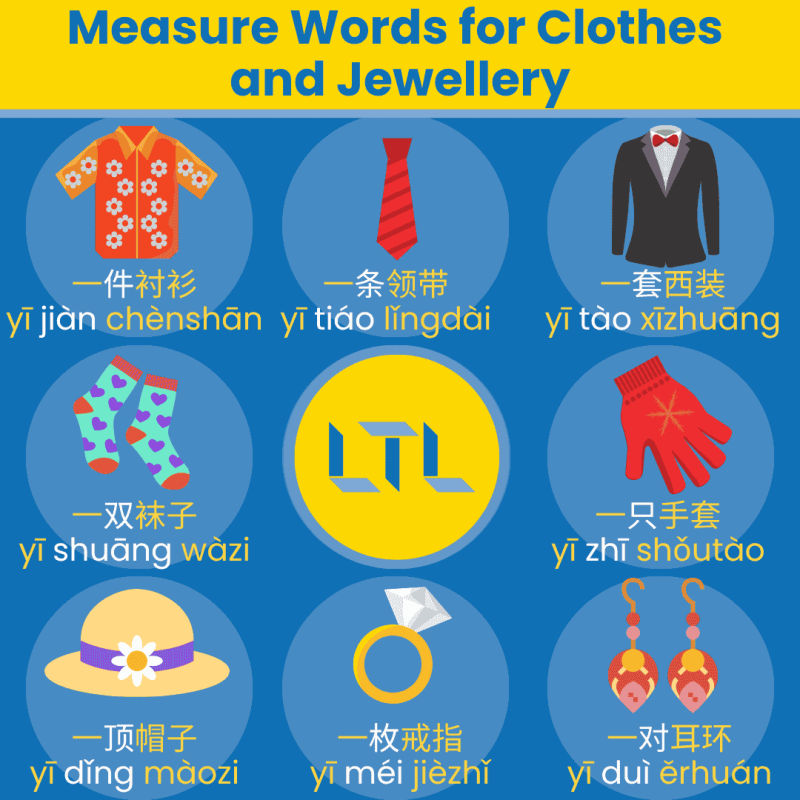
In the most common measure word section we will have seen the word 件 jiàn which can be used for most articles of clothing. However, here are some other measure words also used for clothing.
| Hanzi | PINYIN | Meaning | Example Sentence |
|---|---|---|---|
| 件 | jiàn | Article of clothing | 一件衣服 yī jiàn yīfú An article of clothing |
| 条 | tiáo | A long article of clothing or jewellery | 一条领带 yī tiáo lǐngdài A necktie |
| 套 | tào | A set/suit of clothing | 一套西装 yī tào xīzhuāng A suit |
| 双 | shuāng | A pair | 一双袜子 yī shuāng wàzi A pair of socks |
| 只 | zhī | One of a pair | 一只手套 yī zhī shǒutào A glove |
| 顶 | dǐng | For things that have a top e.g. hats | 一顶帽子 yī dǐng màozi A hat |
| 枚 | méi | Small objects e.g. rings, brooches | 一枚戒指 yī méi jièzhǐ A ring |
| 对 | duì | For certain pairs of objects | 一对耳环 yī duì ěrhuán A pair of earrings |
If you have an interest in clothes or just want to know vocab for some online shopping, have a look at our guides to clothes in Chinese and jewellery in Chinese.

Clothes in Chinese 👗 The Complete Guide to 101 Different Clothing Items (with Quiz)
The Ultimate Guide For Talking About Clothes in Chinese Perhaps you’re just interested in knowing different types of clothes in Chinese, or maybe you want to know specific vocab to use when shopping for clothes on Taobao. Either way our…
Chinese Measure Words – Time
These are definitely some important measure words to learn. Be careful though, as some of them are only used in writing, and aren’t really used in spoken Chinese.
| HANZI | PINYIN | MEANING | EXAMPLE SENTENCE |
|---|---|---|---|
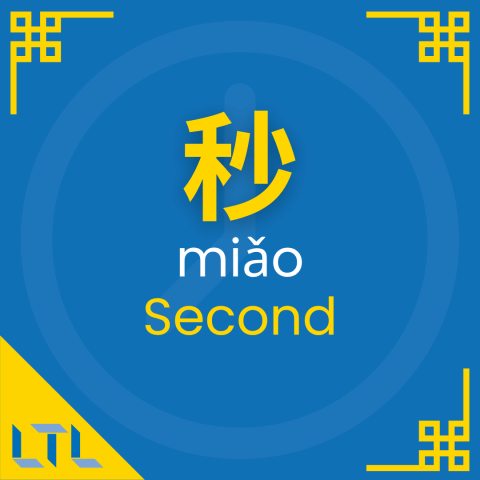
| 秒 | miǎo | Second | 一秒钟 yī miǎo zhōng – One second |
| 分 | fēn | Minute | 一分钟 yī fēnzhōng – One minute |
| 天 | tiān | Day | 一天 yī tiān – One day |
| 日 | rì | Day | 一日 yī rì – One day (used in written form) |
| 周 | zhōu | Week | 一周 yī zhōu – One week (used in written form) |
| 年 | nián | Year | 一年 yī nián – One year |
| 代 | dài | Era, generation | 上一代 shàng yīdài – The previous generation |
| 次 | cì | Time | 一次 yī cì – Once |



Some words that indicate an amount of time can’t be used on their own and need to have the measure word 个 gè used as part of them:
| HANZI | PINYIN | ENGLISH |
|---|---|---|
| 一个小时 | yī gè xiǎoshí | One hour |
| 一个星期 | yī gè xīngqí | One week |
| 一个月 | yī gè yuè | One month |
| 一个年代 | yī gè niándài | One decade |
| 一个世纪 | yī gè shìjì | One century |
Chinese Measure Words – Units of Measure
Next, are some Chinese measure words for units of measure. The weight units of measure are especially helpful to learn for shopping for fresh ingredients such as fruit and vegetables.

Weight
| HANZI | PINYIN | ENGLISH |
|---|---|---|
| 斤 | jīn | 0.5 kg |
| 吨 | dūn | Ton |
| 磅 | bàng | Pound (lb) |


Length
| 寸 | cùn | One inch (different length to western inch – 3.3333cm) |
| 尺 | chǐ | One foot (different length to western foot – 1/3 m) |
| 里 | lǐ | 0.5 km |
As you can see a Chinese inch and a Chinese foot, is not the same length as those used in the west – so be careful you don’t get confused!


Money
If you’re heading to Beijing, Shanghai, or anywhere else in China, these measure words will come up in almost every transaction.
| Hanzi | Pinyin | Meaning | Example |
|---|---|---|---|
| 块 | kuài | colloquial unit (≈ yuan) | 五块钱 (wǔ kuài qián) – five yuan |
| 元 | yuán | formal unit / yuan | 十元 (shí yuán) – ten yuan |
| 角 | jiǎo | 10 cents (formal) | 五角 (wǔ jiǎo) – fifty cents |
| 毛 | máo | 10 cents (colloquial) | 五毛 (wǔ máo) – fifty cents |
| 分 | fēn | 1 cent | 两分 (liǎng fēn) – two cents |
TIP💡 In everyday speech, Chinese people almost always say 块 (kuài) and 毛 (máo) rather than the formal 元 and 角. You’ll hear ‘shí wǔ kuài’ (15 yuan) constantly. The formal versions appear on receipts, menus, and official signage.
| 块 | kuài | Colloquial measure word for 1 元 yuán |
| 毛 | máo | Colloquial measure word for 1 角 jiǎo (1/10 yuan) |
| 笔 | bǐ | An unspecified sum of money |


Volume and Degree
| 升 | shēng | 1 litre |
| 斗 | dòu | 10 litres |
| 度 | dù | Degree, level (e.g. temperature, degree of angle etc.) |


More units of measurement can be found in our complete guide to measurements in Chinese.
Chinese Measure Words by HSK Level
If you’re studying for the HSK exam, here’s a quick breakdown of which measure words appear at each level. LTL’s teachers build these into lessons from day one, they’re the foundation of our 98% HSK pass rate.
HSK 1
个 (gè), 岁 (suì / age), 块 (kuài / money), 本 (běn / books), 杯 (bēi / cups)
HSK 2
张 (zhāng / flat objects), 条 (tiáo / long & narrow), 件 (jiàn / items & clothing), 瓶 (píng / bottles), 只 (zhī / animals & hands)
HSK 3
位 (wèi / polite people), 双 (shuāng / pairs), 层 (céng / floors & layers), 次 (cì / occurrences), 遍 (biàn / actions from start to finish)
HSK 4+
More specific classifiers: 篇 (piān / articles & essays), 幅 (fú / paintings), 架 (jià / aircraft & machines), 棵 (kē / trees), 颗 (kē / small round objects)
TIP💡 For HSK 1 and 2, focus on the 12 most common measure words in this guide. For HSK 3 and above, start learning measure words alongside the nouns they pair with, it’s much easier than memorising them in isolation.
Studying for the HSK? LTL has a 98% HSK pass rate. Our teachers know exactly which measure words examiners test at each level, and how to make sure you’re ready.
Common Mistakes with Chinese Measure Words
Every student makes these, including plenty of LTL students in their first weeks. Knowing them in advance saves you a lot of embarrassment. 🤔
1. Skipping the measure word entirely
Saying ‘三书’ (sān shū) instead of ‘三本书’ (sān běn shū) is the most common beginner error. In English, you can often get away with dropping classifiers. In Mandarin, you really can’t. The measure word is not optional.
2. Using 个 (gè) for everything
个 is your safety net, not your permanent solution. ‘三个书’ instead of ‘三本书’ will be understood, but it signals beginner level immediately. Aim to replace 个 with the correct measure word as you learn each category.
3. Confusing 两 (liǎng) and 二 (èr)
Before measure words, use 两 (liǎng), not 二 (èr). ‘两本书’ ✅ / ‘二本书’ ❌. The number 二 is used in other contexts (maths, phone numbers, ordinal lists) but not before measure words.
4. Using the wrong tone on 一 (yī)
一 changes tone depending on what follows: yí before 4th tone, yì before 1st/2nd/3rd tone. This doesn’t change the measure word, but it changes how natural you sound.
5. Using a Cantonese or regional measure word
If you’ve picked up some Cantonese or have family from southern China, watch out, some measure words differ. Stick to standard Mandarin classifiers in HSK contexts.
How to Memorise Chinese Measure Words // Strategies That Work
Don’t try to memorise all of them at once, that’s the fastest way to forget them all. Here’s what actually works:
1. Learn the measure word with the noun, not separately
When you learn a new noun, learn its measure word at the same time. Don’t learn 书 (shū / book) in isolation, learn 一本书 (yī běn shū / one book) as a unit. This is how LTL teachers build vocabulary from week one.
2. Use shape and function as a memory hook
Many measure words group nouns by physical shape:
- Long, narrow things → 条 (tiáo): roads, fish, rivers, trousers
- Flat things → 张 (zhāng): paper, tickets, tables, beds
- Round or small things → 颗 (kē): stars, seeds, teeth
- Bound volumes → 本 (běn): books, notebooks, magazines
Once you see the pattern, the groupings start to feel logical. 💡
3. Use flashcard apps with sentence context
Pleco and Skritter let you drill measure words in sentence context, not just in isolation. Always practise with a full Number + Measure Word + Noun sentence.
4. Immersion is the accelerant
Nothing beats hearing measure words used naturally, all day, every day. Students who spend time in Beijing or Shanghaiand ordering food, buying tickets, and shopping internalise these patterns in weeks rather than months. That’s the LTL experience.
💡 Want to learn measure words in the classroom, not just from a list?
At LTL, we teach Chinese in small groups with native-speaking teachers across Beijing, Shanghai, Chengdu, Taipei, and more. Our students live, breathe and dream the language, and measure words become automatic far faster when you’re using them in real conversations every day.
Chinese Measure Words – Pairs, Collections and Groups
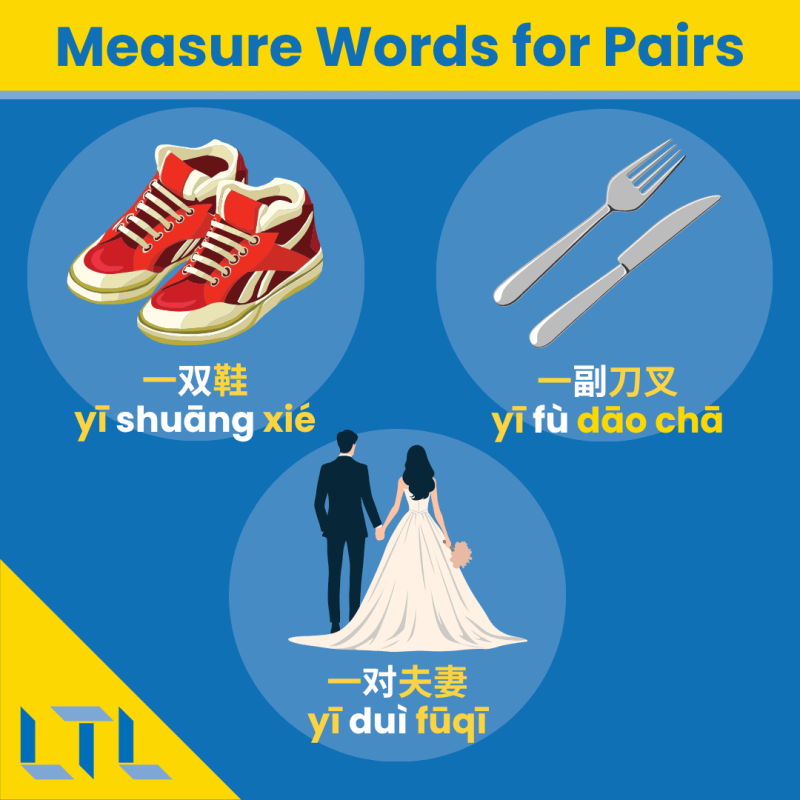
Pairs
We’ve already seen two of these in the clothes and jewellery section, but they can also be used as measure words in other situations.
| Hanzi | Pinyin | Meaning | Example Sentence |
|---|---|---|---|
| 双 | shuāng | Pair of identical objects | 一双筷子 yī shuāng kuàizi |
| 副 | fù | Pair of complementary objects | 一副碗筷 yī fù wǎnkuài Bowl and chopsticks |
| 对 | duì | For couples e.g. man and wife | 一对情人 yī duì qíngrén Pair of lovers |
Collections and Groups
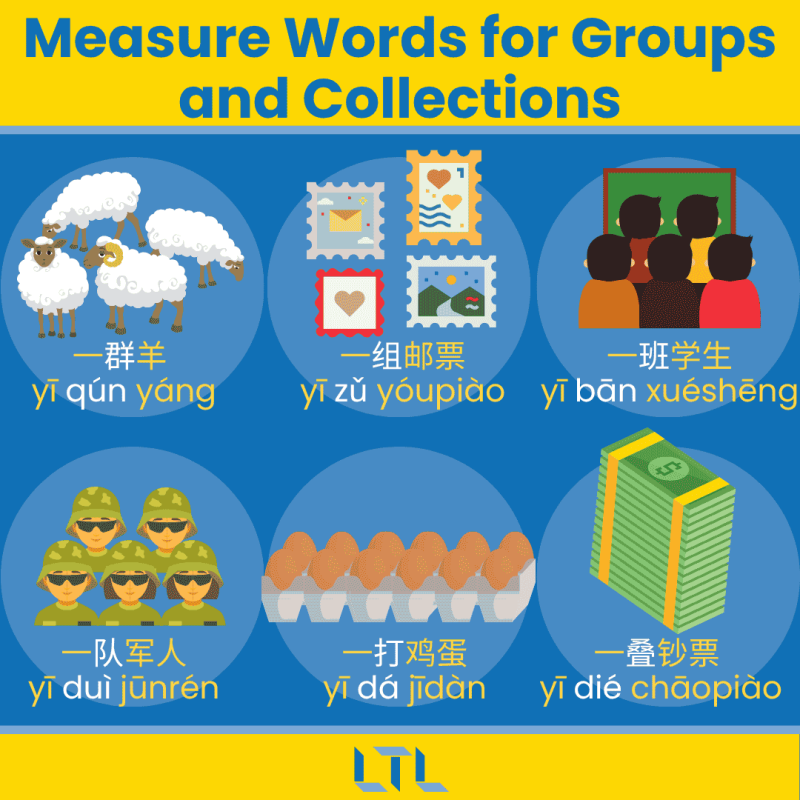
In Chinese, there are also quite a few different measure words for collections and groups of people or objects.
| HANZI | PINYIN | MEANING | EXAMPLE SENTENCE |
|---|---|---|---|
| 些 | xiē | A few | 一些東西 yī xiē dōngxī – A few things |
| 种 | zhǒng | A kind | 一种动物 yī zhǒng dòngwù – A type of animal |
| 群 | qún | Group, flock | 一群人 yī qún rén – A group of people 一群羊 yī qún yáng – A flock of sheep |
| 众 | zhòng | A crowd | 一众人 yī zhòng rén – A crowd of people |
| 组 | zǔ | Set, series | 一组邮票 yī zǔ yóupiào – A set of stamps |
| 帮 | bāng | A group or a band | 一帮贼 yī bāng zéi – A group of thieves |
| HANZI | PINYIN | MEANING | EXAMPLE SENTENCE |
|---|---|---|---|
| 班 | bān | A class | 一班学生 yī bān xuéshēng – A class of students |
| 排 | pái | A row, queue | 一排电杆 yī pái diàn gān – A row of electrical posts |
| 队 | duì | A team, battalion | 一队军人 yī duì jūnrén – A battalion of soldiers |
| 打 | dá | A dozen | 一打鸡蛋 yī dá jīdàn – A dozen eggs |
| 叠 | dié | Stack | 一叠箱 yī dié xiāng – A stack of boxes/containers 一叠钱 yī dié qián – A stack of money |
If you made it this far, congratulations, you’ve officially mastered the measure words in Chinese!
Now let’s see how if you can hear them in conversation here. Watch this video and write down all the measure words you spot!

So what did you think? Did you enjoy our guide? Did you learn anything new?
Drop us a comment below if you have any questions or even requests for further articles or videos – we are always all ears!
Measure words can feel unnatural at first, but with regular practice, or by learning in a structured setting like a semester in a city where it’s spoken every day, they gradually become part of your everyday thinking.
If you want to push your language skills even further, why not check out our guide to Vietnamese Measure Words as well, because learning more languages is just fun!
FREE DOWNLOAD – Measure Words PDF
As that might’ve been a lot to take in (don’t worry, it gets easier)… we thought it’d be a good thing to spend some hours creating the perfect PDF for you guys to download, FREE!
Yes indeed, there is no catch, no email to hand over, no donations – we create them out of sheer love for the language, and our readers!
It took us some time to make so we really hope you like it and use it.
TEST YOURSELF – Our Measure Words Quiz
So we’ve done everything we can! We’ve held your hand until this far, but now it’s time to go it along and take on the Measure Words yourself!
Don’t worry, we believe in you!
This quiz is really simple to follow – every question has four options so just take a guess if you don’t know.
Results are immediate and if you like, why not share your score below?
Chinese Measure Words – FAQs
What are Chinese measure words?
Measure words are a word that is put before all nouns in Chinese. An English example would be a cup of tea or a stick of gum.
How many measure words are there in Chinese?
Modern Mandarin has roughly 150–200 measure words in active use, though many are highly specific or formal. For everyday conversation, mastering 30–50 gets you very far.
This guide covers the most frequently encountered ones.
Can you always use 个 (gè)?
Almost, but not quite. 个 works as a fallback for most general nouns and people, and native speakers will understand you.
But for books (本 běn), animals (只 zhī / 条 tiáo), flat objects (张 zhāng), and vehicles (辆 liàng), using 个 sounds noticeably unnatural.
As a beginner, lean on it; as an intermediate learner, aim to replace it category by category.
Why do measure words exist in Chinese?
Chinese nouns don’t have singular/plural forms the way English nouns do.
Measure words do some of that grammatical work, they classify nouns by shape, function, or type, and signal quantity.
They also carry cultural and aesthetic meaning: using the right measure word is a sign of fluency that native speakers notice and appreciate.
Do measure words change based on tones?
No, the measure word itself doesn’t change. However, 一 (yī / one) does change tone depending on what follows it: it becomes yí before 4th tone syllables and yì before 1st, 2nd, and 3rd tone syllables.
This is tone sandhi, not a measure word rule.
Are measure words the same in Cantonese and Mandarin?
Many overlap, but not all.
This guide focuses on Mandarin (Putonghua). If you’re learning Cantonese, for example in Hong Kong or with family, some classifiers differ significantly.
Do I have to know the correct Chinese measure word for every word?
No so don’t worry if you are learning them. Many advanced speakers don’t even know all of the measure words in Chinese.
If in doubt you can always default to 个 gè.
What is the Chinese measure word for teacher?
When talking about teachers you normally used the polite measure word 位 wèi e.g. 三位老师 sān wèi lǎoshī (three teachers).
What is the Chinese measure word for sofa?
The Chinese measure word for sofa is 张 zhāng e.g. 一张沙发 yì zhāng shāfā – A sofa.
What is the Chinese measure word for animals?
The Chinese measure word used for most animals is 只 zhī, however this isn’t used for all animals.
Want more from LTL?
If you wish to hear more from LTL Language School why not join our mailing list? We give plenty of handy information on learning Chinese, useful apps to learn the language and everything going on at our LTL schools!
Sign up below and become part of our ever-growing community!
⭐ Download our free ebook, your starter pack of essential Mandarin learning resources!
BONUS || Want to study Chinese with us in China? Why not check out our group and individual classes here






[…] to know what the right measure words are for different types of jewellery? Then our Chinese Measure Words Guide is perfect for […]
What is the best way to leanr measure words?
Hi Millie,
The only way to really learn measure words is to memorise them. A helpful way to learn them is to learn the correct measure word when you also learn a new noun. This way you can learn them both together, rather than having to go back and learn the measure word another time. We hope that helps 🙂
LTL
[…] Want to learn some more basics? Check out our blog about the most frequently used Chinese measure words! […]
[…] Quote from the source: … […]
https://ltl-beijing.com/chinese-measure-words/#chapter-2 As mentioned the pdf is free however, when I click on the link it takes me to a page where I need to pay 0.99 USD