
Learn the Names of 172 Animals in Chinese 🙉
Animal in Chinese is 动物 (dòngwù).
This guide lists 172 animal names in Mandarin Chinese with characters, pinyin, and literal translations, organised into 13 categories: zodiac animals, sea creatures, land mammals, birds, marsupials, reptiles, amphibians, insects, pets, farm animals, plus measure words, radicals, idioms, and example sentences.

Do you know how to say your favourite animals in Chinese? 🐼🐯🐬
If not, you’re in the right place!
We’ve created the ultimate Chinese animal names encyclopedia 动物 (dòngwù) with over 170 examples. Here you’ll find the Chinese characters, pinyin pronunciation, and even the funny literal translations behind each name.
You might have heard the saying: “Don’t translate Chinese word by word.” Well… sometimes that’s true, but when it comes to animals, the results are more fun than confusing.
For example, in Chinese a kangaroo is called a “pouch mouse” (袋鼠 dài shǔ), surprisingly logical once you think about it!
BONUS || If you enjoy this kind of thing, you’ll love seeing how animal Pokémon names translated into Chinese, some of them are genuinely inspired.
Get ready to explore everything from the 12 zodiac animals to sea creatures, birds, insects, and more, and discover why learning animal names in Chinese can be both practical and entertaining.
TIP💡 A quick note on tones before you start: Chinese has four tones plus a neutral tone, and getting them right matters. 马 (mǎ, 3rd tone) means horse, but 妈 (mā, 1st tone) means mum, very different!
As you work through the tables below, say each pinyin out loud rather than just reading it. If you want extra pronunciation practice, our pronunciation trainer is a free tool built exactly for this.
Top 20 Animals in Chinese // Quick-Reference Table
Before you dive into the full lists below, here are the 20 most common animals you will hear in everyday Mandarin. Bookmark this and come back to it often!
| Animal | Chinese | Pinyin |
|---|---|---|
| Dog | 狗 | gǒu |
| Cat | 猫 | māo |
| Fish | 鱼 | yú |
| Bird | 鸟 | niǎo |
| Horse | 马 | mǎ |
| Cow / Ox | 牛 | niú |
| Pig | 猪 | zhū |
| Chicken | 鸡 | jī |
| Duck | 鸭 | yā |
| Sheep / Goat | 羊 | yáng |
| Rabbit | 兔 | tù |
| Tiger | 虎 | hǔ |
| Elephant | 象 | xiàng |
| Panda | 熊猫 | xióng māo |
| Monkey | 猴 | hóu |
| Snake | 蛇 | shé |
| Frog | 青蛙 | qīng wā |
| Butterfly | 蝴蝶 | hú dié |
| Eagle | 鹰 | yīng |
| Dolphin | 海豚 | hǎi tún |
Reptiles and Amphibians in Chinese
Pets and Domestic Animals in Chinese
Measure Words for Animals in Chinese
Animal Radicals in Chinese // A Learner’s Shortcut
Chinese Animal Idioms // 成语 with Animals
Animals in Chinese // Example Sentences
BONUS || Animal Quiz

Chinese Animals || Quick Answers
Now just a heads up, we’ve got a LOT of animals in Chinese listed below!
There are some people search for more than others so here are some of the most popular!
How do you say Animal in Chinese?
Animal in Chinese is 动物 (Dòng wù)
How do you say Dog in Chinese?
Dog in Chinese is 狗 (Gǒu)
How do you say Dragon in Chinese?
Dragon in Chinese is 龙 (Lóng)
How do you say Dolphin in Chinese?
Dolphin in Chinese is 海豚 (Hǎi tún)
How do you say Cow in Chinese?
Cow in Chinese is 牛 (Niú)
How do you say Snake in Chinese?
Snake in Chinese is 蛇 Shé
What are the 12 Chinese zodiac animals?
The 12 Chinese zodiac animals are: Rat (鼠 shǔ), Ox (牛 niú), Tiger (虎 hǔ), Rabbit (兔 tù), Dragon (龙 lóng), Snake (蛇 shé), Horse (马 mǎ), Goat (羊 yáng), Monkey (猴 hóu), Rooster (鸡 jī), Dog (狗 gǒu), and Pig (猪 zhū).
They repeat in a 12-year cycle, and your birth year determines your sign.
What are some Chinese pet names?
Common pets in Chinese include: 猫 (māo) = cat, 狗 (gǒu) = dog, 鱼 (yú) = fish, 兔子 (tù zi) = rabbit, 仓鼠 (cāng shǔ) = hamster, 鹦鹉 (yīng wǔ) = parrot, and 金鱼 (jīn yú) = goldfish.
To ask someone if they have a pet, say: 你有宠物吗?(Nǐ yǒu chǒng wù ma?)
What are 100 animal names in Chinese?
This article covers over 170 animal names across categories including zodiac animals, sea animals, land mammals, birds, marsupials, reptiles, amphibians, and insects.
Scroll through all the sections above for the full list with Chinese characters and pinyin for each one.
Who is the ‘fakest’ zodiac, is the Dragon a real animal?
The Dragon (龙 lóng) is the only mythical creature in the Chinese zodiac.
While all the other 11 signs are real animals, the dragon is a legendary beast central to Chinese culture and is actually considered the most auspicious and powerful sign of all. Being born in a Year of the Dragon is seen as especially lucky, which is why birth rates often rise in those years across cities like Beijing and Shanghai.
Chinese Zodiac Animals
The Chinese Zodiac (十二生肖 shí’èr shēngxiào) is one of the most famous parts of Chinese culture.
It’s made up of zodiac animals in Chinese, 12 in total, each representing a year in a repeating cycle.
Below you’ll find the zodiac animals in Chinese, with their characters, pinyin, literal meanings, and a key personality trait, a perfect place to start learning animal names in Chinese.
| Animal | Chinese (汉字) | Pinyin | Key Trait / Luck Association |
|---|---|---|---|
| Rat | 鼠 | shǔ | Quick-witted, resourceful; associated with wealth and abundance |
| Ox | 牛 | niú | Diligent, dependable; symbol of hard work and prosperity |
| Tiger | 虎 | hǔ | Brave, competitive; a powerful protector sign |
| Rabbit | 兔 | tù | Gentle, lucky; considered one of the most fortunate signs |
| Dragon | 龙 | lóng | Charismatic, ambitious; the most auspicious sign in the cycle |
| Snake | 蛇 | shé | Wise, intuitive; associated with deep thinking |
| Horse | 马 | mǎ | Energetic, free-spirited; symbol of success and speed |
| Goat | 羊 | yáng | Creative, calm; linked to good luck in arts and harmony |
| Monkey | 猴 | hóu | Clever, versatile; known for problem-solving |
| Rooster | 鸡 | jī | Observant, hardworking; associated with punctuality |
| Dog | 狗 | gǒu | Loyal, honest; seen as a faithful and trustworthy sign |
| Pig | 猪 | zhū | Generous, compassionate; associated with good fortune and comfort |
So which sign is the luckiest? The Dragon (龙 lóng) is widely considered the luckiest zodiac sign in Chinese culture.
It’s the only mythical creature in the cycle, and years of the Dragon typically see a spike in birth rates across cities like Beijing and Shanghai as families hope to raise a Dragon child.
TOP TIP💡 You’ll notice the zodiac uses 羊 (yáng), often translated as ‘Goat’ or ‘Ram’.

In everyday Mandarin, 羊 covers both sheep and goat. Context (or the full words 绵羊 mián yáng for sheep and 山羊 shān yáng for goat) is how native speakers clarify. Don’t let it trip you up!
Now we’ve discovered our first twelve animals in Chinese, it’s time to find out which animal you represent.
To do this is easy.
What year were you born? Match it up below with the animal and that’s your Chinese zodiac.
Sea Animals in Chinese
When learning sea animals in Chinese, it helps to know that the word 鱼 (yú) means fish.
You’ll notice it appears at the end of many names, like 鲨鱼 (shā yú) – shark and 鲸鱼 (jīng yú) – whale.
Other creatures get wonderfully descriptive names too. For example, a dolphin is a “sea pig” 海豚 (hǎi tún) and a jellyfish is a “water mother” 水母 (shuǐ mǔ).
Check out the table below for some of the most common sea animals in Chinese.
| Chinese | pinyin | English | literal meaning |
|---|---|---|---|
| 藤壶 | Téng hú | Barnacle | Vine Pot |
| 梭子鱼 | Suōzi yú | Barracuda | Shuttle Fish |
| 鲶鱼 | Nián yú | Catfish | Sheat Fish |
| 蛤蜊 | Gé lí | Clam | Clam |
| 小丑鱼 | Xiǎochǒu yú | Clownfish | Little Ugly Fish 😂 |
| 珊瑚 | Shānhú | Coral | Coral |
| 螃蟹 | Pángxiè | Crab | Crab |
| 墨鱼 | Mòyú | Cuttlefish | Ink fish |
| 海豚 | Hǎi tún | Dolphin | Sea Pig |
| 鳗鱼 | Mányú | Eel | Eel Fish |
| 电鳗 | Diànmán | Electric Eel | Electric Eel |
| 鱼 | Yú | Fish | Fish |
| 比目鱼 | Bǐmùyú | Flounder | Compare Eyes Fish |
| 大白鲨 | Dàbáishā | Great White Shark | Big White Shark |
| 马蹄鞋 | Mǎtíxiè | Horseshoe Crab | Horse Hoof Crab |

| 水母 | Shuǐmǔ | Jellyfish | Water Mother |
| 龙虾 | Lóng xiā | Lobster | Dragon shrimp |
| 蝠鲼 | Fú fèn | Manta Ray | Bat Ray |
| 八爪鱼 | Bā zhuǎ yú | Octopus | Eight Claw Fish |
| 牡蛎 | Mǔlì | Oyster | Male Oyster |
| 食人鱼 | Shí rényú | Piranha | Food Person Fish |
| 鸭嘴兽 | Yā zuǐ shòu | Platypus | Duck Mouth Beast |
| 大虾 | Dà xiā | Prawn | Big Prawn |
| 河豚 | Hétún | Puffer Fish | River Pig |
| 海狮 | Hǎishī | Sea Lion | Sea Lion |
| 海胆 | Hǎidǎn | Sea Urchin | Sea Guts |
| 海马 | Hǎimǎ | Sea Horse | Sea Horse |
| 海豹 | Hǎi bào | Seal | Sea Leopard |
| 鲨鱼 | Shāyú | Shark | Shark Fish |
| 虾 | Xiā | Shrimp | Shrimp |
| 鱿鱼 | Yóuyú | Squid | Squid Fish |
| 海星 | Hǎixīng | Starfish | Star Fish |
| 魟鱼 | Hōngyú | Stingray | Stingray Fish |
| 海象 | Hǎixiàng | Walrus | Sea Elephant |
| 鲸鱼 | Jīngyú | Whale | Whale Fish |
| 鲸鲨 | Jīng shā | Whale Shark | Whale Shark |
Land Mammals in Chinese
Mammals are some of the most commonly mentioned animals in everyday Chinese, from pets to wild animals.
Many of their names give a clue to their meaning through vivid literal translations.
Below you’ll find a table of land mammals in Chinese, including the characters, pinyin, English word, and literal meaning to make learning them straightforward and memorable.
| Chinese (汉字) | Pinyin | English | Literal Meaning |
|---|---|---|---|
| 食蚁兽 | Shíyǐshòu | Anteater | Eat Ant Beast |
| 羚羊 | Língyáng | Antelope | Antelope Sheep |
| 犰狳 | Qiúyú | Armadillo | Armadillo |
| 狗獾 | Góuhuān | Badger | Dog Badger |
| 蝙蝠 | Biānfú | Bat | Bat |
| 熊 | Xióng | Bear | Bear |
| 河狸 | Hélí | Beaver | River Raccoon Dog |
| 野猪 | Yězhū | Boar | Wild Pig / Boar |
| 骆驼 | Luòtuo | Camel | Camel Camel |
| 猫 | Māo | Cat | Cat |
| 猎豹 | Lièbào | Cheetah | Cheetah |
| 黑猩猩 | Hēixīngxing | Chimpanzee | Black Orangutan Orangutan |
| 龙猫 | Lóngmāo | Chinchilla | Dragon Cat |
| 花栗鼠 | Huālìshǔ | Chipmunk | Flower Chestnut Mouse |
| 牛 | Niú | Cow | Cow |
| 郊狼 | Jiāoláng | Coyote | Suburb Wolf |
| 鹿 | Lù | Deer | Deer |
| 狗 | Gǒu | Dog | Dog |
| 驴 | Lǘ | Donkey | Donkey |
| 针鼹 | Zhēnyǎn | Echidna | Needle Mole |
| 大象 | Dàxiàng | Elephant | Big Elephant |
| 雪貂 | Xuě diāo | Ferret | Snow Ferret |
| 狐狸 | Húli | Fox | Fox Raccoon Dog |
| 羚羊 | Língyáng | Gazelle | Antelope Sheep |
| 大熊猫 | Dà xióngmāo | Giant Panda | Large Bear Cat |
| 长颈鹿 | Cháng jǐng lù | Giraffe | Long Neck Deer |
| 大猩猩 | Dàxīngxing | Gorilla | Big Orangutan Orangutan |
| 豚鼠 | Túnshǔ | Guinea Pig | Pig Mouse |
| 仓鼠 | Cāngshǔ | Hamster | Warehouse Mouse |
| 刺猬 | Cìwei | Hedgehog | Thorn Hedgehog |
| 河马 | Hémǎ | Hippopotamus | River Horse |
| 人类 | Rénlèi | Human | Human Kind |
| 鬣狗 | Liègǒu | Hyena | Mane Dog |
| 美洲虎 | Měizhōuhǔ | Jaguar | American Tiger |
| 狐猴 | Húhóu | Lemur | Fox Monkey |
| 豹子 | Bàozi | Leopard | Leopard |
| 狮子 | Shīzi | Lion | Lion |
| 狐獴 | Húměng | Meerkat | Fox Mongoose |
| 鼹鼠 | Yǎnshǔ | Mole | Mole Mouse |
| 驼鹿 | Tuólù | Moose | Camel Deer |
| 老鼠 | Lǎoshǔ | Mouse | Old Mouse |
| 骡子 | Luózi | Mule | Mule |
| 猩猩 | Xīngxing | Orangutan | Orangutan Orangutan |
| 水獭 | Shuǐtǎ | Otter | Water Otter |
| 美洲豹 | Měizhōubào | Panther | American Panther / Leopard |
| 北极熊 | Běijíxióng | Polar Bear | North Pole Bear |
| 豪猪 | Háozhū | Porcupine | Forthright Pig |
| 负鼠 | Fùshǔ | Possum | Burden Mouse |
| 美洲狮 | Měizhōushī | Puma | American Lion |
| 浣熊 | Huànxióng | Raccoon | Wash Bear |
| 小熊猫 | Xiǎo xióngmāo | Red Panda | Little Bear Cat |
| 驯鹿 | Xùnlù | Reindeer | Tame Deer |
| 犀牛 | Xīniú | Rhinoceros | Rhino Ox |
| 树懒 | Shùlǎn | Sloth | Tree Lazy |
| 松鼠 | Sōngshǔ | Squirrel | Pine Mouse |
| 貘 | Mò | Tapir | Tapir |
| 疣猪 | Yóuzhū | Warthog | Wart Pig |
| 鼬鼠 | Yòushǔ | Weasel | Weasel Mouse |
| 白虎 | Báihǔ | White Tiger | White Tiger |
| 狼 | Láng | Wolf | Wolf |
| 牦牛 | Máoniú | Yak | Tail/Yak Cow |
| 斑马 | Bānmǎ | Zebra | Stripey Horse |



94 Countries in Chinese 🌏 What Are Their Literal Translations?
Discover how to say 94 country names in Chinese and what the literal translations are. There are some funny ones!
Birds in Chinese
In Chinese, the word for bird is 鸟 (niǎo), and you’ll notice it appears in many bird names.
Here’s a full list of common birds in Chinese with their characters, pinyin, English meaning, and literal translation to help you remember them more easily.
| Chinese | Pinyin | English | Literal Meaning |
|---|---|---|---|
| 鸟 | niǎo | Bird | Bird |
| 鸡 | jī | Chicken | Chicken |
| 鹤 | hè | Crane | Crane |
| 鸭子 | yā zi | Duck | Duck |
| 鹰 | yīng | Eagle | Eagle |
| 鸸鹋 | ér miáo | Emu | Big Flightless Bird |
| 隼 | sǔn | Falcon | Falcon |
| 火烈鸟 | huǒ liè niǎo | Flamingo | Fire Strong Bird |
| 鹅 | é | Goose | Goose |
| 蜂鸟 | fēng niǎo | Hummingbird | Wasp Bird |
| 翠鸟 | cuì niǎo | Kingfisher | Kingfisher |
| 几维鸟 | jǐ wéi niǎo | Kiwi | A Few Thinking |
| 喜鹊 | xǐ què | Magpie | Magpie |
| 鸵鸟 | tuó niǎo | Ostrich | Ostrich |
| 猫头鹰 | māo tóu yīng | Owl | Cat Head Eagle |
| 鹦鹉 | yīng wǔ | Parrot | Parrot |
| 孔雀 | kǒng què | Peacock | Hole Sparrow |
| 鹈鹕 | tí hú | Pelican | Pelican |
| 企鹅 | qì’é | Penguin | Standing Goose |
| 野鸡 | yě jī | Pheasant | Wild Chicken |
| 鹌鹑 | ān chún | Quail | Quail |
| 罗宾 | luó bīn | Robin | Gather Guests |
| 麻雀 | má què | Sparrow | Flax Sparrow |
| 天鹅 | tiān é | Swan | Sky Goose |
| 巨嘴鸟 | jù zuǐ niǎo | Toucan | Huge Mouth Bird |
| 秃鹫 | tū jiù | Vulture | Bald Eagle |
| 啄木鸟 | zhuó mù niǎo | Woodpecker | Peck Wood Bird |

Marsupials in Chinese
Ok ok… Marsupials are a type of mammal too, but because they have such great names in Chinese we thought they deserved their own separate section.
Another appropriate name could be ‘Pouch Animals in Chinese‘.
| Chinese | Pinyin | English | Literal Meaning |
|---|---|---|---|
| 袋鼠 | dài shǔ | Kangaroo | Pouch Mouse |
| 考拉 | kǎo lā | Koala | Phonetic translation |
| 袋獾 | dài huān | Tasmanian Devil | Pouch Badger |
| 袋狸 | dài lí | Bandicoot | Pouch Civet |
| 袋狼 | dài láng | Tasmanian Tiger | Pouch Wolf |
| 袋鼯 | dài wú | Sugar Glider | Pouch Flying Squirrel |
| 短尾矮袋鼠 | duǎn wěi ǎi dài shǔ | Quokka | Short-tailed Small Kangaroo |
| 小袋鼠 | xiǎo dài shǔ | Wallaby | Small Kangaroo |

Reptiles and Amphibians in Chinese
| Chinese | Pinyin | English | Literal Meaning |
|---|---|---|---|
| 鳄鱼 | è yú | Alligator | Alligator Fish |
| 胡子龙 | húzi lóng | Bearded Dragon | Beard Dragon |
| 变色龙 | biàn sè lóng | Chameleon | Change Colour Dragon |
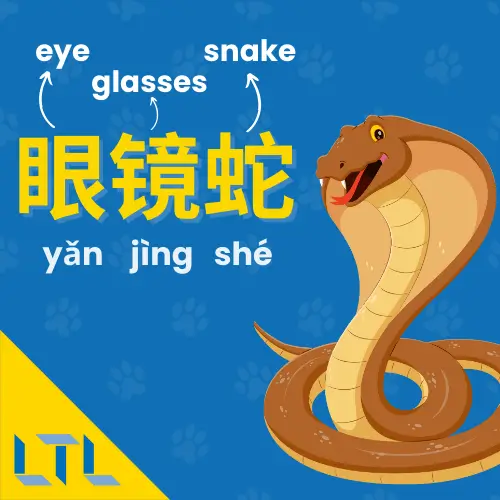
| 眼镜蛇 | yǎn jìng shé | Cobra | Eyeglasses Snake |
| 鳄鱼 | è yú | Crocodile | Crocodile Fish |
| 青蛙 | qīngwā | Frog | Green Grass Frog |
| 壁虎 | bì hǔ | Gecko | Wall Tiger |
| 鬣蜥 | liè xī | Iguana | Mane Lizard |
| 科莫多龙 | kē mò duō lóng | Komodo Dragon | Branch Nothing Many Dragon |
| 蜥蜴 | xī yì | Lizard | Lizard |
| 蝾 | róng | Salamander | Salamander |
| 蟾蜍 | chánchú | Toad | Toad |
| 乌龟 | wūguī | Tortoise | Crow Turtle |
| 龟 | guī | Turtle | Turtle |
| 水龙 | shuǐ lóng | Water Dragon | Water Dragon |

Insects in Chinese
| Chinese | Pinyin | English | Literal Meaning |
|---|---|---|---|
| 蚂蚁 | Mǎyǐ | Ant | Ant |
| 蜜蜂 | Mì fēng | Bee | Honey Bee |
| 甲虫 | Jiǎ chóng | Beetle | Shell Insect |
| 蝴蝶 | Hú dié | Butterfly | Butterfly |
| 毛虫 | Máo chóng | Caterpillar | Hair Insect |
| 蜈蚣 | Wú gōng | Centipede | Centipede |
| 蜻蜓 | Qīng tíng | Dragonfly | Dragonfly |
| 苍蝇 | Cāng yíng | Fly | House Fly |
| 蚱蜢 | Zhàměng | Grasshopper | Grasshopper |
| 瓢虫 | Piáo chóng | Ladybird | Ladle Insect |
| 千足虫 | Qiānzú chóng | Millipede | 1,000 Foot Insect |
| 蝎子 | Xiē zi | Scorpion | Scorpion |
| 蜗牛 | Wō niú | Snail | Snail Cow |
| 蜘蛛 | Zhīzhū | Spider | Spider |
| 黄蜂 | Huáng fēng | Wasp | Yellow Bee |
| 虫 | Chóng | Worm | Insect / Worm |


Pets and Domestic Animals in Chinese
Whether you’re talking about your own pet or asking about someone else’s (a great conversation starter in China!), this vocabulary is genuinely useful from day one.
| Animal | Chinese | Pinyin | Literal Meaning |
|---|---|---|---|
| Dog | 狗 | gǒu | Dog |
| Cat | 猫 | māo | Cat |
| Fish | 鱼 | yú | Fish |
| Bird | 鸟 | niǎo | Bird |
| Hamster | 仓鼠 | cāng shǔ | Granary rat |
| Rabbit | 兔子 | tù zi | Rabbit |
| Parrot | 鹦鹉 | yīng wǔ | Parrot |
| Turtle | 乌龟 | wū guī | Black tortoise |
| Guinea pig | 豚鼠 | tún shǔ | Pig-rat |
| Goldfish | 金鱼 | jīn yú | Gold fish |
A quick example sentence to get you started:
— 你有宠物吗?(Nǐ yǒu chǒng wù ma?) = Do you have a pet?
— 我有一只猫。(Wǒ yǒu yī zhī māo.) = I have a cat.
Farm Animals in Chinese
Farm animals come up constantly in beginner textbooks, graded readers, and HSK vocabulary lists, so knowing them early pays off.
| Animal | Chinese | Pinyin | Literal Meaning |
|---|---|---|---|
| Cow / Ox | 牛 | niú | Cow |
| Pig | 猪 | zhū | Pig |
| Sheep / Goat | 羊 | yáng | Sheep (note: covers both sheep and goat) |
| Chicken | 鸡 | jī | Chicken |
| Duck | 鸭 | yā | Duck |
| Horse | 马 | mǎ | Horse |
| Donkey | 驴 | lǘ | Donkey |
| Goose | 鹅 | é | Goose |
| Rooster | 公鸡 | gōng jī | Male chicken |
| Hen | 母鸡 | mǔ jī | Mother chicken |
Measure Words for Animals in Chinese
Once you know how to name an animal in Chinese, the next step is counting them correctly. Chinese uses measure words (量词 liàngcí) between a number and a noun. Get these right and your Mandarin sounds noticeably more natural.
Here are the four measure words you will use most often with animals:
| Measure Word | Pinyin | Used For | Example |
|---|---|---|---|
| 只 | zhī | Most small animals: cats, dogs, birds, insects | 一只猫 (yī zhī māo) = one cat |
| 头 | tóu | Large livestock: cows, elephants, pigs | 一头牛 (yī tóu niú) = one cow |
| 条 | tiáo | Long, flexible creatures: fish, snakes, dogs (also common) | 一条鱼 (yī tiáo yú) = one fish |
| 匹 | pǐ | Horses and mules | 一匹马 (yī pǐ mǎ) = one horse |
TIP💡 When in doubt, 只 (zhī) is your safe default for most animals. Native speakers use it broadly, so you will rarely go wrong.
Want to practise these in a real class? Visit our Chinese Grammar Bank for more on measure words and other core grammar patterns.
Animal Radicals in Chinese // A Learner’s Shortcut
Here’s something that will speed up your vocabulary learning: many Chinese animal characters share a radical, a visual building block that hints at the category of the word.
Spot the radical, and you can often guess that an unknown character is an animal even before you look it up.
犭(quǎn), the dog radical
Appears in characters related to dogs and dog-like mammals.
- 狗 (gǒu) = dog
- 狼 (láng) = wolf
- 狐 (hú) = fox
- 猫 (māo) = cat
鸟 (niǎo), the bird radical
Appears in characters for birds.
- 鸡 (jī) = chicken
- 鸭 (yā) = duck
- 鹰 (yīng) = eagle
- 鹦鹉 (yīng wǔ) = parrot
虫 (chóng), the insect/creature radical
Despite meaning ‘insect’, this radical appears in a wide range of creature characters.
- 蛇 (shé) = snake
- 蝴蝶 (hú dié) = butterfly
- 蚊子 (wén zi) = mosquito
- 虾 (xiā) = shrimp
TIP💡 Once you learn these three radicals, you will start recognising patterns across dozens of animal characters you have never studied before.
That’s the power of learning characters systematically rather than one at a time.
Chinese Animal Idioms // 成语 with Animals
Chinese is full of four-character idioms called 成语 (chéngyǔ).
A huge number of them feature animals, and learning even a handful will impress native speakers enormously.
Here are five worth knowing:
马到成功 (mǎ dào chéng gōng)
Literal meaning: The horse arrives and success follows.
Usage: Said to wish someone good luck before a task or exam.
Example: 明天考试,马到成功!(Míng tiān kǎo shì, mǎ dào chéng gōng!) = Good luck on your exam tomorrow!
虎头蛇尾 (hǔ tóu shé wěi)
Literal meaning: Tiger’s head, snake’s tail.
Usage: Describes something that starts strong but fizzles out.
Example: 他的计划虎头蛇尾。(Tā de jì huà hǔ tóu shé wěi.) = His plan started well but came to nothing.
对牛弹琴 (duì niú tán qín)
Literal meaning: Playing the lute to a cow.
Usage: Wasting effort on someone who cannot appreciate it.
Example: 跟他解释没用,对牛弹琴。(Gēn tā jiě shì méi yòng, duì niú tán qín.) = Explaining to him is pointless.
狐假虎威 (hú jiǎ hǔ wēi)
Literal meaning: The fox borrows the tiger’s power.
Usage: Describes someone who bullies others by relying on a powerful backer.
鸡飞狗跳 (jī fēi gǒu tiào)
Literal meaning: Chickens fly, dogs jump.
Usage: Describes complete chaos or a scene of great commotion.
Example: 家里鸡飞狗跳。(Jiā lǐ jī fēi gǒu tiào.) = The house is in total chaos.
TIP💡 Try our Chinese Proverb of the Day to pick up a new piece of Chinese wisdom every single day.
Animals in Chinese // Example Sentences
Vocabulary lists are a great starting point, but hearing animals used in real sentences is where the language clicks.
Here are ten natural examples, read them, say them out loud, and notice how the measure words and grammar patterns work.
- 我喜欢猫。(Wǒ xǐ huān māo.) = I like cats.
- 那只狗很可爱。(Nà zhī gǒu hěn kě’ài.) = That dog is very cute.
- 中国的大熊猫很有名。(Zhōngguó de dà xióng māo hěn yǒu míng.) = China’s giant pandas are very famous.
- 我在动物园看到了一头大象。(Wǒ zài dòng wù yuán kàn dào le yī tóu dà xiàng.) = I saw an elephant at the zoo.
- 他属虎。(Tā shǔ hǔ.) = He was born in the Year of the Tiger. (lit. ‘He belongs to the tiger.’)
- 水里有很多鱼。(Shuǐ lǐ yǒu hěn duō yú.) = There are many fish in the water.
- 花园里有一只蝴蝶。(Huā yuán lǐ yǒu yī zhī hú dié.) = There is a butterfly in the garden.
- 农场里有很多牛和羊。(Nóng chǎng lǐ yǒu hěn duō niú hé yáng.) = There are many cows and sheep on the farm.
- 你属什么?(Nǐ shǔ shén me?) = What is your Chinese zodiac sign? (lit. ‘What do you belong to?’)
- 那条蛇爬得很快。(Nà tiáo shé pá de hěn kuài.) = That snake moves very fast.
There you have it, learning Chinese really is that logical! Want to keep learning Mandarin? Why not start taking Chinese lessons online with us from the comfort of your own home?
Chinese Zodiac Animals Quiz
So now you’ve had time to learn the Zodiac Animals in Chinese, want to put your knowledge to the test?
Take our quiz and see how many of the 12 names you’ve remembered!

Ready to go further than vocabulary lists?
Find your perfect Mandarin program and start building real fluency with native-speaker teachers in cities across Asia.








21 comments
[…] is not only the favoured food of China’s national animal the panda (lit. bear cat). Due to its versatility and strength bamboo is used to make literally everything in China. […]
[…] meaning Sun or月 meaning Moon), people (the previously mentioned 女, 手 or 心 / 忄) or maybe animals (马 meaning horse, 虫 meaning insect or犭meaning […]
[…] up on your Chinese animal names […]
[…] in relation to the borders of “China” at the time of these dynasties. 99. The word for “Kangaroo” in Chinese is literally “ Pouch Mouse” 袋鼠. 100. 1.1 billion people speak Mandarin as their first […]
[…] instance, when you’re learning animals in Chinese. For dog (狗 gǒu) why not learn it while looking at a picture of your favourite four-legged friend and reminiscing […]
[…] day he was out and about in town and saw some cows. He thought they might like his music and he started playing the lute (a traditional Chinese […]
[…] ingredients for the filling include shrimp, crab, lamb, egg, even noodles! Traditional Shanghainese Shao Mai is stuffed with glutinous rice, or […]
[…] stores flank the walkway displaying shelves of fish tanks, cages with small and large furry friends, plants, the aforementioned crickets in neat containers, and even jewelries and decorations like […]
[…] One day he was out and about in town and saw some cows. […]
[…] have all the animals in Chinese and plants in Chinese mastered after playing this […]
[…] There are four different measure words used for animals in Chinese. […]
[…] we’ve already seen with the nature poses, animal poses are also mostly direct translations of the animal name with 式 shì added. Here are some of […]
[…] Trova tutti gli animali in Cinese […]
This list is insane! The literal translations got me 😂
We spent hours laughing at some of them Ben!
thank you I loved this list. I'm having problem with the measure word 只。 most of the definitions I see are very limited they just say a measure word for certain animals but don't specify which specific animals. I have been able to find the measure word for some animals such as domestic animals or horses. I wish I could find a list that would tell me the measure words for each of the animals listed above do you have such a list I have not been able to find one but it's difficult to find the correct search query. thank you for all your help
[…] tiger is another literal translation of the Chinese 纸老虎 […]
[…] Quote from the source: … […]
Very fun read^^ I think gong in gongji here means male, not public. So Rooster is Male Chicken.
The name of the section "Reptiles in Chinese" should be changed to "Reptiles and Amphibians in Chinese", since frogs, salamanders, and toads are amphibians, not reptiles.
It is a shame pigeons and doves were left out.