
Must-Know Chinese Characters: The Most Common 100

With thousands of Chinese characters in existence, it’s easy to feel overwhelmed when starting out.
To make things more confusing, there are many different lists claiming to show the most common ones.
So, where should you begin?
The truth is, you don’t need to learn all the Chinese characters—far from it. By focusing on the most frequently used ones, you can build a strong foundation and make real progress fast.
Start small: learn 10 characters, then 50, then 100… before you know it, you’ll reach 1,000—the point where fluent conversation becomes possible. Aim for around 3,000 characters, and you’ll be able to read newspapers, websites, and books with confidence.
Ready to begin? Let’s start with the first 100 most common Chinese characters.
TEST YOUR KNOWLEDGE – We’ve got a great free quiz on the most common characters at the end!
Chinese characters are made up of one, two, or several Chinese radicals.

Most Common Chinese Characters || 1-10
Most Common Chinese Characters || 11-20
Most Common Chinese Characters || 21-30
Most Common Chinese Characters || 31-40
Most Common Chinese Characters || 41-50
Most Common Chinese Characters || 51-60
Most Common Chinese Characters || 61-70
Most Common Chinese Characters || 71-80
Most Common Chinese Characters || 81-90
Most Common Chinese Characters || 91-100
BONUS || Most Common Chinese Characters Quiz
DOUBLE BONUS || Common Chinese Characters Poster
Most Common Chinese Characters || FAQs
Before we reveal all… we think you’ll like this

Most Common Chinese Characters: 1-10
| Character | Pinyin | Meaning in English | Example |
|---|---|---|---|
| 的 | de | grammatical particle marking possession | 这 是 我 的。 (zhè shì wǒ de.) (This is mine.) |
| 一 | yī | one | 我 要 一 个。 (wǒ yào yī gè.) (I want one.) |
| 是 | shì | to be | 他 是 老师。 (tā shì lǎoshī.) (He is a teacher.) |
| 不 | bù | not, negative | 我 不 知道。 (wǒ bù zhīdào.) (I don’t know.) |
| 了 | le | verb particle marking past tense, completed action, change in condition. | 我 吃 了。 (wǒ chī le.) (I ate.) |
| 人 | rén | person | 他 是 好 人。 (tā shì hǎo rén.) (He is a good person.) |
| 我 | wǒ | I | 我 爱 你。 (wǒ ài nǐ.) (I love you.) |
| 在 | zài | at, located at | 他 在 家。 (tā zài jiā.) (He is at home.) |
| 有 | yǒu | have, there is | 我 有 钱。 (wǒ yǒu qián.) (I have money.) |
| 他 | tā | he | 他 不 在。 (tā bù zài.) (He is not here.) |
Most Common Chinese Characters: 11-20
| Character | Pinyin | Meaning in English | EXAMPLE SENTENCE |
|---|---|---|---|
| 这 | zhè | this | 这 是 什么? (zhè shì shénme?) (What is this?) |
| 中 | zhōng | middle | 我 在 中 间。 (wǒ zài zhōngjiān.) (I’m in the middle.) |
| 大 | dà | big | 那 只 狗 很 大。 (nà zhǐ gǒu hěn dà.) (That dog is big.) |
| 来 | lái | come | 过 来! (guò lái!) (Come here!) |
| 上 | shàng | above, on, over/last, previous | 他 上 楼 了。 (tā shàng lóu le.) (He went upstairs.) |
| 国 | guó | country | 我 爱 中 国。 (wǒ ài Zhōngguó.) (I love China.) |
| 个 | gè | general quantifier | 我 要 一 个。 (wǒ yào yī gè.) (I want one.) |
| 到 | dào | to, towards, until, arrive | 他 到 了。 (tā dào le.) (He arrived.) |
| 说 | shuō | speak, say | 你 说 什么? (nǐ shuō shénme?) (What did you say?) |
| 们 | men | pluralize nouns referring to people | 我们 是 朋友。 (wǒmen shì péngyǒu.) (We are friends.) |

Most Common Chinese Characters: 21-30
| Character | Pinyin | Meaning in English | |
|---|---|---|---|
| 为 | wèi | in order to, for the purpose of… | 为 你 加油! (wèi nǐ jiāyóu!) (Cheering for you!) |
| 子 | zǐ | child | 小 子 很 聪明。 (xiǎo zi hěn cōngmíng.) (The boy is smart.) |
| 和 | hé | together, with | 我 和 你 去。 (wǒ hé nǐ qù.) (I’ll go with you.) |
| 你 | nǐ | you | 你 好 吗? (nǐ hǎo ma?) (How are you?) |
| 地 | dì | earth, ground, place | 这 个 地 方。 (zhè ge dì fāng) (This place.) |
| 出 | chū | go out, come out | 他 出 去 了。 (tā chūqù le.) (He went out.) |
| 道 | dào | way, path | 人 各 有 道。 (rén gè yǒu dào) Everyone has their own path. |
| 也 | yě | also, as well | 我 也 喜欢。 (wǒ yě xǐhuān.) (I like it too.) |
| 时 | shí | time period, season | 什 么 时 候? (shén me shí hòu?) What time? |
| 年 | nián | year | 我 明 年会 去。 (wǒ míng nián huì qù.) (I’ll go next year) |

Most Common Chinese Characters: 31-40
| Character | Pinyin | Meaning in English | EXAMPLE SENTENCE |
|---|---|---|---|
| 得 | de | adverbial particle | 跑 得 很 快。 (pǎo de hěn kuài.) (Runs very fast.) |
| 就 | jiù | just, simply, right away | 我 就 知道! (wǒ jiù zhīdào!) (I just knew it!) |
| 那 | nà | that | 那 是 谁? (nà shì shéi?) (Who is that?) |
| 要 | yào | want, will do, need, important | 我 要 水。 (wǒ yào shuǐ.) (I want water.) |
| 下 | xià | below, under, down / next | 请 坐 下。 (qǐng zuò xià.) (Please sit down.) |
| 以 | yǐ | because of, in order to / according to | 可 以 走 了。 (kěyǐ zǒu le.) (You can leave now.) Note: “以” appears in compound words like 可以. |
| 生 | shēng | give birth, life | 生 孩 子。 (Shēng hái zǐ) (Give birth) |
| 会 | huì | can, able, meet, party, society | 我 会 说 中文。 (wǒ huì shuō zhōngwén.) (I can speak Chinese.) |
| 自 | zì | from, self | 他 自 学 中文。 (tā zì xué zhōngwén.) (He self-studies Chinese.) |
| 着 | zhe | verb particle marking a progressive aspect (e.g. -ing) | 他 笑 着 说。 (tā xiào zhe shuō.) (He smiled while speaking.) |
Most Common Chinese Characters: 41-50
| Character | Pinyin | Meaning in English | EXAMPLE SENTENCE |
|---|---|---|---|
| 去 | qù | go, leave, depart | 我 要 去 了。 (wǒ yào qù le.) (I’m going now.) |
| 之 | zhī | possessive particle (formal), go, leave for | 中 国 之 美。 (Zhōng guó zhī měi) (Beauty of china) |
| 过 | guò | past particle, pass, cross, exceed | 我 去 过 北京。 (wǒ qù guò Běijīng.) (I’ve been to Beijing.) |
| 家 | jiā | home, family | 我 回 家 了。 (wǒ huí jiā le.) (I went home.) |
| 学 | xué | study, learn | 她 学 中文。 (tā xué zhōngwén.) (She studies Chinese.) |
| 对 | duì | correct, mutual, pair | 你 说 得 对。 (nǐ shuō de duì.) (You are right.) |
| 可 | kě | ~able, may, can | 可 不 可以? (kě bù kěyǐ?) (Can I or not?) Used in 可 as part of 可以 |
| 她 | tā | she | 她 是 我 妹 妹。 (tā shì wǒ mèi mei.) (She is my sister.) |
| 里 | lǐ | inside | 他 在 家 里。 (tā zài jiā lǐ.) (He is at home.) |
| 后 | hòu | behind, after | 在 你 后 面。 (zài nǐ hòu miàn) (Behind you) |
If you are still with us, we salute you… we’ve hit the half-way point. Time for the next 50, deep breath, let’s go!
The most common characters in Chinese from 50th-100th…
Most Common Chinese Characters: 51-60
| Character | Pinyin | Meaning in English | EXAMPLE SENTENCE |
|---|---|---|---|
| 小 | xiǎo | small | 他 很 小。 (tā hěn xiǎo.) (He is small.) |
| 么 | me/mo | interrogative suffix | 你 做 什 么? (nǐ zuò shénme?) (What are you doing?) Used in 什么 – shénme |
| 心 | xīn | heart | 我 心 很 累。 (wǒ xīn hěn lèi.) (My heart is tired.) |
| 多 | duō | many, much, more | 人 太 多 了。 (rén tài duō le.) (Too many people.) |
| 天 | tiān | sky, heaven, god, day | 今 天 很 热。 (jīn tiān hěn rè.) (Today is hot.) |
| 而 | ér | and, furthermore | 知 易 而 行 难。 (zhī yì ér xíng nán.) (Knowing is easy, doing is hard.) |
| 能 | néng | can, be able | 我 能 去 吗? (wǒ néng qù ma?) (Can I go?) |
| 好 | hǎo | good | 我 很 好。 (wǒ hěn hǎo.) (I’m good.) |
| 都 | dōu | all | 我 们 都 去。 (wǒmen dōu qù.) (We all go.) |
| 然 | rán | like that, correct, so | 突 然 下 雨 了。 (tūrán xià yǔ le.) (It suddenly rained.) (Used in 突然 – suddenly) |

Most Common Chinese Characters: 61-70
| Character | Pinyin | Meaning in English | EXAMPLE SENTENCE |
|---|---|---|---|
| 没 | méi | haven’t, there isn’t, no | 我 没 有 钱。 (wǒ méi yǒu qián.) (I don’t have money.) |
| 日 | rì | sun | 日 出 了。 (rì chū le.) (The sun has risen.) |
| 于 | yú | in, at, for, to, from, by, than | 生 于 中国。 (shēng yú Zhōngguó.) (Born in China.) (Used more formally/literary) |
| 起 | qǐ | rise, start | 站 起 来。 (zhàn qǐ lái.) (Stand up.) |
| 还 | hái | still, yet | 我 还 没 去。 (wǒ hái méi qù.) (I still haven’t gone.) |
| 发 | fā | send, develop, expand | 发 邮 件 吧。 (fā yóujiàn ba.) (Send the email.) |
| 成 | chéng | accomplish, succeed / to become | 成 他 成 功 了。 (tā chénggōng le.) (He succeeded.) |
| 事 | shì | matter, thing, event, accident | 没 事。 (méi shì.) (It’s nothing / No problem.) |
| 只 | zhǐ | only, just | 我 只 有 一 个。 (wǒ zhǐ yǒu yī gè.) (I only have one.) |
| 作 | zuò | writings; work | 作 业 做 完 了。 (zuòyè zuò wán le.) (Homework is finished.) |


Most Common Chinese Characters: 71-80
| Character | Pinyin | Meaning in English | EXAMPLE SENTENCE |
|---|---|---|---|
| 当 | dāng | serve as, act as | 他 当 老师。 (tā dāng lǎoshī.) (He works as a teacher) |
| 想 | xiǎng | think, feel, want | 我 想 你。 (wǒ xiǎng nǐ.) (I miss you.) |
| 看 | kàn | see, look at | 你 看! (nǐ kàn!) (Look!) |
| 文 | wén | language, literature | 我 爱 中文。 (wǒ ài zhōngwén.) (I love Chinese.) |
| 无 | wú | without, have not | 无 可 奈 何。 (wú kě nài hé.) (Helpless / Nothing can be done.) Common idiom |
| 开 | kāi | open | 门 开 了。 (mén kāi le.) (The door opened.) |
| 手 | shǒu | hand | 举 手。 (jǔ shǒu.) (Raise your hand.) |
| 十 | shí | ten | 我 十 岁 了。 (wǒ shí suì le.) (I’m ten years old.) |
| 用 | yòng | use | 怎 么 用? (zěnme yòng?) (How do I use it?) |
| 主 | zhǔ | lord, master, live | 主 人 回 来 了。 (zhǔrén huí lái le.) (The owner came back.) |
Most Common Chinese Characters: 81-90
| Character | Pinyin | Meaning in English | EXAMPLE SENTENCE |
|---|---|---|---|
| 行 | xíng | go, OK | 这 样 行 吗? (zhè yàng xíng ma?) (Is this OK?) |
| 方 | fāng | side | 另 一 方 面 (Lìng yī fāng miàn) (On the other hand) |
| 又 | yòu | again, both… and… | 他 又 来 了。 (tā yòu lái le.) (He came again.) |
| 如 | rú | like, as, as if | 如 你 所 说。 (rú nǐ suǒ shuō.) (As you said.) |
| 前 | qián | in front, previous, first, former | 他 在 前 面。 (tā zài qián miàn.) (He’s in front.) |
| 所 | suǒ | place | 我 所 想 的。 (wǒ suǒ xiǎng de.) (What I’m thinking about.) |
| 本 | běn | basis, origin, edition | 我 本 来 去。 (wǒ běnlái qù.) (I was going to go.) |
| 见 | jiàn | appear to be, meet with | 我 看见 他 了。 (wǒ kànjiàn tā le.) (I saw him.) |
| 经 | jīng | pass through | 火车 经 过 北京。 (huǒchē jīngguò Běijīng.) (The train passes through Beijing.) |
| 头 | tóu | head, top, first | 他 头 很 大。 (tā tóu hěn dà.) (His head is big.) |

Most Common Chinese Characters: 91-100
| Character | Pinyin | Meaning in English | EXAMPLE SENTECE |
|---|---|---|---|
| 面 | miàn | face, surface | 我 见 过 他 面。 (wǒ jiàn guò tā miàn.) (I’ve seen his face.) |
| 公 | gōng | public, official | 公 园 很 大。 (gōngyuán hěn dà.) (The park is big.) |
| 同 | tóng | same | 我 同 意。 (wǒ tóng yì) (I agree.) |
| 三 | sān | three | 我 有 三 个。 (wǒ yǒu sān gè.) (I have three.) |
| 已 | yǐ | already | 她 已 经 到 了。 (tā yǐjīng dào le.) (She already arrived.) |
| 老 | lǎo | old | 他 很 老。 (tā hěn lǎo.) (He is old.) |
| 从 | cóng | from, through | 我 从 北京 来。 (wǒ cóng Běijīng lái.) (I come from Beijing.) |
| 动 | dòng | move | 别 动! (bié dòng!) (Don’t move!) |
| 两 | liǎng | two | 我 有 两 本。 (wǒ yǒu liǎng běn.) (I have two books.) |
| 长 | cháng | long, length | 她 头 发 很 长。 (tā tóufa hěn cháng.) (Her hair is very long.) |


BONUS – Most Common Chinese Characters Quiz
Ready to put yourself to the test with our quick-fire quiz?


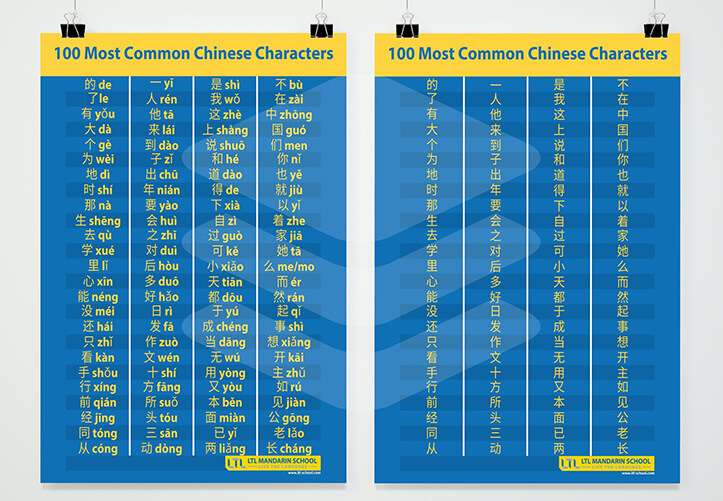
Common Chinese Characters Poster
Two Chinese character posters for the price of one… aren’t we good to you…
Once you’ve got a grasp of the most-used characters, a semester program in Beijing is a great way to keep building on that foundation through daily immersion
BONUS CONTENT | Interested in other languages too? Why not check out our list of 100 Korean words to learn, the 100 most common Japanese words and the most commonly used Vietnamese words too.
Most Common Chinese Characters || FAQs
What is the most common Chinese character?
The most common Chinese character is 的 (de) which actually has no meaning by itself but is a grammatical particle used in Chinese.
What are the top 10 most common Chinese characters?
The top 10 most common Chinese characters are (from first to tenth):
的 一 是 不 了 人 我 在 有 他
How many characters do I need to know to pass HSK1?
If you know 178 Chinese characters, you should be able to pass HSK 1, which is the most basic exam to define a foreigners capability in Mandarin.
How long does it take to learn the first 100 Chinese characters?
You could learn these characters, and their meanings pretty quickly if you study Chinese intensively. This is the key, if you have the time, and the drive and motivation, you can learn these in a few hours of Chinese class no problem.
Want more from LTL?
If you wish to hear more from LTL Language School why not join our mailing list? We give plenty of handy information on learning Chinese, useful apps to learn the language and everything going on at our LTL schools!
Sign up below and become part of our ever-growing community!
⭐ Download our free ebook, your starter pack of essential Mandarin learning resources!
BONUS || Want to study Chinese with us in China? Why not check out our group and individual classes here







[…] know some mandarin. I’m not suggesting learning the entire language right before you start a new business […]
[…] as you’ll notice, are two fairly common characters and can actually both be used in the same context so be very careful with […]
[…] are the 100 most common Chinese Characters to get you […]
[…] In the meantime, you can check out our posts on Chinese radicals, language learning tips or 100 most common Chinese characters. […]
[…] In the meantime, you can check out our posts on Chinese radicals, language learning tips or 100 most common Chinese characters. […]
[…] biggest struggle with Chinese language learning has been reading Chinese characters so Anna is helping me to overcome […]
[…] qiú is quite a common Chinese character which you will see in other words such […]
[…] You might find some similarities to these 100 common Chinese Characters […]
I really didn't know where to begin learning characters but this really helps!
Hi Greg,
Thanks for the kind comment, really glad to hear that this has helped you. If you're trying to teach yourself Chinese be sure to check out our free Chinese classes which run every week!
LTL
I alwaysssss get character like this mixed up thanks for sharing!
Thanks Derek! Yes, some of these are very hard to tell apart, we feel your pain 😵.
The LTL Team
Posters are super tidy, downloaded
Really happy to hear that Amita
Your article helped me a lot. Chinese is hard but I will do my best
You got this Ravi