
Chinese Homophones // 58 Pairs (116 Words) You Need To Watch Out For
Chinese homophones are words that sound the same, or nearly the same, but are written with different characters and mean different things. Some are exact matches with identical tones, like 目的 mùdì (goal) and 墓地 mùdì (grave). Others differ only by tone, like 问 wèn (to ask) and 吻 wěn (to kiss).
Mandarin has only around 400 distinct syllables without tones, so homophones are everywhere. Tones, context and characters are how you tell them apart.
If you’ve been studying Chinese to any level you will know that the importance of tones is absolutely paramount to your success.
Learning them incorrectly at the beginning will mean you need to learn them again properly further down the line, which is a great waste of time and energy.
Here we’ll introduce you to Chinese homophones, and they’re the best proof we know that learning your tones properly is a big deal.
You wouldn’t want to get your boss (老板 lǎobǎn) and your wife (老伴 lǎobàn) mixed up, right?
That’s exactly our point: Learn.Your.Tones!
It’s always a good idea to review how to pronounce Chinese tones from time to time, so here are two video resources to help you do just that:
Most Common Chinese Homophones (Beginner)
Chinese Homophones | Exact Match
Chinese Homophone Puns, Jokes // Internet Slang
Chinese Homophones | Same Pronunciation, Different Tones
Chinese Tones // 5 Tips & Tricks to Tell Homophones Apart
Sing Songs & Practice Tone Twisters
BONUS | We created a fantastic Chinese Pronunciation Trainer powered by AI to help you get those tones right.
The plus? All lessons are linked to our Flexi Classes, so if you’re studying with us, we highly recommend you start using it.

Most Common Chinese Homophones (Beginner)
Chinese homophones (同音词 tóngyīncí) are words that sound the same but use different characters and mean different things. They’re not quite the same as homonyms.
A homonym shares its written form as well as its sound, like “bank” in English. In Chinese, that’s one character with several meanings, such as 花 huā, which can mean flower or to spend.
With Chinese Homophones you can encounter 2 situations:
- Two words have exactly the same pronunciation and same tones
- Two words have the same pronunciation but different tones
Here’s a quick example to illustrate just that:
- 问 wèn = to ask
- 吻 wěn = to kiss
See why we need to focus on learning the tones?! Whilst these words are different to a native speaker (4th and 3rd tone are used here) – when starting out, these will likely sound the same to you!
Bizarre, yet true. Do you want to ask your teacher, or kiss your teacher – could lead to some embarrassment!
To ease you into Chinese homophones, here’s a list of words you’ll meet in your first months of study. Many of them, like 是, 十, 四, 买 and 书, appear on the very first HSK vocabulary lists. Pairs like 买 mǎi (to buy) and 卖 mài (to sell) are the kind of tone trap that can cost you marks in the HSK listening section.
TIP💡 Preparing for an exam? Test your HSK knowledge and see how many of these words you already know.
Pay attention to the tones.
| Chinese | English | Chinese | English |
|---|---|---|---|
| 是 shì | To be | 十 shí | Ten |
| 问 wèn | To ask | 吻 wěn | To kiss |
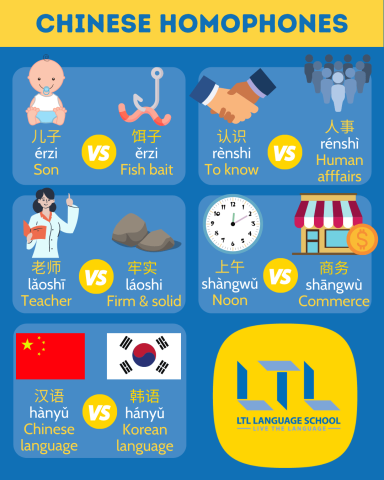
| 汉语 hànyǔ | Mandarin | 韩语 hányǔ | Korean |
| 伞 sǎn | Umbrella | 散 sàn | To Break Up |
| 四 sì | Four | 死 sǐ | To die |
| 买 mǎi | To buy | 卖 mài | To sell |
| 泰语 tàiyǔ | Thai language | 台语 táiyǔ | Taiwanese |
| 臭 chòu | Smelly | 丑 chǒu | Ugly |
| 花 huā | Flower | 画 huà | Painting |
| 书 shū | Book | 输 shū | To Lose |
| 鱼 yú | Fish | 余 yú | Surplus |
| 梨 lí | Pear | 离 lí | To Leave |
| 送钟 sòng zhōng | Gift a clock | 送终 sòng zhōng | To bury a parent |
| 老板 lǎobǎn | Boss | 老伴 lǎobàn | Wife, partner |
Did you notice the words with the exact same tones but different characters?
The context is what will make the sentence clear to the person you are talking to.
Here’s how it can sound when 老板 lǎobǎn (boss) and 老伴 lǎobàn (wife, partner) get swapped:
- Learner: 这是我的老伴。(Zhè shì wǒ de lǎobàn.) = “This is my wife.” (They meant: my boss)
- Colleague: 啊?你们结婚了?(Á? Nǐmen jiéhūn le?) = “Huh? You two are married?”
- Learner: 不是!是老板!(Bú shì! Shì lǎobǎn!) = “No! My boss!”
One tone slip, and the whole office has a story to tell. 💡
Some of these homophones shape everyday life in China, from the numbers people choose to the food on the table at Chinese New Year.
| Chinese | Pinyin | Meaning | Sounds like | Why it matters |
|---|---|---|---|---|
| 四 | sì | Four | 死 sǐ (to die) | Many buildings skip the 4th floor, and people avoid 4s in phone numbers |
| 八 | bā | Eight | 发 fā, as in 发财 fācái (to get rich) | The luckiest number, prized in phone numbers, car plates and prices |
| 鱼 | yú | Fish | 余 yú (surplus) | A whole fish is served at New Year: 年年有余 niánnián yǒu yú, ‘may you have surplus every year’ |
| 生菜 | shēngcài | Lettuce | 生财 shēngcái (to make money) | Eaten and hung up at New Year for prosperity |
| 苹果 | píngguǒ | Apple | 平安 píng’ān (safe and sound) | Apples are a popular gift on Christmas Eve, 平安夜 Píng’ān Yè |
| 送钟 | sòng zhōng | To give a clock | 送终 sòng zhōng (to see someone off at death) | Never give a clock as a gift |
| 梨 | lí | Pear | 离 lí (to leave) | Friends and couples avoid splitting a pear, 分梨 fēn lí, which sounds like 分离 fēnlí (to separate) |
That’s why the 2008 Olympics in Beijing opened at 8:08 pm on 8 August 2008! You’ll find more in our Chinese Superstitions article.


Chinese Homophones | Exact Match
Let’s discover some exact Chinese Homophones in more detail. There are quite a few!
Why so many? Standard Mandarin has only around 400 distinct syllables without tones, and roughly 1,200 to 1,300 once you add the tones. That small set of sounds has to cover thousands of characters, so many words end up sharing exactly the same pronunciation. The syllable shì, for example, is written 是 (to be), 事 (matter), 试 (to try) and 室 (room).
In speech, you tell these words apart by tone and context. On paper, the characters do the work, which is why 目的 (mùdì, goal) and 墓地 (mùdì, grave) never get mixed up in writing.
Context is key so be sure to learn plenty of vocabulary and sentence structures to be able to explain yourself and give detail when needed.
Otherwise you might end up telling someone you are focusing on your tomb instead of your goals!
| Chinese | English | Chinese | English |
|---|---|---|---|
| 由于 yóu yú | Because | 鱿鱼 yóu yú | Squid |
| 丫头 yā tóu | Girl | 鸭头 yā tóu | Duck head |
| 电源 diàn yuán | Power supplier | 店员 diàn yuán | Clerk |
| 无限 wú xiàn | Infinite | 无线 wú xiàn | Wireless |
| 去世 qù shì | To pass away | 趣事 qù shì | Funny thing |
| 报复 bào fù | Revenge | 抱负 bào fù | Ambition |
| 休养 xiū yǎng | To recuperate | 修养 xiū yǎng | Accomplishment |
| 悲剧 bēi jù | Tragedy | 杯具 bēi jù | Cups |
| 喜剧 xǐ jù | Comedy | 洗具 xǐ jù | Washing tool |
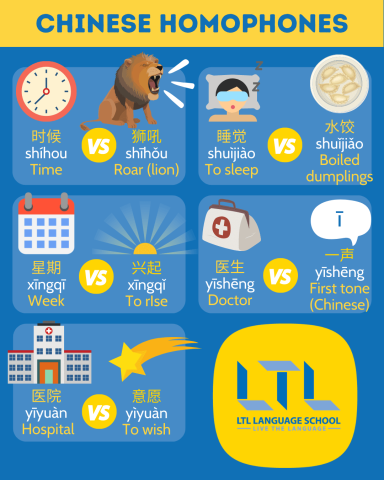
| 医生 yīshēng | Doctor | 一声 yīshēng | First tone (pronunciation) |
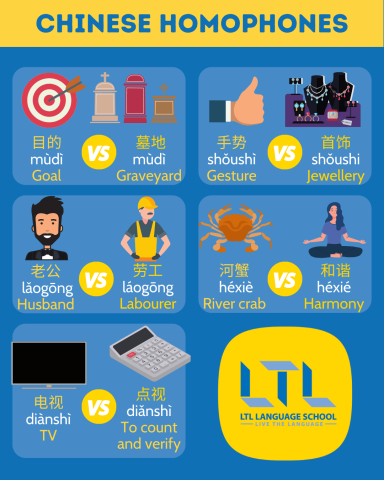
| 目的 mùdì | Goal | 墓地 mùdì | Tomb, grave |
| 手势 shǒushì | Gesture | 首饰 shǒushì | Jewellery |
| 攻击 gōng jī | To attack | 公鸡 gōng jī | Rooster |
| 记忆 jì yì | To remember | 技艺 jì yì | Skill / art |
How many of these did you already know?
Let us know in the comments what Chinese homophones we missed!

Chinese Homophone Puns, Jokes // Internet Slang
Chinese speakers don’t just put up with homophones, they play with them. Homophonic wordplay is called 谐音 xiéyīn, and a deliberate double meaning is a 双关 shuāngguān. You’ll hear it in ads, wedding speeches and plenty of puns and cold jokes.
Two-Part Puns
A 歇后语 xiēhòuyǔ is a two-part saying. You say the first half, and the listener supplies a punchline that only works because of a homophone.
| Chinese | Pinyin | Literal meaning | The pun |
|---|---|---|---|
| 孔夫子搬家:净是书 | Kǒngfūzǐ bānjiā: jìng shì shū | Confucius moves house: nothing but books | 书 shū (book) sounds like 输 shū (to lose), so it also means “nothing but losses” |
Internet Slang
Online, homophones turn into shorthand. Remember 杯具 (cups) from the exact-match table? Online it stands in for 悲剧 (tragedy), as in “what a disaster”.
| Slang | Pinyin | Sounds like | Meaning |
|---|---|---|---|
| 520 | wǔ èr líng | 我爱你 wǒ ài nǐ | I love you |
| 杯具 | bēijù | 悲剧 bēijù | What a tragedy |
| 童鞋 | tóngxié | 同学 tóngxué | Classmate |
| 稀饭 | xīfàn | 喜欢 xǐhuan | To like |
| 围脖 | wéibó | 微博 Wēibó |
Chinese Homophones | Same Pronunciation, Different Tones
Same pronunciation with different tones is the most common case of Chinese homophone. Whilst the above examples cannot be differentiated with their tone – these examples below can.
Check out if you know these ones already:
| Chinese | English | Chinese | English |
|---|---|---|---|
| 过奖 guò jiǎng | To flatter | 果酱 guǒ jiàng | Jam |
| 苹果 píngguǒ | Apple | 平锅 píngguō | Pan |
| 被子 bèizi | Quilt | 杯子 bēizi | Cup |
| 北京 běijīng | Beijing | 背景 bèijǐng | Background |
| 电话 diànhuà | Telephone | 点画 diǎnhuà | Strokes and dots |
| 汤 tāng | Soup | 糖 táng | Sugar, candy |
| 树 shù | Tree | 数 shǔ | To count |
| 胸毛 xiōngmáo | Chest hair | 熊猫 xióngmāo | Panda |
| 老师 lǎoshī | Teacher | 牢实 láoshi | Firm and solid |
| 认识 rènshi | To know (someone) | 人事 rénshì | HR (Human Resources) |
| 上午 shàngwǔ | Morning | 商务 shāngwù | Commerce |
| 时候 shíhou | Time, moment | 狮吼 shīhǒu | Lion roar |
| 睡觉 shuìjiào | To sleep | 水饺 shuǐjiǎo | Boiled dumpling |
| 星期 xīngqí | Week | 兴起 xīngqǐ | To rise |
| 医院 yīyuàn | Hospital | 意愿 yìyuàn | To wish |
| 老公 lǎogōng | Husband | 劳工 láogōng | Labour |
| 河蟹 héxiè | River crab | 和谐 héxié | Harmony |
| 业主 yè zhǔ | Owner | 野猪 yě zhū | Wild boar |
| 茶具 chá jù | Tea set | 差距 chā jù | Gap |
| 绊住 bàn zhù | To entangle | 版主 bǎn zhǔ | Forum moderator |
| 上海 shànghǎi | Shanghai | 伤害 shānghài | To harm |
| 包子 bāozi | Steamed bun | 豹子 bàozi | Leopard |
| 病 bìng | Disease | 冰 bīng | Ice |
| 生气 shēngqì | Angry | 升起 shēngqǐ | To rise |
| 各个 gègè | Each; every | 哥哥 gēge | Elder brother |
| 买家 mǎi jiā | Buyer | 卖家 mài jiā | Seller |
| 习惯 xíguàn | Habit | 吸管 xīguǎn | Straw |
| 知道 zhīdào | To know | 直到 zhídào | Until |
| 美丽 měilì | Beautiful | 魅力 mèilì | Charm |
| 派对 pàiduì | Party | 排队 páiduì | To line up |
Surprised at how many there are? Don’t worry! Check out the next chapter to review how to learn your tones properly.
Chinese Tones // 5 Tips & Tricks to Tell Homophones Apart
These tips and tricks all come from our guide on how to remember the four tones forever.
Ready to get the advice that could change everything?
Let’s go:
Say The Tones with Gestures
Drawing the tones with gestures can be a silly trick for some, but I can assure you it works.
All you have to do is mimic the movement of the tone with either your finger or your whole hand, kind of like a conductor of an orchestra.
Here’s an analysis for each tone:
- First tone (ˉ): Draw a straight line above your head to keep your pitch high and level. Notice how characters in the first tone tend to sound longer than the others, so try to draw a longer line or draw the imaginary line slowly.
- Second tone (/): Draw a diagonal quickly from the bottom left to the top right to slightly increase the pitch of your voice.
- Third tone (V): Draw a “V” or a “U” as a guide to scoop or drop, and then raise your pitch.
- Fourth tone (\): Draw a diagonal quickly from the top left to the bottom right to add a hard stress to the pinyin.
- Fifth/Neutral tone (.): Draw a dot to keep the pronunciation short and succinct.

Exaggerate The Tones
Giving each tone that extra punch increases the chance of you actually remembering how the tones should sound, and the more you do this, the more you will improve your pronunciation.
All you have to do is exaggerate it a little more, turning it into a little theatrical production of your own, if you will.
Always Have a Dictionary
It is completely normal to have doubts about the pronunciation and tones of a given word.
Having a dictionary will help you correct yourself, shed clarity on the situation and find answers to your questions.
Pleco is your best friend here. The app functions as an integrated dictionary, document reader and flashcard system with handwriting input, so it’s fully equipped to assist you with any of your translation needs.

Sing Songs & Practice Tone Twisters
One of the best ways as a beginner to get your mouth muscles accustomed to Chinese tones and pronunciation is to sing Chinese songs and practice Chinese tongue twisters.
In order to speak Chinese with a native accent, students have to ensure they are always using proper inflection and training their muscles to create sounds that are not used in English.
Tongue twisters in Mandarin will teach beginner speakers to communicate with firm, clear enunciation, creating the foundation for natural-sounding speech as they continue to develop their Chinese language abilities.
Listen to the Radio & Watch TV
For intermediate or advanced learners, listening to some Chinese radio or watching Chinese TV is a great way to practice tones and pronunciation.
While conversations are also great practice, one of the best things about spoken Chinese in broadcast media is that everything is enunciated with the correct tones, whereas some tones might be mumbled in real-life dialogue.
From international news stations to pop music and cultural programs, there are numerous Chinese radio stations that’ll give you opportunities to listen for real world usage of tones.
Alternatively, animated cartoons for clearly pronounced, repetitive phrases are extremely beneficial.
Chinese Homophones Quiz // Pick the Right Word
Time to test yourself. Choose the word that fits each sentence, then say the whole sentence out loud.
- 我今天很累,想早点儿___。Wǒ jīntiān hěn lèi, xiǎng zǎo diǎnr ___. (I’m really tired today and want to ___ early.) a) 睡觉 shuìjiào b) 水饺 shuǐjiǎo
- 我有一个问题,想___一下老师。Wǒ yǒu yí gè wèntí, xiǎng ___ yíxià lǎoshī. (I have a question and want to ___ the teacher.) a) 问 wèn b) 吻 wěn
- 早饭我吃了两个___。Zǎofàn wǒ chīle liǎng gè ___. (For breakfast I ate two ___.) a) 豹子 bàozi b) 包子 bāozi
- 我学中文的___是去北京工作。Wǒ xué Zhōngwén de ___ shì qù Běijīng gōngzuò. (My ___ in learning Chinese is to work in Beijing.) a) 目的 mùdì b) 墓地 mùdì
- 天气太热了,我想喝___水。Tiānqì tài rè le, wǒ xiǎng hē ___ shuǐ. (It’s so hot, I want to drink ___ water.) a) 病 bìng b) 冰 bīng
Answers: 1a, 2a, 3b, 4a, 5b. Number 4 is an exact homophone, so only context and the characters can save you there!
TIP💡 Nail your tones with our Pronunciation Trainer by reading each answer aloud and checking your tones.
We hope this article was useful and helped you understand the Chinese language a bit better!
Let us know if we missed any Chinese Homophones in the comment section.
Make sure to check our How To Remember Chinese Tones Forever guide for even more advice on how to get your pronunciation just right.
Are you taking Chinese classes with a professional teacher already?
If not, we strongly recommend you to check out our Flexi Classes platform, which allows you to learn Chinese 24/7 (and other Asian languages) by choosing your study time and study topic.
FREE TRIAL | Start your 7-Day Free Trial on Flexi Classes and book your first lesson with a native-speaker teacher.
FREQUENTLY ASKED QUESTIONS
What are Chinese Homophones?
Homophones are two words with the same pronunciation, with a different meaning.
For example: 墓地 (mùdì) means grave, however 目的 (mùdì) means goal.
You need to be very careful with your tones, as it could change the meaning of your whole sentence!
Are there any good ways to practice my Chinese pronunciation?
Check out our Chinese Pronunciation Trainer.
It is powered by AI and recognise your voice, to then let you know if your pronunciation is correct, or where you didn’t do well.
All lessons available actually come from our Flexi Classes platform, so if you are studying with us already we strongly recommend you use it to review a class.
If you are not a student of Flexi Classes yet, make sure to claim your 7 Day Free Trial here.
Can I download your infographics for personal use?
Yes you can.
However if you wish to share them, always be sure to credit us.
You can find us on most social media platforms, our main ones being:
– Instagram at @ltl_mandarin
– Facebook at @LTL_School
– X (formerly Twitter) at @ltl_school
– TikTok at @ltl_mandarin
Do you teach Chinese Homophones in class?
Yes, whenever there are some in the lesson the teacher will explain every new word, and help you review your tones if necessary.
Did you take lesson on our Flexi Classes platform already?
If not, make sure to claim you 7 Day Free Trial here.
Where can I find more articles like this one?
For more resources similar to this topic, here’s a list of articles you might find interesting:
Why does Mandarin Chinese have so many homophones?
Standard Mandarin has only around 400 distinct syllables without tones, and roughly 1,200 to 1,300 once tones are added.
That small set of sounds has to cover thousands of characters, so many words end up sharing the same pronunciation. The syllable shì, for example, can be written 是 (to be), 事 (matter), 试 (to try) or 室 (room).
What is the difference between a homophone and a homonym in Chinese?
A Chinese homophone sounds the same as another word but uses different characters, like 书 shū (book) and 输 shū (to lose).
A homonym shares its written form as well as its sound. In Chinese that means one character with several meanings, such as 花 huā, which can mean flower or to spend.
Why are the numbers 4 and 8 important in China?
The number 4, 四 sì, sounds like 死 sǐ (to die), so many buildings skip the 4th floor and people avoid 4s in phone numbers.
The number 8, 八 bā, sounds like 发 fā, as in 发财 fācái (to get rich). It is considered the luckiest number, which is why the 2008 Beijing Olympics opened at 8:08 pm on 8 August 2008.
What does 520 mean in Chinese internet slang?
In Chinese internet slang, 520 (wǔ èr líng) means “I love you” because it sounds like 我爱你 wǒ ài nǐ.
It is one of many homophone-based shortcuts used online. Others include 杯具 bēijù (cups) for 悲剧 bēijù (tragedy) and 稀饭 xīfàn for 喜欢 xǐhuan (to like).
Want more from LTL?
If you wish to hear more from LTL Language School why not join our mailing list? We give plenty of handy information on learning Chinese, useful apps to learn the language and everything going on at our LTL schools!
Sign up below and become part of our ever-growing community!
⭐ Download our free ebook, your starter pack of essential Mandarin learning resources!
BONUS || Want to study Chinese with us in China? Why not check out our group and individual classes here








愿意是一个动词,意愿是一个名词