
Laugh Your Way to Better Mandarin with Our Top 10 Jokes PLUS Chinese Memes!
The word for ‘joke’ in Chinese is 笑话 (xiàohuà).
Chinese humour is built primarily on puns (双关语 shuāngguānyǔ), homophones, and character wordplay, thanks to Mandarin’s tonal system and its roughly 400 syllables.
This guide walks you through 10 jokes in Chinese, plus memes and Chinglish, from beginner to intermediate, each with a clear explanation so you can actually get the punchline.
Mastered basic Mandarin conversations? Time to tackle humour!
Understanding jokes in another language means you’re truly beginning to think in that language.
Before we get into the jokes, it helps to know a few key Chinese humour terms:
笑话 (xiàohuà) is the standard word for ‘joke’. You’ll hear this constantly once you start chatting with native speakers.
冷笑话 (lěng xiàohuà) is literally a ‘cold joke’, meaning a deadpan, dry, or anti-climactic pun. Think dad jokes with a Chinese twist. These are enormously popular and have their own dedicated fan base online.
段子 (duànzi) is a short humourous anecdote or internet gag, closer to a meme in text form. You’ll find these all over Chinese social media platforms like Weibo and Douyin.
Chinese humour, with its love of puns (双关语, shuāngguānyǔ), offers a perfect opportunity to deepen your language skills while having fun.
In this post, we’ll explore ten Chinese jokes and Chinese language-themed memes with explanations that will enhance your language comprehension and give you some great conversation starters with native speakers.
Ready to laugh your way to better Chinese?
Why Does Chinese Humour Feel Different?
If you’ve spent time with Chinese friends or colleagues, you might have noticed that humour there doesn’t always land the way you expect. Here’s why:
Wordplay is everything. Mandarin has around 400 syllables (compared to 15,000+ in English). That means homophones are everywhere, and Chinese humour exploits them constantly. A joke that’s hilarious in Chinese can be completely untranslatable.
Deadpan is the default. 冷笑话 (cold jokes) are delivered completely straight-faced. If you’re waiting for a signal that the punchline has arrived, you’ve already missed it.
Absurdist logic is celebrated. Chinese internet humour, especially on Douyin and Weibo, often leans into non sequiturs and anti-climax. The worse the pun, the more people appreciate the audacity.
Understanding this won’t just make you laugh more, it’ll make you a far better listener when you’re in the classroom or chatting with a host family in Beijing or Chengdu. 💡
Jokes in Chinese | Life Advice
Jokes in Chinese | Alphabet Humour
Jokes in Chinese | Marriage Advice
Jokes in Chinese | Fruit Humour
Jokes in Chinese | Vampires and Spicy Food
Jokes in Chinese | Why Did the Chicken Cross the Road?
Jokes in Chinese | Spiderman
Jokes in Chinese | Character-Based Joke
Jokes in Chinese | Cold Jokes (冷笑话)
BONUS | Chinese Memes
BONUS #2 | Chinglish in China
Chinese Joke #1: Life Advice || 🟢 Beginner
Outsmarted by your child. It happens to parents all the time! Here’s a prime example!
妈妈说:”今天能完成的事,不要留到明天”
Mom says: Do not put off until tomorrow what you can do today.儿子回答:“好吧,把全蛋糕给我,我今天都吃光了吧”
The son responds: Okay, then give me the whole cake. I will eat the whole thing today.DOWNLOAD OUR FREE EBOOK
Looking for reliable tools to boost your Mandarin? We’ve gathered our favourite websites, extensions, and learning platforms into one handy ebook, completely free! It’s perfect for beginners or anyone looking to refresh their skills.
👉 Get your free Mandarin Resource Pack and take your studies to the next level.
Chinese Joke #2: Alphabet Humour || 🟢 Beginner
A clever joke that plays on the order of the alphabet, ABCD, and yes, hilarious Chinese tone mix-ups are very much a real thing when you’re learning.
谁比较高?A还是C?
Who is taller? A or C?C, 因为,A比C低。
C because, A is lower than C.The humour comes from the phrase “A 比 C 低” (A bǐ C dī), which means “A is lower than C”, but also sounds like “A, B, C, D” when spoken aloud.
Since 低 (dī, meaning “low”) sounds like the letter D, the sentence sounds like the sequence “A, B, C, D,” making it a clever pun!
Chinese Joke #3: Marriage Advice || 🟢 Beginner
An inquisitive kid gets a true reality check at the cost of weddings!
一个小孩儿问他的爸爸:“爸爸,结婚 需要 花 多少钱”
A little kid asked his father: “Dad, how much does it cost to get married?”爸爸说:“儿子,我 不知道。 我 还在付款!”
The father said: “Son, I don’t know. I’m still paying!”This one is pretty self-explanatory because it plays on the idea that marriage is so expensive that the cost never really ends. The child asks, “Dad, how much does it cost to get married?”The father responds, “Son, I don’t know. I’m still paying!” Relatable? 👀
Mandarin Joke #4: Fruit Humour || 🟢 Beginner
Notice we switched from Chinese to Mandarin, but why?
Here’s why!
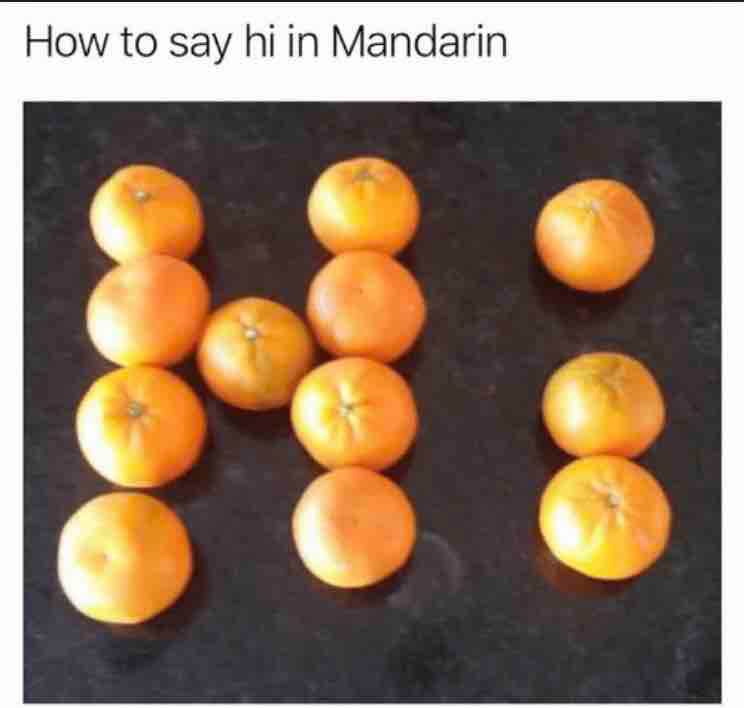

Back to basics with these two! No one need know any Mandarin to understand these. Simple is best, less is more! These were too fun not to share!
For the record the Mandarin is saying Happy Birthday in Chinese 生日快乐, the poor old apple will never know!

Chinese + English = Chinglish 😲 You Must See To Believe
Chinglish – Sometimes you have to see it to believe it. You will be amazed at some of these language mishaps that are made when translating to Chinese.
Homophone Jokes in Chinese (谐音笑话 xiéyīn xiàohuà)
Chinese is packed with homophones, words that sound the same (or nearly the same) but have completely different meanings. This makes it an absolute goldmine for puns.
The jokes below all hinge on this mechanism, so listen closely to the sounds as well as the words.
Chinese Joke #5: Vampires and Spicy Food || 🟡 Intermediate
If you’ve ever been to China before, especially if you’ve spent time in Chengdu, you’ve probably encountered some pretty spicy food. Our students at LTL’s Chengdu school learn very quickly that 辣 (là, spicy) is a way of life there.
But can vampires handle the heat? Let’s find out…
吸血鬼吃辣吗?
Do vampires eat spicy food?不吃,因为他们只吃不辣的。
No, because they only eat ‘blood’ (literally: non-spicy)This joke is funny because it plays on a pun that works in Chinese but loses something in translation to English. Here’s the mechanism:
不辣 (bù là) means ‘not spicy’. But listen carefully, 不辣 sounds very close to 血 (xuè, blood) in certain regional pronunciations, and the phrase ‘only eat non-spicy things’ (只吃不辣的) becomes a sly way of saying vampires only eat blood. The deadpan delivery is very much in the 冷笑话 tradition, the joke is funnier the more seriously you say it. 🧛
TIP💡 If this joke made you think about tones and homophones, that instinct is exactly right. Mandarin’s tonal system is what makes puns like this possible, and yes, it takes real practice to hear them. That’s part of what makes it so satisfying when they click.
Chinese Joke #6: Why Did the Chicken Cross the Road? || 🟡 Intermediate
This one is a classic in English. But how does it go in Mandarin?
为什么鸡要过马路?
Why did the chicken cross the road?因为它想找一个”机会”!
Because it wants to find an “opportunity”!The classic joke “Why did the chicken cross the road?” traditionally has the punchline “To get to the other side.”
In this version, the chicken crosses the road for a “机会” (jīhuì), which means “opportunity” in Chinese. However, the “机” in “机会” (jīhuì) sounds similar to “chicken” when pronounced.
In Mandarin, chicken is 鸡 (jī) 🐔

12 City Names in Chinese 😂 The Funniest Literal Translations
City Names in Chinese 😅 Funny Chinese Translations Ready for some hilarious city names in Chinese direct translations? Chinese to English translations sometimes make little to no sense! Although Chinese is an incredibly logical language to learn we can’t help…
Chinese Joke #7: Spiderman || 🟡 Intermediate
This one is for the Marvel fans out there! Though bear in mind this joke is based on a pun, so it doesn’t translate well to English!
谁最知道猪?
Who knows pigs best?蜘蛛人!
Spiderman!The humour in this joke comes from the sound similarity:
“蜘蛛” (zhī zhū) which means “spider” sounds the same as “知猪” (zhī zhū) which means “to know pigs”.
So when asked who knows pigs best, the answer is “Spiderman” – which makes no logical sense but works as a pun because “knows pigs” (zhī zhū) and “spider” (zhī zhū) sound very similar in Chinese.
It’s a classic example of a homophonic pun where the joke relies entirely on similar-sounding words rather than any actual connection between pigs and Spiderman.
Chinese Joke #8: A Character-Based Joke (汉字笑话 hànzì xiàohuà) || 🟡 Intermediate
Chinese characters are built from components, and that opens up a whole category of humour that simply doesn’t exist in alphabet-based languages.
| Pinyin | Characters | English |
|---|---|---|
| Nǐ zhīdào wèishéme ‘kū’ (哭) de xià miàn shì ‘quǎn’ (犬) ma? | 你知道为什么’哭’的下面是’犬’吗? | Do you know why ‘cry’ (哭) has ‘dog’ (犬) at the bottom? |
| Yīnwèi gǒu kū bù chū lèi lái! | 因为狗哭不出泪来! | Because dogs can’t cry tears! |
Look at the character 哭 (kū, to cry), it contains two 口 (kǒu, mouths) on top and 犬 (quǎn, dog) below. The joke plays on the visual structure of the character itself. This is uniquely Chinese humour, you genuinely need to be able to read characters to get it. Another great reason to keep studying! 😄
TIP💡 Character-based jokes are a fantastic motivation to push past pinyin and start learning 汉字 properly. Try apps like Pleco or Skritter to build your character recognition.
Cold Jokes in Chinese (冷笑话 lěng xiàohuà)
冷笑话 are the kings of Chinese internet humour. Deadpan, dry, and built on wordplay, they land with a thud rather than a punchline, which is exactly the point. Here are two classics:
Chinese Joke #9: Cold Joke #1 || 🟡 Intermediate
| Pinyin | Characters | English |
|---|---|---|
| Wèishéme shū shang de zì dōu hēi sè de? | 为什么书上的字都是黑色的? | Why are the words in books all black? |
| Yīnwèi tāmen hài pà. | 因为它们害怕。 | Because they’re scared. |
The punchline: 害怕 (hàipà) means ‘scared/afraid’, but this is a 冷笑话, the logic is absurd on purpose. The humour is in the total non sequitur delivery.
Welcome to Chinese dry humour.
Chinese Joke #10: Cold Joke #2 || 🟡 Intermediate
| Pinyin | Characters | English |
|---|---|---|
| Shīzi hé lǎohǔ dǎjià, shéi yíng? | 狮子和老虎打架,谁赢? | A lion and a tiger fight. Who wins? |
| Dǎjià de yíng. | 打架的赢。 | The one who fights wins. |
Again, completely literal, completely unhelpful, completely on purpose. This is 冷笑话 at its finest. 😄
TIP💡 Once you can understand a 冷笑话 without needing the explanation, you’re genuinely thinking in Chinese.
Chinese Jokes || Memes
Memes appear to me all the rage online these dates, no matter what way you pronounce it!
- Some of our favourite Chinese Memes
Here are some of our favourites!!




Chinglish in China
And just to wrap up, it wouldn’t be a blog of jokes without some Chinglish thrown in there.
For those of you who don’t know, the equation is simple
Chinese + English = Chinglish!
Again – we dedicated a whole blog towards Chinglish which you have to check out – 20 of the finest examples, but here are some of our favourites.


We hope you enjoyed our series of Chinese jokes, videos, memes and the rest of it!
Ask your friends or Chinese teacher to share their favourite Chinese jokes with you.
Feeling brave? Try translating some of these jokes from English into Chinese!
Enjoyed the wordplay? Chinese gets even more creative when things get edgy. If you want to explore funny Chinese wordplay and insults, we’ve got you covered, just maybe don’t try them out in class on your first day. 😄
Ready to Take Your Mandarin Further?
Want to go beyond jokes and actually get fluent? Whether you’re planning a gap year, a short intensive, or want to study for a full semester, LTL has programs across Beijing, Shanghai, Chengdu, Taipei, and more.
👉 Find your perfect Mandarin program and start living the language.
Like learning jokes in other languages? Then why not check out our favourite Japanese jokes. Russian jokes, and our favourite Korean Jokes also.
Frequently Asked Questions
What are some funny Chinese jokes?
Some of the funniest jokes in Chinese rely on puns (双关语 shuāngguānyǔ) and homophones.
Classic examples include the Spiderman pun (蜘蛛 zhī zhū meaning ‘spider’ sounds like 知猪 zhī zhū, ‘to know pigs’), the chicken-crossing-the-road pun playing on 鸡 (jī) and 机会 (jīhuì, ‘opportunity’), and the alphabet pun where ‘A 比 C 低’ (A is lower than C) sounds like ‘A, B, C, D’. Cold jokes (冷笑话) like ‘Why are the words in books all black? Because they’re scared’ are also hugely popular.
What are some Chinese slang phrases?
Common Chinese internet and humour slang includes 段子 (duànzi) for a short humorous anecdote or meme in text form, 冷笑话 (lěng xiàohuà) for a dry or corny joke, and 谐音 (xiéyīn) referring to homophonic wordplay.
You’ll encounter these constantly on platforms like Weibo and Douyin, where puns and absurdist humour dominate.
What is funny in Chinese?
The word for ‘funny’ in Chinese is 好笑 (hǎoxiào) or 搞笑 (gǎoxiào).
Chinese humour itself tends to be built on wordplay, homophones, character structure jokes (汉字笑话), and deadpan delivery. Physical comedy is generally less prominent than in Western humour, while puns and absurdist logic are celebrated.
What are some Chinese tongue twisters?
Chinese tongue twisters (绕口令 ràokǒulìng) are popular for practicing tones and pronunciation.
A famous example is 四是四,十是十 (sì shì sì, shí shì shí), meaning ‘four is four, ten is ten’, which trains learners to distinguish the tricky ‘s’ and ‘sh’ sounds. These are excellent training tools alongside jokes for building tonal accuracy practising.
We have a full list of more Chinese tongue twisters here.
What’s funny in Chinese?
To say something is funny in Chinese, use 很好笑 (hěn hǎoxiào) meaning ‘very funny’ or 太搞笑了 (tài gǎoxiào le) meaning ‘so hilarious’.
What’s genuinely funny in Chinese culture usually involves clever homophones, cold jokes (冷笑话), memes on Weibo and Douyin, and character-based wordplay that only makes sense once you can read 汉字.
What are some funny Chinese sayings?
Chinese has plenty of witty everyday sayings. The ‘marriage advice’ joke in this post is a good example: ‘How much does it cost to get married? I don’t know, I’m still paying.’
Cold jokes like ‘A lion and a tiger fight. Who wins? The one who fights wins’ also function as absurdist sayings.
Once you’re comfortable with puns, you can start dropping these into conversation to impress native speakers.
Want more from LTL?
If you wish to hear more from LTL Mandarin School why not join our mailing list? We give plenty of handy information on learning Chinese, useful apps to learn the language and everything going on at our LTL schools!
Sign up below and become part of our ever-growing community!







9 comments
Hello in Mandarin 😂
Sometimes simplicity is best!
It was just oranges
[…] funny and humorous image of Avanti riding a donkey and his uncontrollable jokes make the cartoon hugely famous […]
ABCD - very clever!
😎
[…] Source: https://ltl-school.com/chinese-jokes/ […]
[…] know you’ve mastered Chinese when you can laugh at the jokes the natives laugh at — and that’s exactly what 不亦樂乎 will help you […]
This is great.