
Chinese Songs // Famous Hits, Classics & Songs for Learners
The most iconic Chinese song of all time is 月亮代表我的心 (Yuèliàng dàibiǎo wǒ de xīn / ‘The Moon Represents My Heart’) by Teresa Teng.
Beyond that classic, this guide covers 12 essential Mandarin and Cantopop tracks, from Teresa Teng and Jay Chou to Faye Wong, Eason Chan, and viral hits like 小苹果 (Xiǎo píngguǒ), each rated for beginner-friendliness so you can learn Mandarin through music.
Chinese songs are one of the best tools for learning Mandarin, and if you want to go further, picking up singing and music vocabulary in Mandarin means you can actually talk about what you’re listening to.
Aside from the learning angle, there’s some genuinely great music out there you’ve probably never come across.
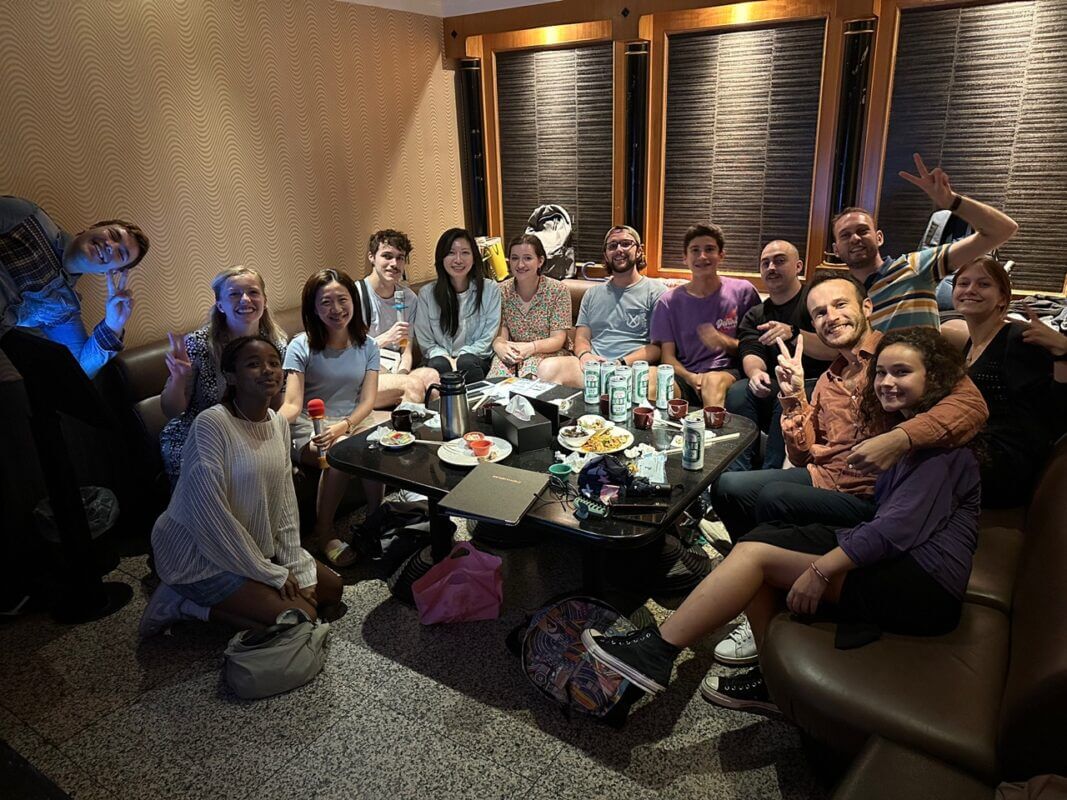
Most of the songs on this list live in the hearts of KTV regulars across Beijing, Taipei, Shanghai, and Singapore.
If you’ve ever stood in a KTV booth wondering what song to pick next, this list is your answer.
We’ve also rated each song for beginner-friendliness, so you know which ones to tackle first when you’re building your Mandarin vocabulary through music.
Grab a drink. There are some genuine classics here.
Table of Contents
Chinese Song #1 – Tiánmì mì (甜蜜蜜)
Chinese Song #2 – Xiǎo píngguǒ (小苹果)
Chinese Song #3 – Dāng (当)
Chinese Song #4 – Wǒmen de ài (我们的爱)
Chinese Song #5 – Tónghuà (童話)
Chinese Song #6 – Yuèliàng dàibiǎo wǒ de xīn (月亮代表我的心)
Chinese Song #7 – Wěnbié (吻别)
Chinese Song #8 – Wǒ yuànyì (我愿意)
Chinese Song #9 – Dà yú (大鱼)
Chinese Song #10 – Gàobái qìqiú (告白气球)
Chinese Song #11 – Shí nián (十年)
Chinese Song #12 – Chénmò shì jīn (沉默是金)

Chinese Song #1 – Tiánmì mì (甜蜜蜜) – Teresa Teng
This was actually one of the first Chinese songs I discovered and it was thanks to KTV (shock).
Karaoke with a mixture of Chinese and foreigners has the capability of bringing out a whole wealth of different tastes.
Where else would you go from Oasis > Xiao Pingguo > Kylie Minogue > Teresa Teng?
Teresa Teng is widely regarded as having one of the most beautiful voices in the history of Chinese music and hearing this song for the first time, the thing that struck me was how it united the whole room.
Singability at KTV: 甜蜜蜜 sits comfortably in a mid-range and doesn’t demand the high notes that catch people out. Most people can carry the melody, which is exactly why it works so well in a group setting. ⭐⭐⭐⭐⭐ for beginners.
The room came together and within 3 or 4 listens I was hooked as well.
We’ll be bumping into Teresa once again later down the list with her most famous song of all, but this one held a soft spot and grabs our first spot.
Beginner-friendly: ⭐⭐⭐⭐⭐ (very beginner-friendly, slow tempo, clear diction).
Sit back and enjoy
![Tian Mi Mi – Teresa Teng Lyrics [CHINESE MANDARIN | PINYIN | ENGLISH]](https://ltl-school.com/wp-content/uploads/yt-thumbs/tc2tW0jFHPo.webp)
Chinese Song #2 – Xiǎo píngguǒ (小苹果) – Chopstick Brothers
From the downright beautiful to the downright bizarre. That’s Chinese music in a nutshell!
小苹果 (Xiǎo píngguǒ / ‘Little Apple’) shot to fame in 2014 and never looked back, becoming one of the most popular Chinese songs of the modern era. It is also the answer to the question ‘what is that viral Chinese meme song?’. The infectious chorus and deliberately bizarre music video made it a global meme, with parody versions filmed everywhere from office canteens to army barracks. If someone asks you about the famous Chinese meme song, this is the one they mean.
Its repetitive (albeit fast) nature makes the song a really good one to learn Chinese, and it’s also got that irritating toe-tapping ability meaning once you listen to it, it’s likely to be stuck in your head all day.
Whether that’s good or bad is down to you!!
Beginner-friendly: ⭐⭐⭐ (fast chorus but highly repetitive, so easier to memorise).
The chopstick brothers (great name by the way) consist of the duo Wang Taili (王太利) and Xiao Yang (肖央). The song was actually originally made for the movie Old Boys: The Way of the Dragon before taking off online and making into KTV’s across the country, and further afield.
The video, put together with the song, creates something that is the complete opposite of our first entry, but hey, that’s Chinese music for you!
](https://ltl-school.com/wp-content/uploads/yt-thumbs/QESBcjX-G9g.webp)
If you like what you hear, the chorus is very learnable. Here it is with pinyin and translation:
小苹果 chorus (pinyin):
Nǐ shì wǒ de xiǎo ya xiǎo píngguǒ
你是我的小呀小苹果
(‘You are my little apple’)Zěnme ài nǐ dōu bù xián duō
怎么爱你都不嫌多
(‘No matter how much I love you, it’s never too much’)
TIP💡 Use these lines as a pronunciation drill. Tap out the tones on your desk as you sing. It sounds ridiculous but it works, and our teachers in Beijing swear by it.
Check it out and impress your Chinese friends at KTV by belting out this crowdpleaser!
![Little Apple by Chopstick Brothers [English, Chinese & Pinyin]](https://ltl-school.com/wp-content/uploads/yt-thumbs/cxYYuSXnL_Y.webp)
Chinese Song #3 – Dāng (当) – Power Station
动力火车, which translates to Power Station, are a Taiwanese rock band who came to prominence in 1997. If their sound gets you hooked on the genre, we have a full guide to Chinese rock and indie bands worth exploring.
The band consists of Yu Chiu-hsin and Yen Chih-lin and their distinctive looks (long hair wasn’t a common sight on rock stages across Taipei and beyond in the 90s) combined with energetic rock ballads helped them shoot to the top.
Four years after forming they released their first album “Walking Along Zhongxiao East Road Nine Times”.
This particular song became famous as the theme song to the TV drama My Fair Princess. Always a good way to get your name out there!
Power Station have won 3 star awards from 4 nominations between 1999 and 2015, including for that TV theme.
Good going 动力火车 🤘
Beginner-friendly: ⭐⭐⭐ (intermediate). The ballad tempo is manageable but the rock phrasing can be tricky. Worth attempting once you’re comfortable with tones.

Chinese Song #4 – Wǒmen de ài (我们的爱) F.I.R
Another Taipei band steps up to the plate. F.I.R are a 3-piece act who jumped onto the scene in 2004 and built a following that stretches from Taipei KTV booths to karaoke bars in Singapore and Beijing.
Where does the name F.I.R come from?
Quite simple really. Take the first initial of each band member: Faye (lead vocals), Ian (keyboard) and Real (guitar and vocals).
我们的爱, meaning Our Love, is the band’s most famous song but they are far from just a one hit wonder.
Check out some of their other hit songs which include Lydia,” “你的微笑,” and “I Remember”.
For reference, that 2nd song there translates to your smile!
Beginner-friendly: ⭐⭐⭐⭐ (mid-tempo ballads with clear diction).
![F.I.R. 飞儿乐团 - 《我们的爱》 [歌词]](https://ltl-school.com/wp-content/uploads/yt-thumbs/SCFlWiMbHd0.webp)
Chinese Song #5 – Tónghuà (童話) – Michael Wong
Tónghuà (which translates to fairytale) is the lead song, and also the title of Wong’s 3rd album, released in 21st January 2005.
Michael Wong (王光良) is of Chinese/Malaysian descent and became hugely popular in China due to his ability to reel off multiple, high-quality love songs over and over.
Love songs are hugely popular in China FYI.
Despite releasing 5 albums, it was only until this 3rd one, where he really shot to fame.
Before 2000, Wong began his singing career in a duo with Victor Wong, however, they went their own ways and thus began the start of something special.
Wong has proved his ability on the acting scene also, with appearances in Chinese drama and achieving cult fame throughout mainland China, Taiwan, Hong Kong, and Malaysia, where he currently resides!
Lucky chap, hats off to you Mr Wong, here’s one of his many classics for you to enjoy…
Beginner-friendly: ⭐⭐⭐⭐ (clear pronunciation, romantic ballad pacing).

Chinese Song #6 – Yuèliàng dàibiǎo wǒ de xīn (月亮代表我的心) – Teresa Teng
Quite possibly the most famous Chinese song of all time…
Our friend Teresa is back again and this one exceeds her first entry, in terms of all round popularity, if online numbers were defining.
The Moon Represents My Heart is an all time Chinese classic.
The song was released in 1977 by Teng, who was actually born in Taiwan.
Sadly, Teng passed away due to an asthma attack in 1995 but her legacy lives on and her music is heard all over Asia every day in or out of KTV!
According to The New York Times, it is one of the best-known Chinese pop songs of all time
Singability at KTV: the melody sits in a comfortable mid-range that suits most vocal ranges. This is why it’s still the go-to closer at KTV nights across Beijing, Taipei, and Singapore.
You may no longer be with us, Teresa, but thanks for the memories…
Beginner-friendly: ⭐⭐⭐⭐⭐
Chinese Song #7 – Wěnbié (吻别) – Jacky Cheung
We head back to 1993 for the 7th song on our greatest Chinese songs list.
Wěnbié (吻别) is actually the name of Jacky Cheung’s 5th album, with the first track of the album taking the same name (goodbye kiss in English).
The 10 track album enjoyed huge success, as Wikipedia illustrates here:
“The album sold over 5 million copies in 1993 throughout Asia, including 1,360,000 copies in Taiwan alone. It still holds the record as Taiwan’s second greatest selling album”
Reference here
The sign of a top class track can sometimes by defined by who and how many artists cover the song, and this one has enjoyed glowing references from Asian superstars including Jay Chou, Anson Hu and Justin Lo.
Compliments continue to flow for the Hong Kong native which include:
- Nicknamed – THE GOD OF SONGS
- Received the Honour of Golden Song 35th Anniversary Award in 2012
- Received the Best-Selling Asian Artist in 1995 and 1996
- Won a Golden Horse Award for Best Supporting Actor his role in the 1990 film The Swordsman.
Yes, he’s an actor too! Here’s his title track to that 5th album.
Beginner-friendly: ⭐⭐⭐ (some high notes required, best for intermediate learners).

Chinese Song #8 – Wǒ yuànyì (我愿意) – Faye Wong
“The Diva” as she is referred to in China. Step up, Faye Wong, Beijing born, before moving to Hong Kong in 1987.
Wong is adored throughout Asia and in truth, picking one song from her long repertoire is quite the challenge.
Perhaps not surprisingly, Wong and her school had to hide her strong singing abilities from her mum. Let’s say she was on the strict side! Wong’s mum saw singing as a dead-end career.
Lucky they hid it, and hid it well because Wong was to take not just China, but Asia by storm.
Wong has released songs in Mandarin, Cantonese and English.
Believe it or not, turned down a 3,000,000 Yuan payday to perform in her hometown of Beijing, for the 2008 Olympic Opening Ceremony. This was at the time of her hiatus from performing.
The song we use here is called “I’m willing” in English and was the top hit from her album Mystery.
Beginner-friendly: ⭐⭐⭐ (Faye’s phrasing is airy and stretches vowels, which can make individual words harder to pick out).

LIKE WHAT YOU HEAR? Check out our five favourite Faye Wong Song’s in this blog.
Chinese Song #9 – Dà yú (大鱼) – Zhou Shen
Zhou Shen was born after some of the above songs were released!
Zhou Shen was born in 1992 with his most popular song, Big Fish, released in 2016.
Big Fish (the soundtrack to the program Big Fish and the Begonia) made it into the Top 10 Hits Songs of Fresh Asia Music Award in 2016, alongside another song of his also called The Rose and The Deer.
Zhou is blessed with a unique, female-like voice which actually led to him being too embarrassed to perform in front of people at a younger age.
High praise has come from many, including Gao Xiaosong who stated the following:
“Zhou’s voice is ethereal and intangible, like mountain spring that refresh people’s mind. Zhou’s unique angelic voice is something of a rarity in Chinese Music.”
Zhou has also received international acclaim, winning the Best Greater China Act at the MTV Europe awards in 2019.
If you are in China, and music is your thing, Zhou is still active and touring, so check out his tour dates and get yourself along!
Beginner-friendly: ⭐⭐ (high notes required, better as a listening exercise than a KTV attempt).

Chinese Song #10 – Gàobái qìqiú (告白气球) – Jay Chou
For anyone with even a smidgen of knowledge of Chinese music, you’ll probably be shocked it’s taken until this far to mention the name Jay Chou.
For those of you with zero knowledge of Chinese music this name will probably be unfamiliar. Not anymore.
Jay Chou (周杰伦 Zhōu Jiélún), born in Taiwan, is probably the biggest name in Chinese music since the turn of the millennium.
His discography and popularity is so incredibly broad that perhaps one song doesn’t do him any justice at all.
Like many of the artists mentioned above, Jay doesn’t just specialise in Music, oh no. His CV boasts…
Musician, singer, songwriter, record producer, film producer, actor, and director
Not giving anyone else a chance eh, Jay!
The turn of the new millennium prompted Chou to release his very first album simply titled Jay (2000) at the age of 21.

He’s enjoyed success throughout Asia but perhaps more significantly compared to some of the above, Chou has broken through into the US and Australia, in the Asian communities at least. No mean feat.
His list of gongs in music and film are lengthy, so take our word for it, you are dealing with a superstar here!
To prove this furthermore, Chou had the “honour” of “breaking the Internet” in 2019 when his release broke sales records with his single, “Won’t Cry” which was downloaded more than eight million times.
WOW!
The song we focus on here is called Love Confession in English and is from the album Jay Chou’s Bedtime Stories and comes from his 14th album, released in 2016.
Beginner-friendly: ⭐⭐⭐⭐ (one of Jay’s clearer tracks, good for HSK 2-3 level).
Chinese Song #11 – Shí nián (十年) – Eason Chan
To give you an idea of the popularity of Eason Chan, he was ranked number 6 in the 2013 Forbes China Celebrity Top 100 List.
In a country of 1.4 billion others, that’s not half bad!
Chan, descending from Hong Kong has been active since 1995 and enjoys his acting roles as much as getting up on stage to belt out some of his classics.
His net worth exceeds 100 million Hong Kong Dollars (pretty much exactly 10 million GBP) and he is another on the list with a plethora of awards and gongs to his name.
In 2018, Chan was named Best Mandarin Male Singer for the third time.
Let’s enjoy our favourite Chan song below, called Ten Years.
Beginner-friendly: ⭐⭐⭐⭐ (slow tempo, emotionally clear, one of the most-sung tracks at KTV).
![陳奕迅 Eason Chan《十年(國) [OT : 明年今日]》[Official MV]](https://ltl-school.com/wp-content/uploads/yt-thumbs/JM9rx_hN1Ko.webp)
Chinese Song #12 – Chénmò shì jīn (沉默是金) – Leslie Cheung
Sadly Leslie Cheung is no longer with us, but he left quite the legacy, including this Canto-Classic – “Silence is Golden”
Cheung, Hong Kong-Canadian, is widely regarded as “one of the founding fathers of Cantopop” (meaning Cantonese Pop).
Cheung proved he could mix not just with Asian heavyweights, but worldwide ones as well, which was illustrated by CNN, who voted him 3rd in the “Most Iconic Musicians of All Time” back in 2010.
He also enjoyed huge success on TV as much as with his music and debuted in 1977 before announcing his retirement from pop music in 1989. He would return to the music industry just 5 years later however.
Incredibly, to this day Cheung is the only foreign artist ever to hold 16 concerts in Japan, proving his popularity was far more than just in Hong Kong/China

His incredible legacy came to a hugely sad end for millions of fans in 2003. He was diagnosed with depression and on April 1st 2003, he jumped off the 24th floor of the Mandarin Oriental Hotel in Hong Kong.
Below is a live performance of Silence is Golden from 1988, just before his brief hiatus from music, with Roman Tam.
Beginner-friendly: ⭐⭐ (Cantonese, not Mandarin, so best treated as a cultural listen rather than a Mandarin study track).
4 More Chinese Songs Worth Your Time
We couldn’t stop at 12. Here are four more artists our teachers and students keep coming back to.
Eric Chou (周興哲) – 你好不好 (Nǐ hǎo bù hǎo)
Eric Chou is one of the biggest Mandopop voices of his generation. 你好不好 (‘Are You Okay?’) is a heartbreak ballad with slow, clear diction, perfect for intermediate learners. The chorus is beginner-friendly and a KTV crowd-pleaser.
Hebe Tien (田馥甄) – 小幸运 (Xiǎo xìngyùn)
小幸运 (‘A Little Happiness’) became a phenomenon after featuring in the 2015 film Our Times. Hebe’s clear enunciation makes it one of the best songs for picking out individual Mandarin words. Beginner-friendly ⭐⭐⭐⭐⭐.
WeiBird (韋禮安) – 如果可以 (Rúguǒ kěyǐ)
WeiBird’s falsetto and stripped-back production make 如果可以 (‘If I Could’) easier to follow lyrically than most Mandopop. Good for learners at HSK 3 level and above.
René Liu (劉若英) – 后来 (Hòulái)
后来 (‘Later’) is one of the most-covered songs at KTV across the whole Mandarin-speaking world. The tempo is slow, the vocabulary is accessible, and the emotion hits hard every time. A classic.
What is the Most Popular Chinese Song Right Now?
Trending Mandarin pop moves fast 🎵. As of 2025-2026, Jay Chou’s back catalogue (particularly 告白气球 / Gàobái qìqiú) continues to dominate streaming. Eric Chou (周興哲) and Hebe Tien (田馥甄) are the most-streamed Mandopop artists on Spotify globally.
On NetEase Cloud Music (网易云音乐), China’s largest music streaming platform, emotionally driven ballads by these artists consistently top the charts.
For a constantly updated picture, search ‘华语歌曲排行榜’ (Huáyǔ gēqǔ páiháng bǎng / ‘Chinese song chart’) on NetEase or QQ Music.
Fun Facts About Chinese Music
Chinese music is pretty different to what you might be used to, and for some people it takes time to understand and get your head around what makes the Chinese tick.
Here are some fun facts about Chinese music you probably never knew:
- The Chinese categorise music into different age groups like the post 90s, post 80s etc.
- There are actually a number of KTV (karaoke) specific apps in which the user can download them, sing and record whilst also sharing your voice with your friends, family and also fans via social media! So China!
- The 2nd song on our list 小苹果 actually became a very popular song for outdoor dancing with the older generation of Chinese.
Best Selling Chinese Albums of ALL TIME
So we’ve given you a rundown of some of China’s most famous songs and their respective artists, but who holds the gong for best-selling Chinese album of all time?
We’ll break it down into two lists. Digital Sales and Physical Sales.
Top Selling Chinese Albums of ALL TIME – Physical Sales
| Position | Artist | Album |
|---|---|---|
| 1st | Jay Chou | Common Jasmine Orange |
| 2nd | Cheng Fangyuan | Wandering |
| 3rd | Cheng Fangyuan | Childhood |
| 4th | Chen Lin | I can never understand your love |
| 5th | James Horner/Celine Dion | Titanic |
Check out 5th position there, Titanic, an absolute monster in the Chinese music market! Who knew…
Interesting fact relating to the first position here (unsurprisingly held by Jay Chou).
The number of physical albums purchased is 2.6 millions sales, which, if listed in the Digital charts to follow would land in 9th place.
Speaking of which…
Top Selling Chinese Albums of ALL TIME – Digital Sales
| Position | Artist | Album |
|---|---|---|
| 1st | Cai Xukun | Young |
| 2nd | Li Yuchun | Growing Wild |
| 3rd | Lay | Honey |
| 4th | Lu Han | Xplore |
| 5th | Lu Han | Π-volume.1 |
Yes, yes we know we most likely missed out your favourite song!
There are just so many… China is not a small country by any stretch of the imagination!
What is your favourite Chinese song? Do you have a favourite type of Chinese music or Chinese artist/band?
Comment below with your top choices and we will update this blog with our favourite choices as we go along!
WANT MORE? – Check out the Chengdu music scene and discover China’s best Rock/Indie/Alt bands.
If you want to dig even deeper, we’ve also written an article on the top Vietnamese songs to learn Vietnamese and our favourite kpop songs to learn Korean! Oh yea, we really do cover it all!
Chinese Songs // Frequently Asked Questions
What is that one famous Chinese song?
The most iconic Chinese song of all time is 月亮代表我的心 (Yuèliàng dàibiǎo wǒ de xīn / ‘The Moon Represents My Heart’) by Teresa Teng.
Released in 1977, it’s still sung at KTV venues across Beijing, Taipei, Hong Kong, and Singapore, and is recognisable to generations of Mandarin speakers worldwide.
What’s that viral Chinese song called?
The viral Chinese song most people are thinking of is 小苹果 (Xiǎo píngguǒ / ‘Little Apple’) by the Chopstick Brothers (Wang Taili and Xiao Yang).
Released in 2014, it became a global meme thanks to its catchy chorus and deliberately bizarre music video.
What’s that one Chinese meme song?
The answer is almost always 小苹果 (Xiǎo píngguǒ / ‘Little Apple’) by the Chopstick Brothers.
It spawned parody videos everywhere from office canteens to army barracks and became one of the earliest truly global Chinese-language memes.
What is the most popular Chinese song now?
As of 2025-2026, Jay Chou’s 告白气球 (Gàobái qìqiú) continues to dominate streaming, while Eric Chou (周興哲) and Hebe Tien (田馥甄) are the most-streamed Mandopop artists on Spotify globally.
On NetEase Cloud Music and QQ Music inside China, emotionally driven ballads by these artists consistently top the charts.
Ready to Go Beyond the Songs? 🎶
Learning Mandarin through music is a great start, but nothing accelerates progress like immersive study with native-speaker teachers in a city where Chinese is the air you breathe.
Our students in Beijing, Shanghai, Taipei, and Singapore hear these songs everywhere, in taxis, cafés, and yes, at KTV, and that constant exposure makes the vocabulary stick fast.
Find your perfect Mandarin program and see how quickly the music starts to make sense.






26 comments
Thank you ! I'm very familiar with T. Teng and F. Wong but not so much the others.
Hey James,
Glad we could introduce to you some new artists and songs!
Whose your favourite?
LTL
Me too. I’m such a fan of Teresa Teng. I’ve heard many of her Japanese songs too
She's the best. Our teachers love to teach our students 月亮代表我的心!
I love Teresa! Moon Represents My Heart is my favourite Chinese song
Loved throughout China, that's a popular opinion Eddy! So many classics.
LTL
Amazing list! Love learning the songs!
Really glad to hear it Debs!
Some classics here
Absolutely Kate!!
Jay Chou melts my heart
😻
Loving the spotify embed!! Thanks LTL
Yay, so glad! We do too!
Teresa is the Queen of music in China, no one will top her
Hard to disagree!
Xiao Pinguo 😂
Banger isn't it!
[…] as a beginner to get your mouth muscles accustomed to Chinese tones and pronunciation is to sing Chinese songs and practice Chinese tongue […]
[…] Trích nguồn: … […]
[…] Chinese songs are a great way to learn Chinese // Discover China’s most famoous songs and the … […]
thanks
Pleasure 🙂
[…] milestones. Make language learning enjoyable by incorporating activities you love, such as listening to music or cooking while practicing the language. Use online resources, language learning apps, or join […]
I thought i'll see WayV here😭 I'm actually from the younger generation here (004) so i'm sure the crowd is'nt familiar with WayV.. I really love that boyband. Based in China but main company is in Korea, WayV has opened eyes of so many with their Chinese songs... because of them tbh i've learnt so much. i watch their content videos (which they speak mostly in chinese) and alot of their lives. in those they use simple chinese and it helps alot cuz there are few foreigners in the group, so with them its like learning Chinese together😭❤️ and their songs are so beautifully written and so wow!! for the modern generation to cater to their taste i'm dropping this comment Also i love Jay Chao too
ain't no way that 小苹果 is translated to ""little apple"