
A Complete Guide to 51 Different Directions in Chinese

Navigating a new city or country can be daunting, but knowing how to ask for directions can make all the difference.
The four basic directions in Chinese are 东 (dōng, East), 南 (nán, South), 西 (xī, West) and 北 (běi, North), traditionally said in the order 东南西北.
Left is 左 (zuǒ) and right is 右 (yòu). To ask the way, start with 请问 (qǐngwèn), then use 在哪里 (zài nǎ lǐ, where is…?) or 怎么走 (zěn me zǒu, how to get there?).
Expect answers like 一直走 (go straight) and 往左拐 (turn left).
Whether you’re traveling, living abroad, or simply learning the language, understanding basic directional words in Chinese is an essential skill.
This guide walks you through the key phrases and vocabulary you need to confidently find your way around.
All words come with characters, pinyin, and English translations, so if you are new to reading pinyin, check out our primer on Chinese characters and pinyin basics first.
From basic directional terms and describing locations to asking for directions and navigating public transportation, we’ve got you covered.
By the end of this guide of 50+ key words and phrases, you’ll be ready to explore Chinese-speaking cities with ease!
⬇️⬇️ Don’t miss our Directions Quiz below ⬇️⬇️

1. Directions in Chinese || Basic Directional Words
First, let’s cover the essential words to describe directions, so you know what to say when you’re pointing somewhere. All four cardinal directions plus left, right, and the combined compass points are here.
TIP💡 A quick memory trick: picture the sun rising in the 东 (dōng – East), setting in the 西 (xī – West), warming the 南 (nán – South), and pointing toward the cold 北 (běi – North). That single image locks in all four for good.
One cultural note worth knowing: Chinese traditionally orders the compass as 东南西北 (dōng-nán-xī-běi), which is East-South-West-North, rather than the English North-South-East-West. You’ll hear this sequence in everyday speech and see it in place names all over Beijing and Shanghai.
➡️ 东 (dōng) – East
太阳从东边升起。
The sun rises in the east.⬅️ 西 (xī) – West
图书馆在学校的西边。
The library is on the west side of the school.⬇️ 南 (nán) – South
超市在街道的南边。
The supermarket is on the south side of the street.⬆️ 北 (běi) – North
北边有一个很大的公园。
There’s a big park to the north.Combined compass directions work by pairing East or West first, then North or South:
- 东北 (dōngběi) – Northeast
- 东南 (dōngnán) – Southeast
- 西北 (xīběi) – Northwest
- 西南 (xīnán) – Southwest
So if someone tells you the hotel is 往东南方向走 (wǎng dōngnán fāngxiàng zǒu), they mean ‘walk in a southeast direction’.

左 (zuǒ) – Left (also written 左边 zuǒbiān)
右 (yòu) – Right (also written 右边 yòubiān)
前 (qián) – Front / In front (also 前面 qiánmiàn)
后 (hòu) – Behind / Back (also 后面 hòumiàn)
里面 (lǐ miàn) – Inside
餐厅在商场里面。
The restaurant is inside the mall.外面 (wài miàn) – Outside
外面正在下雨。
It’s raining outside.旁边 (páng biān) – Beside / Next to
银行在超市旁边。
The bank is next to the supermarket.对面 (duì miàn) – Opposite / Across From
电影院就在学校对面。
The cinema is right across from the school.

2. Directions in Chinese || Describing Locations
There are certain occasions when you describe something not in a specific place but in the surrounding environment and its relations.
So you can use these location words (方位词, fāngwèicí), which describe where something sits in relation to something else.
尽头 (jìn tóu) – End of
在这条路的尽头左转。
Turn left at the end of this road.附近 (fù jìn) – Nearby
我们就在附近。
We’re just nearby.中间 (zhōng jiān) – In the middle
商场在这两个建筑的中间。
The mall is in the middle of these two buildings.周围 (zhōu wéi) – Around / Surrounding
学校周围有很多餐馆。
There are many restaurants around the school.角落 (jiǎo luò) – Corner
猫躲在房间的角落里。
The cat is hiding in the corner of the room.
The Complete Guide to Countries & Capitals in Chinese
You may know how to say China in Chinese but what about other countries? Let’s learn how to name all the countries and their capital cities in Chinese.
上面 (shàng miàn) – Above / On top of
书在桌子上面。
The book is on top of the table.下面 (xià miàn) – Below / Underneath
猫在椅子下面。
The cat is underneath the chair.两旁 (liǎng páng) – On both sides
这条路的两旁都是树。
There are trees on both sides of the road.对角线 (duì jiǎo) – Diagonally
咖啡馆在超市的对角。
The café is diagonally opposite the supermarket.3. Directions in Chinese || Asking for Directions
Now you know how to describe locations. This section covers the words and patterns you need to ask for directions and to give them.
Starting politely matters. Before you ask anything, open with one of these two phrases:
- 请问 (qǐngwèn) – Excuse me / May I ask… (formal, respectful)
- 不好意思 (bù hǎo yì si) – Sorry to bother you / Excuse me (warm, slightly apologetic)
Both signal politeness before your question. In practice you’ll hear both in Beijing and Shanghai every day.
The key grammar pattern: A + 在 + B + location word
The A + 在 + B + location word pattern is the sentence structure you need most. It tells you where something is in relation to something else:
- 银行在超市旁边。(Yínháng zài chāoshì pángbiān.) – The bank is next to the supermarket.
- 地铁站在路口的北边。(Dìtiězhàn zài lùkǒu de běibiān.) – The metro station is on the north side of the intersection.
Note the difference between 在 (zài) and 有 (yǒu) for location:
- 在 (zài) answers ‘where is X?’ (subject + 在 + place): 书店在哪里?
- 有 (yǒu) answers ‘what is there at Y?’ (place + 有 + object): 路口旁边有一家书店。
The 往 (wǎng) pattern: 往 + direction + verb
When you give or receive a direction instruction, 往 sets the direction and a movement verb follows:
- 往左拐 (wǎng zuǒ guǎi) – Turn left
- 往右转 (wǎng yòu zhuǎn) – Turn right
- 往前走 (wǎng qián zǒu) – Walk forward / Go straight ahead
Core giving-directions phrases
- 直走 (zhí zǒu) or 一直走 (yīzhí zǒu) – Go straight
- 向左拐 (xiàng zuǒ guǎi) – Turn left
- 向右拐 (xiàng yòu guǎi) – Turn right
- 然后 (ránhòu) – Then (connecting steps)
- 就到了 (jiù dào le) – And you’re there / You’ve arrived
A typical set of directions might sound like: 一直走,然后在红绿灯处往左拐,就到了。(Yīzhí zǒu, ránhòu zài hónglǜdēng chù wǎng zuǒ guǎi, jiù dào le.) – Go straight, then turn left at the traffic lights, and you’re there.
去 (qù) – To go
我该怎么去火车站?
How do I get to the train station?过 (guò) – Cross
请过马路后向右走。
Please cross the street and then turn right.靠近 (kào jìn) – Near
这家咖啡店靠近哪儿?
Where is this café near?在哪里 (zài nǎ lǐ) – Where is…?
请问洗手间在哪里?
Excuse me, where is the restroom?

怎么走 (zěn me zǒu) – How to get there?
到火车站怎么走?
How do I get to the train station?离 (lí) – Away from / Distance from
这里离最近的地铁站有多远?
How far is the nearest subway station from here?往 (wǎng) – Towards
往前走,你会看到一个红绿灯。
Walk towards the front, and you’ll see a traffic light.往哪边 (wǎng nǎ biān) – Toward which way?
去博物馆往哪边走?
Which way do I go to get to the museum?拐 (guǎi) – Turn (spoken, especially in northern cities)
请在前面的红绿灯处左拐。
Please turn left at the traffic light ahead.走多远 (zǒu duō yuǎn) – How far to walk?
从这里到超市要走多远?
How far do I need to walk to get to the supermarket from here?沿着 (yán zhe) – Along
沿着这条路一直走。
Walk straight along this road.
Ready to go beyond vocabulary and master the grammar behind directions?
Visit our Chinese Grammar Bank for structured lessons on 在, 往, location patterns, and more.
4. Directions in Chinese || Navigating Public Transportation
It’s practical to learn some words to navigate public transportation as well.
In cities like Beijing and Shanghai, subways and buses are the fastest way to get around. The system can be complex, so these words will help.
Before you start, one key phrase: 导航 (dǎoháng) means navigation or GPS navigation. You’ll hear it constantly: 开导航 (kāi dǎoháng) means ‘turn on navigation’.
The words for direction (方向, fāngxiàng), route (路线, lùxiàn), and giving directions (指路, zhǐlù) are also worth knowing from day one.
Urban landmark vocabulary you’ll use every day:
- 地铁站 (dìtiězhàn) – Metro / subway station
- 路口 (lùkǒu) – Intersection / junction
- 十字路口 (shízìlùkǒu) – Crossroads (literally ‘cross-shaped intersection’)
- 红绿灯 (hónglǜdēng) – Traffic lights
- 马路 (mǎlù) – Road / street
TIP💡 A note on 拐 vs 转: both mean ‘turn’, and you’ll hear both. 拐 (guǎi) is especially common in spoken Mandarin in northern cities like Beijing; 转 (zhuǎn) is more widely used in standard Mandarin and across cities in the south. Neither is wrong, so don’t worry if you hear both.
TIP💡 Tone pitfalls to watch out for: 左 (zuǒ, 3rd tone, ‘left’) versus 作/坐 (zuò, 4th tone); and 前 (qián, 2nd tone, ‘front/forward’) versus 钱 (qián, 2nd tone, ‘money’). The tones on 前 and 钱 are actually identical, so context is everything.
Getting tones wrong here can literally send someone the wrong way.
Want to work on your tones? Practice your Chinese pronunciation with our free Pronunciation Trainer.
到达 (dào dá) – Arrive
火车什么时候到达北京?
When does the train arrive in Beijing?出发 (chū fā) – Depart
地铁几点出发?
What time does the subway depart?前往 (qián wǎng) – Head to
我现在要前往地铁站。
I’m heading to the subway station now.经过 (jīng guò) – Pass through
这条公交线路会经过市中心吗?
Does this bus route pass through the city center?直达 (zhí dá) – Direct
有去机场的直达车吗?
Is there a direct bus to the airport?换乘 (huàn chéng) – Transfer
我在哪里换乘去地铁4号线?
Where do I transfer to Line 4 of the subway?下一个 (xià yī gè) – Next
在下一个路口左转。
Turn left at the next intersection.出口 (chū kǒu) – Exit
请问地铁的出口在哪里?
Excuse me, where is the subway exit?上车 (shàng chē) – Get on the bus/train
你可以在这里上车。
You can get on the bus/train here.下车 (xià chē) – Get off the bus/train
在第三站下车。
Get off at the third stop.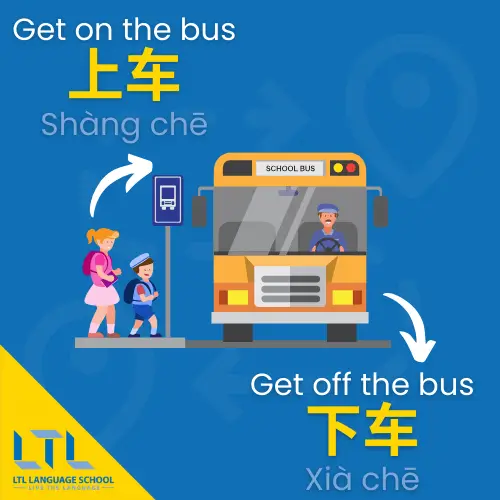
终点站 (zhōng diǎn zhàn) – Terminal station
这趟车的终点站是哪里?
Where is the terminal station for this route?走过 (zǒu guò) – Walk past
走过两个路口就到了。
Walk past two intersections and you’ll be there.Taxi and ride-hailing phrases
If you’re catching a taxi or DiDi (China’s main ride-hailing app), these phrases will get you where you need to go:
- 师傅,去… (Shīfu, qù…) – Driver, please take me to…
- 在这里停 (zài zhèlǐ tíng) – Stop here
- 往前走一点 (wǎng qián zǒu yīdiǎn) – Go a little further ahead
- 到了吗?(Dào le ma?) – Are we there?
TIP💡 Chinese addresses go from large to small, which is the opposite of English. You start with the city or district, then the street name, then the building number. So instead of ’25 Wangfujing Street, Dongcheng District, Beijing’, a Chinese address reads: 北京市东城区王府井大街25号 (Běijīng shì Dōngchéng qū Wángfǔjǐng dàjiē 25 hào). Knowing this helps enormously when reading maps or telling a driver your destination.
Keep practicing all these words. If you can recall them smoothly, you’ll have no trouble getting anywhere. For the numbers you’ll need along the way, check out Mandarin numbers and pinyin.
Want to put these directions into real conversations with a native speaker?
Find your perfect Mandarin program and start practising in context from day one.
Directions in Chinese – QUIZ

BONUS: Why not check out how to say Directions in Japanese and Directions in Spanish!
Directions in Chinese || FAQs
How do you say Up in Chinese?
Up
xiàng shàng
向上
How do you say North in Chinese?
North
běi
北
How do you say Down in Chinese?
Down
xiàng xià
向下
How do you say South in Chinese?
South
nán
南
How do you say West in Chinese?
West
xī
西
How do you say East in Chinese?
East
dōng
东
How do you say Left & Right in Chinese?
Left
zuǒ biān
左边
Right
yòu biān
右边
What are the four cardinal directions in Chinese?
The four cardinal directions in Chinese are: 东 (dōng) for East, 南 (nán) for South, 西 (xī) for West, and 北 (běi) for North.
A quick way to remember them: think of the sun rising in the East (东), setting in the West (西), warming the South (南), and pointing toward the cold North (北).
Chinese traditionally orders these as 东南西北 (East-South-West-North), which is different from the English North-South-East-West sequence.
How do you say northeast (and other intercardinal directions) in Chinese?
Combine the cardinal directions by putting East or West first, then North or South: 东北 (dōngběi) is Northeast, 东南 (dōngnán) is Southeast, 西北 (xīběi) is Northwest, and 西南 (xīnán) is Southwest. For example: 往东北方向走 (wǎng dōngběi fāngxiàng zǒu) means ‘walk in a northeast direction’.
How do you say navigation in Chinese?
Navigation in Chinese is 导航 (dǎoháng). In everyday speech you’ll hear 开导航 (kāi dǎoháng), which means ‘turn on navigation’ or ‘use GPS’.
Related terms include 方向 (fāngxiàng, direction/orientation) and 路线 (lùxiàn, route).
How do you ask for directions politely in Chinese?
Always open with a polite phrase before asking.
The two most useful openers are: 请问 (qǐngwèn), which means ‘Excuse me, may I ask…’, and 不好意思 (bù hǎo yì si), which means ‘Sorry to bother you’ or ‘Excuse me’.
Then follow with your question, for example: 请问,最近的地铁站在哪里?(Qǐngwèn, zuìjìn de dìtiězhàn zài nǎlǐ?) means ‘Excuse me, where is the nearest metro station?’
How do you say ‘go straight’ in Chinese?
Go straight is 直走 (zhí zǒu) or 一直走 (yīzhí zǒu). Both are widely used. For example: 一直走,过了红绿灯就到了。(Yīzhí zǒu, guòle hónglǜdēng jiù dào le.) means ‘Go straight, once you pass the traffic light you’re there.’
How do you say ‘turn left’ and ‘turn right’ in Chinese?
Turn left is 向左拐 (xiàng zuǒ guǎi) or 往左转 (wǎng zuǒ zhuǎn). Turn right is 向右拐 (xiàng yòu guǎi) or 往右转 (wǎng yòu zhuǎn). In spoken Mandarin, especially in northern cities, you’ll often hear the shorter forms 左拐 (zuǒ guǎi) and 右拐 (yòu guǎi).
What is the difference between 拐 (guǎi) and 转 (zhuǎn) for ‘turn’?
Both mean ‘turn’ when giving directions, but they have regional flavours. 拐 (guǎi) is more common in spoken Mandarin in northern cities; 转 (zhuǎn) is standard across all Chinese-speaking regions and is more formal. In practice, locals will understand either, so use whichever feels natural.
What is the correct traditional order of compass directions in Chinese?
The traditional Chinese order is 东南西北 (dōng-nán-xī-běi), East-South-West-North.
This order appears in many Chinese idioms and place names.
The word 东西 (dōngxī), for instance, literally means ‘east-west’ but is the everyday word for ‘things’ or ‘stuff’.
What common mistakes do learners make with direction words in Chinese?
Three common ones:
(1) Tone confusion on 左 (zuǒ, 3rd tone, ‘left’) versus 坐 (zuò, 4th tone, ‘sit’) or 作 (zuò, 4th tone, ‘do’).
(2) Mixing up 前 (qián, ‘front/forward’) and 钱 (qián, ‘money’), which share the same pinyin and tone, so context is essential.
(3) Word-order errors when using 在 for location: the location word comes after the reference landmark (银行在超市旁边, ‘the bank is next to the supermarket’), not before it as in English.
Want more from LTL?
If you wish to hear more from LTL Language School why not join our mailing list? We give plenty of handy information on learning Chinese, useful apps to learn the language and everything going on at our LTL schools!
Sign up below and become part of our ever-growing community!
⭐ Download our free ebook, your starter pack of essential Mandarin learning resources!
BONUS || Want to study Chinese with us in China? Why not check out our group and individual classes here








[…] Directions in Chinese […]
[…] you’re done check out directions in Chinese or basic mandarin phases for more helpful stuff to help you get around […]
[…] conversations at the dinner table with your host family, negotiations with a street food vendor, or offering directions to a taxi driver, your language abilities will constantly be […]
[…] public transport, mothers would push their children in my direction, urging them to practice their English with me (to no […]
[…] Taxi: Hop into a taxi and tell the driver either 798 艺术区 (qījiǔbā yìshù qū) or 大山子艺术区 (dàshān zi yìshù qū) and they’ll know where you’re talking about. They may ask you which gate you want to be taken to so this is a good chance to try out your directions in Chinese. […]
[…] If they respond positively and you think they understand you might be ready to learn some simple relative directions. […]
[…] Trying to learn directions in Chinese? […]
[…] also important to know your directions for yoga, as you’ll often be told to move left or right, up or down etc. Although, I’m […]
[…] However, further development of compasses during the Song dynasty (960 – 1279) did lead to them being used for navigation. […]
[…] Vedi tutta la lista di direzioni in cinese. […]
[…] Chinese, it’s ideal for anyone looking to master basic topics like greetings, family members, directions, visiting the pharmacy, […]