
Download Your FREE Pinyin Chart in Chinese & Learn Pinyin in Minutes
Starting to learn Chinese and in need of an easy to follow, downloadable Pinyin Chart?
You are in the right place!
A pinyin chart is a table of every syllable in Mandarin Chinese. The initials (opening consonants) run down the side, the finals (vowel endings) run across the top, and each filled square is a real syllable.
To read pinyin, split each syllable into its initial and final, then follow the tone mark over the vowel. Mandarin has four main tones plus a light neutral tone.
As always at LTL, our goal isn’t simply teaching our students Chinese, it’s teaching EVERYONE Chinese.
We spend hours behind the scenes creating excellent tools and useful things for you to get involved, from the comfort of you own sofa.
Want some examples?
- Free HSK Vocab Tests – We cover HSK 1 all the way through to HSK 6
- Free Chinese Vocab Tests – Measure Words, Radicals and even Chinese Proverbs
- Hundreds of super useful flashcards
- In depth Chinese app reviews to discover the best apps for learning Mandarin
… and trust us, there is plenty more!
Pinyin Chart || Download Yours FREE
Pinyin Chart || What is Pinyin?
Pinyin Chart || Initials and Finals
Pinyin Chart || Tricky Sounds for English Speakers
Pinyin Chart || More Examples of Initials and Finals
Pinyin Chart || Funny Mistakes You MUST Avoid
Pinyin Chart || Type Chinese with Tones
Pinyin Chart || FAQs
Pinyin Chart || Download Yours FREE
Today though, you want your FREE downloadable Chinese Pinyin Chart…
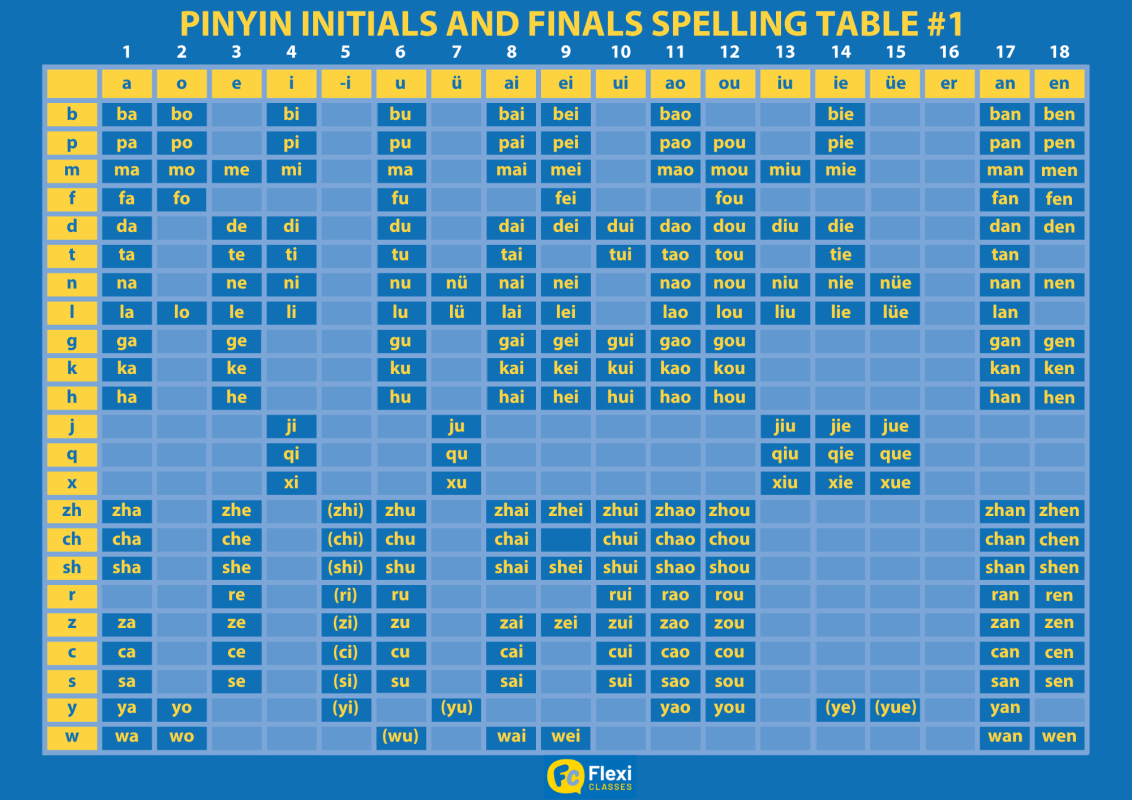
A pinyin chart is a grid of every sound in Mandarin Chinese. The initials (opening consonants) run down the side, the finals (vowel endings) run across the top, and each filled square is a real syllable. Empty squares are combinations Mandarin simply doesn’t use.
Standard Mandarin has only about 400 distinct syllables (around 410, depending on how you count). Add the tones and that grows to roughly 1,200 to 1,300 sounds, so every syllable you’ll ever say in Mandarin fits on one sheet of paper.
We’ll give you some context so you know what you’re looking at, because for a Chinese beginner, it can be a bit of a head spinner at first.
Pinyin Chart || What is Pinyin?
So when learning Chinese, a word is made up of Hanzi (Chinese characters) which look like this:
- 你好
- 我是
- 再见
Now of course as a newbie to Chinese, we have no idea how to read or interpret this, so what do we do?
LUCKILY FOR YOU, there’s pinyin: a system designed to help you read Chinese out loud.
You need it because written Chinese doesn’t spell out sounds at all. Each character stands for a meaning, which is why there’s no Chinese alphabet, and pinyin fills that gap for learners.
Its full name is Hanyu Pinyin (汉语拼音). It was officially adopted in 1958, after a team of linguists including Zhou Youguang spent several years developing it. Pinyin is the romanization of Chinese characters: it spells out how each one sounds using the Latin alphabet.
So if we take the above three examples the pinyin would be…
| Hanzi/Characters | Pinyin | Meaning |
|---|---|---|
| 你好 | nǐ hǎo | Hello |
| 我是 | wǒ shì | I am… |
| 再见 | zài jiàn | Goodbye |
Now we have a much more friendly way to read Chinese characters, and it’s the Pinyin that we focus on in our chart above.
Let’s try it on a phrase everyone wants to learn first. Read each syllable on its own, then say them together:
| Hanzi | Pinyin | English |
|---|---|---|
| 我 | wǒ | I |
| 爱 | ài | love |
| 你 | nǐ | you |
| 我爱你 | wǒ ài nǐ | I love you |
Notice that ài has no initial, only a final, and that wǒ and nǐ both carry the dipping third tone. 💡 Say it slowly at first, because a rushed tone is the quickest way to turn a love song into nonsense.
When you start to study Chinese, you will focus your earlier studies on Pinyin, as it will take time to learn and recognise Chinese characters.
As you become more adept and advanced, you will disregard pinyin entirely, but it’s essential for beginner and intermediate students.
EXAMPLE – Take the official HSK tests. Under the older six-level HSK, the HSK 1 and 2 papers printed pinyin alongside the characters, while HSK 3 and above used Chinese characters only.
The new HSK 3.0 has nine levels, grouped into three stages, and brings in handwriting from the early levels. Check the current exam format on chinesetest.cn before you count on seeing pinyin in your paper.
Pinyin Chart || Initials and Finals
So now we have an idea of what Pinyin is and how it can help us, we need to understand how to use it.
The good news: the system is very logical once you see the pattern.
Every Chinese syllable is made up of an initial (声母 shēngmǔ), a final (韵母 yùnmǔ) and a tone. A few syllables, like 爱 ài (love), have no initial at all.
Pinyin Initials (声母 shēngmǔ)
Mandarin has 21 initials, grouped by where your mouth makes the sound. y and w also appear at the start of syllables as spelling initials: 一 yī, 我 wǒ.
| Group | Initials | Examples |
|---|---|---|
| Lips | b, p, m, f | 八 bā, 怕 pà, 妈 mā, 饭 fàn |
| Tongue tip behind top teeth | d, t, n, l | 大 dà, 他 tā, 你 nǐ, 来 lái |
| Back of the mouth | g, k, h | 哥 gē, 看 kàn, 好 hǎo |
| Flat tongue | j, q, x | 几 jǐ, 去 qù, 谢 xiè |
| Curled tongue (retroflex) | zh, ch, sh, r | 中 zhōng, 吃 chī, 是 shì, 人 rén |
| Tongue tip against teeth | z, c, s | 在 zài, 菜 cài, 三 sān |
Pinyin Finals (韵母 yùnmǔ)
Depending on how you count them, there are 35 to 39 finals. They fall into five families.
| Type | Finals | Examples |
|---|---|---|
| Simple vowels | a, o, e, i, u, ü | 八 bā, 我 wǒ, 喝 hē, 你 nǐ, 不 bù, 女 nǚ |
| Compound vowels | ai, ei, ao, ou, ia, ie, iao, iu, ua, uo, uai, ui, üe | 爱 ài, 北 běi, 好 hǎo, 都 dōu, 家 jiā, 谢 xiè, 小 xiǎo, 六 liù, 话 huà, 说 shuō, 快 kuài, 水 shuǐ, 学 xué |
| Front nasal (-n) | an, en, in, ian, uan, un, ün, üan | 看 kàn, 很 hěn, 您 nín, 见 jiàn, 欢 huān, 春 chūn, 群 qún, 远 yuǎn |
| Back nasal (-ng) | ang, eng, ing, ong, iang, iong, uang, ueng | 忙 máng, 冷 lěng, 听 tīng, 中 zhōng, 想 xiǎng, 熊 xióng, 黄 huáng, 翁 wēng |
| Special | er | 二 èr |
These are all listed in the Pinyin Chart above, but again, taking our three examples from before, this is how they break down
| Hanzi | Pinyin | Initials | Finals |
|---|---|---|---|
| 你好 | nǐ hǎo | n & h | ǐ & ǎo |
| 我是 | wǒ shì | w & sh | ǒ & ì |
| 再见 | zài jiàn | z & j | ài & iàn |
Makes sense so far? Once you can split a syllable like this, reading the chart gets much faster.
An easy way to discover where the initial ends and the final starts is to use the tonal mark.
The tone mark always sits on a vowel inside the final, never on the initial. So the initial is simply the consonant (or pair, like zh, ch or sh) in front of it.
Which vowel gets the mark follows a fixed order:
- If the final has an a or an e, that letter takes the mark: hǎo, xiè.
- In ou, the o takes it: dōu.
- Otherwise the mark goes on the last vowel: shuǐ, liù, guó.
TIP💡 Can’t type tone marks? Use our Pinyin Converter to add tone marks to pinyin by typing numbers, so hao3 becomes hǎo.
Just to nail that point home, here is our wonderful friend Amy illustrating these exact points in a super quick-fire two minute video.

The Four Tones and How They’re Marked
You’ll have noticed we mentioned tones before. Mandarin has four main tones plus a light neutral tone, and the mark over the vowel tells you which one to use.
| Hanzi | Pinyin | Meaning | Tone | Mark | Pitch (1 low to 5 high) |
|---|---|---|---|---|---|
| 妈 | mā | mother | 1st: high and flat | ¯ | 5-5 |
| 麻 | má | hemp | 2nd: rising, like a question | ˊ | 3-5 |
| 马 | mǎ | horse | 3rd: dips down, then rises | ˇ | 2-1-4 |
| 骂 | mà | to scold | 4th: sharp fall | ˋ | 5-1 |
| 吗 | ma | question particle | Neutral: short and light | none | depends on the tone before |
The neutral tone (轻声 qīngshēng) has no mark at all. You’ll hear it on the second syllable of words like 妈妈 māma (mum) and on little particles like 吗 ma and 的 de.
Third tone sandhi is the rule that when two third tones meet, the first one is said as a second tone, so 你好 nǐ hǎo sounds like ní hǎo. The pinyin keeps the original marks.
For tricks to remember the four tones, our full tones guide has you covered.
Tones are one thing that scares many beginners to Mandarin – don’t let them.
And if that wasn’t enough material, Amy is back with another visual look at how the four tones work in Chinese, complete with initials and finals, aren’t we good to you!
Pinyin Chart || Tricky Sounds for English Speakers
Most pinyin letters sound roughly how you’d expect. A handful don’t, and they trip up almost every beginner, so here’s how to make them.
j, q, x vs zh, ch, sh
These two sets sound alike to English ears, but your tongue does very different things.
- j, q, x: keep the tip of your tongue down behind your lower teeth and press the flat middle of the tongue up toward the roof of your mouth, lips slightly spread. They are only ever followed by an i or ü sound.
- zh, ch, sh, r: these are the retroflex initials. Curl the tip of your tongue up and back, just behind the ridge above your top teeth. r sits somewhere between the r in “run” and the s in “pleasure”.
Read this table in pairs:
| Hanzi | Pinyin | Meaning |
|---|---|---|
| 鸡 | jī | chicken |
| 知 | zhī | to know |
| 七 | qī | seven |
| 吃 | chī | to eat |
| 西 | xī | west |
| 诗 | shī | poem |
The ü Sound
To make ü, say “ee”, then round your lips as if you were about to say “oo”, keeping your tongue where it is. There’s no English equivalent, so expect to practise this one.
After j, q, x and y the two dots are dropped, because a plain u can never follow those letters anyway: 去 qù (to go), 鱼 yú (fish). After n and l the dots stay, since 女 nǚ (woman) and 怒 nù (anger) are different syllables. On most keyboards you type ü as v.
-n vs -ng Finals
-n is a front nasal: finish with the tip of your tongue pressed against the ridge behind your top teeth, as in “ran”. -ng is a back nasal: the tongue tip stays low and the back of the tongue rises to the soft palate, as in “sang”.
| Hanzi | Pinyin | Meaning |
|---|---|---|
| 三 | sān | three |
| 桑 | sāng | mulberry |
| 金 | jīn | gold |
| 京 | jīng | capital, as in 北京 Běijīng |
er and the Beijing “r”
er is the only final that always stands alone, with no initial: 二 èr (two), 儿 ér (son). It sounds close to an American “are” said with a relaxed jaw.
In Beijing you’ll also hear an r added to the end of words, a habit called érhuà (儿化): 哪儿 nǎr (where), 一点儿 yìdiǎnr (a little). It’s typical of northern speech, and people elsewhere will understand you fine without it.
Hearing the Sounds
Our PDF is a printable visual chart, so it doesn’t play audio. To hear initials, finals and all four tones spoken out loud, watch Amy’s two videos above.
Then practice your Chinese pronunciation with our Pronunciation Trainer and say each pair from the tables above until they stop sounding the same.
Pinyin Chart || More Examples of Initials and Finals
We’ve given the same three examples above but just to help you out further here are some more examples of how Chinese words are broken down using initials and finals.
This is just 10 of many possible combinations which we picked at random.
| Hanzi | Pinyin | Initial | Final | Meaning |
|---|---|---|---|---|
| 单 | dān | d | ān | single |
| 水 | shuǐ | sh | uǐ | water |
| 啰 | luō | l | uō | as in 啰嗦 luōsuo, long-winded |
| 捞 | lāo | l | āo | to scoop up |
| 镇 | zhèn | zh | èn | town |
| 糖 | táng | t | áng | sugar |
| 说 | shuō | sh | uō | to speak |
| 几 | jǐ | j | ǐ | how many |
| 圈 | quān | q | uān | circle |
| 桌 | zhuō | zh | uō | table (as in 桌子 zhuōzi) |
There’s ten examples of initials and finals at work.
Now put pinyin to work on the numbers 1 to 10. They’re the first words most learners use out loud, so they make great reading practice.
| Hanzi | Pinyin | English |
|---|---|---|
| 一 | yī | One |
| 二 | èr | Two |
| 三 | sān | Three |
| 四 | sì | Four |
| 五 | wǔ | Five |
| 六 | liù | Six |
| 七 | qī | Seven |
| 八 | bā | Eight |
| 九 | jiǔ | Nine |
| 十 | shí | Ten |
💡 Watch the pair sì (four) and shí (ten). They only differ by the initial, s versus sh, and by the tone, so say them back to back until you can hear the difference.
It’s important to be able to differentiate between initials and finals because this will be a big help when pronouncing words as you move forward with Chinese.
Understanding how words are built and structured is one of the first things to master – when that becomes apparent you start to see real progress.
It’s also worth remembering in Chinese, because of the limited number of initials and finals there are only a certain number of possible combinations.
This means many words in Chinese have the same pinyin.
SHI is a great example of this. Take these words here:
| Hanzi | Pinyin | Meaning |
|---|---|---|
| 是 | shì | to be / is |
| 市 | shì | market / city |
| 十 | shí | ten |
| 时 | shí | time |
| 食 | shí | meal / food |
| 使 | shǐ | make / cause / use |
| 式 | shì | type / style |
| 石 | shí | stone / rock |
| 世 | shì | life / generation |
| 事 | shì | a matter / thing |
There’s one to spin you out! 10 completely different words, but the same pinyin (just note the different tones for pronunciation)
Why does this happen?
It happens for the reason we mentioned above.
Because there are a limited number of initials and finals, there are only a certain number of possible combinations.
That’s kind of good news and bad news depending on if you are a glass half full or empty person!
There are less combinations to remember meaning words in theory, should be easier to remember.
However, it then becomes easy to confuse words with the wrong tones which can of course lead to some rather embarrassing mistakes…
Pinyin Chart || Funny Mistakes You MUST Avoid
You guessed it, because of the lesser combinations, it means innocuous mistakes can be made very easily, for all levels of Chinese speaker!
We highlighted five great examples in a post which we’ll link below, but to give you a taster here is one of those examples!
SPOILER – Wife and Boss have the same initials and finals in Chinese! Clever beggars who invented Chinese 🤔 Laughing away at our expense!
lǎo bǎn: boss
lǎo bàn: wife
Could lead to…
- Wǒ zhēn de bù xǐhuan wǒ de lǎobǎn, Wǒ yào huàn yīgè xīn de.
- I really don’t like my boss, I want a new one.
- Wǒ zhēn de bù xǐhuan wǒ de lǎobàn, Wǒ yào huàn yīgè xīn de.
- I really don’t like my wife, I want a new one.
Check out the other four funny mistakes made commonly by students of Mandarin here.
There we have it.
You’ve got your brand new Chinese Pinyin Chart to use whenever you please, you’ve got a tonne of new resources you didn’t know about and a handy pocket guide to Chinese initials and finals, what more could you want!?
Well… if you’re craving further material we have no doubt you will love our Instagram and YouTube channels which are jam packed full of superb Mandarin learning content… here’s a taster before we leave you!
Our YouTube Channel
A quick taster of what you can expect…

Our Instagram Channel
Another taster of what’s on show every week.


Pinyin Chart || Type Chinese with Tones

We do have one more resource for you also, and this is a good one.
You’ll find when typing pinyin on a western keyboard you cannot type the tonal marks and this is actually a big negative when learning because tones are essential.
How to get around this?
Oh yes, your friends at LTL have your back covered well and truly because we created this super-cool Pinyin Converter which allows you to type Chinese with tones (simply by using numbers).
Want to try it out? Go ahead, be our guest, and let us know below what you think.
Pinyin Chart || FAQs
What is Pinyin?
Essentially Pinyin is romanized Chinese characters.
Its full name is Hanyu Pinyin (汉语拼音). It was officially adopted in 1958, after a team of linguists including Zhou Youguang spent several years developing it. Pinyin is the romanization of Chinese characters: it spells out how each one sounds using the Latin alphabet.
You need it because written Chinese doesn’t spell out sounds at all. Each character stands for a meaning, which is why there’s no Chinese alphabet, and pinyin fills that gap for learners.
What is “Pinyin” in Chinese characters?
拼音
Can I get a downloadable PDF of all the Chinese Pinyin?
Absolutely, we made a full colour Chinese Pinyin chart you can download here.
It’s a printable PDF, so you can stick it on your wall or keep it on your phone.
What’s the difference between Pinyin and Chinese Characters?
Characters (or Hanzi) are, for example – 我 是 and 你
Pinyin is the romanized version, for example wǒ shì and nǐ
Is Pinyin ever the same for multiple words?
Yes, many in fact, because the combinations of Initial and Final are actually not that many.
Here’s a funny/dangerous example.
lǎo bǎn: boss
lǎo bàn: wife
MORAL? Learn your tones!
What is a pinyin chart?
A pinyin chart is a grid of every sound in Mandarin Chinese. The initials (opening consonants) run down the side, the finals (vowel endings) run across the top, and each filled square is a real syllable.
Empty squares are combinations Mandarin doesn’t use. Standard Mandarin has only about 400 distinct syllables, so the whole system fits on one sheet of paper.
What is “I love you” in pinyin?
“I love you” in Chinese is 我爱你, written in pinyin as wǒ ài nǐ. 我 wǒ means I, 爱 ài means love and 你 nǐ means you.
Both wǒ and nǐ carry the dipping third tone, while ài has a falling fourth tone and no initial. Say it slowly at first so each tone comes out clearly.
How do you say 1 to 10 in Chinese?
The numbers 1 to 10 in pinyin are yī (一), èr (二), sān (三), sì (四), wǔ (五), liù (六), qī (七), bā (八), jiǔ (九) and shí (十).
Watch the pair sì (four) and shí (ten). They differ only by the initial, s versus sh, and by the tone, so practise them back to back.
Want more from LTL?
If you wish to hear more from LTL Language School why not join our mailing list? We give plenty of handy information on learning Chinese, useful apps to learn the language and everything going on at our LTL schools!
Sign up below and become part of our ever-growing community!
⭐ Download our free ebook, your starter pack of essential Mandarin learning resources!
BONUS || Want to study Chinese with us in China? Why not check out our group and individual classes here






[…] example, below the pinyin ‘jiu dian’ was typed. This, amongst other things, could mean either hotel, or 9 […]
Very nice content, super helpful
Thanks Tim!
Chart downloaded! Love it, well designed
That's great to hear! Well done Heidi and thanks for the comment
Xie xie
This is great for beginners
Thanks for the kind words Gerald
[…] find the dialogue with the hanzi, pinyin and English translation in the description of each episode, so it’s an easy series to follow […]
Chinese here... in the chart there are two "i"s one is "i" one is "-i". what are the differences?
[…] order to do this, it’s important to learn both pinyin (Chinese written with English letters) and the four […]
Great content. Lots of things explained well.
Glad you found it useful!