
Chinese Slang // 70+ Ways To Speak Like A Native
Chinese slang (俚语, lǐyǔ) is the informal Mandarin people use with friends and online. It ranges from number codes like 666 (awesome) and 520 (I love you) to letter shortcuts like YYDS and buzzwords such as 躺平 (tǎng píng, lying flat).
Most of it spreads on WeChat, Weibo, Douyin and Xiaohongshu, while spoken slang changes from city to city. Use it casually, not in formal settings or exams.
Most spoken Chinese slang comes from different dialects.
Depending on where you’re learning Chinese, your accent will most probably change to use the local slang if you’re speaking and hanging out with the locals.
Whether you’re in Beijing, Shanghai or Taipei, the local street slang sounds very different.
In Beijing, for example, you’ll hear the famous 儿 (er) sound tacked onto words, plus a handful of local favourites you won’t find in your textbook:
| Slang | Pinyin | Meaning |
|---|---|---|
| 没门儿 | méi ménr | No way, not a chance |
| 哥们儿 | gēmenr | Buddy, mate (a close male friend) |
| 倍儿 | bèir | Super, really (倍儿棒 bèir bàng = really great) |
| 局气 | júqi | Generous and decent, a stand-up person |
| 溜达 | liūda | To stroll or wander around |
So without beating around the bush, let’s get straight into the good stuff: the Chinese slang you’ll actually hear in cafés, classrooms and group chats, from classics like 666 to the newer buzzwords people are using in 2026.
Slang moves fast, so we flag which terms are rude, which are safe with friends and which are starting to sound a bit dated. 💡
Chinese Slang || Internet Slang
Chinese Slang || Chinese Slang Using Numbers
Chinese Slang || Chinese Slang Using Letters
Chinese Slang || Chinese Slang About Society
Chinese Slang || FAQs

Internet Slang
One thing Chinese slang has in common throughout the entirety of China is the use of Chinese slang on the internet.
If you’re using Chinese social media websites (which by the way is a great way to immerse yourself into Chinese culture, get Chinese friends and learn Chinese) such as WeChat, Weibo, Douyin, Xiaohongshu (RedNote) or QQ, you may be a bit confused at first by how much slang is flying around.
WeChat is where you’ll meet most of it day to day. Classmates, host families and colleagues drop number codes like 88 and 666 or letter shortcuts like XSWL straight into group chats, while brand new buzzwords tend to catch on in Weibo, Douyin and Xiaohongshu comment sections.
The amount of numbers that float around with apparently no meaning in comments is clear from the beginning. We’ll come to this shortly!
Also, you will see a large amount of random capital letters amongst the Chinese Characters that also appear to have no meaning.
Actually, all of these colloquial expressions of numbers and letters all have a very specific meaning and all have a (somewhat) logical origin.
You’ll discover some of these as you read on…
光想青年 (guāng xiǎng qīngnián)
光想青年 (guāng xiǎng qīngnián) refers to young people who proclaim to have many ideas and or many intentions to do things.
However, when it comes down to it they end up just procrastinating and not putting any of them into practice.
For example someone who always says that they want to improve their Chinese and will sign up for online classes but then they never actually get round to doing it.
绿茶婊 (lǜchá biǎo)
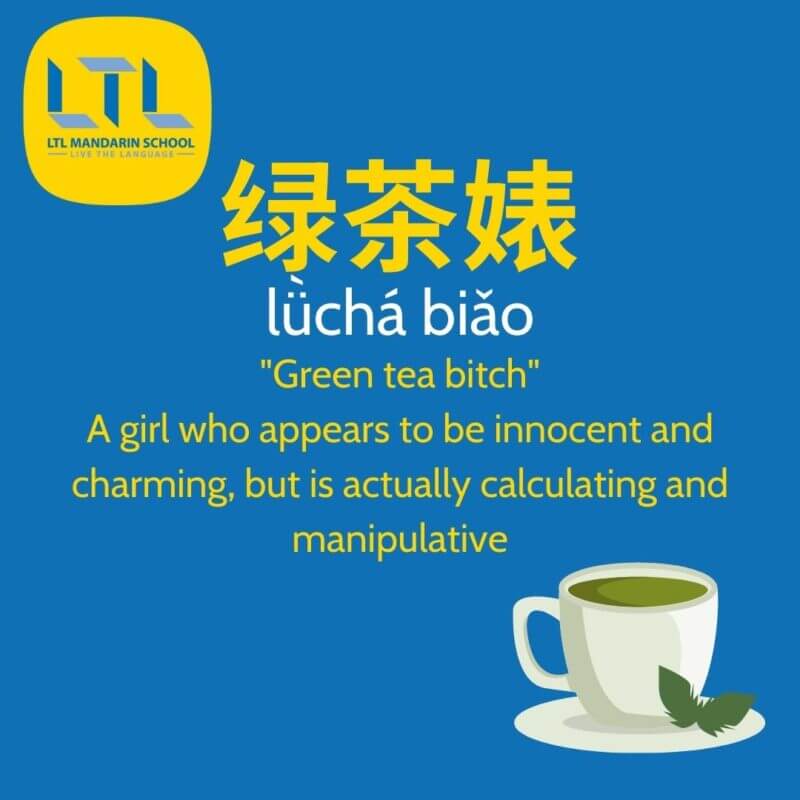
Green tea bitch is an internet slang term used to describe a girl who appears to be innocent and charming….
But in fact the girl is only faking this and is actually calculating and manipulative.
It’s unclear why exactly the term “green tea” was used.
Some people think it’s because many green tea commercials use innocent looking female models to represent the “purity” of green tea.
宅 (zhái)
The word 宅 (zhái) means residence or house but has now become slang to refer to someone who is a bit antisocial.
宅 basically describes someone who enjoys just hanging out at home or who will refuse invitations to go out and prefer prefers to stay at home.
小鲜肉 (xiǎo xiān ròu)
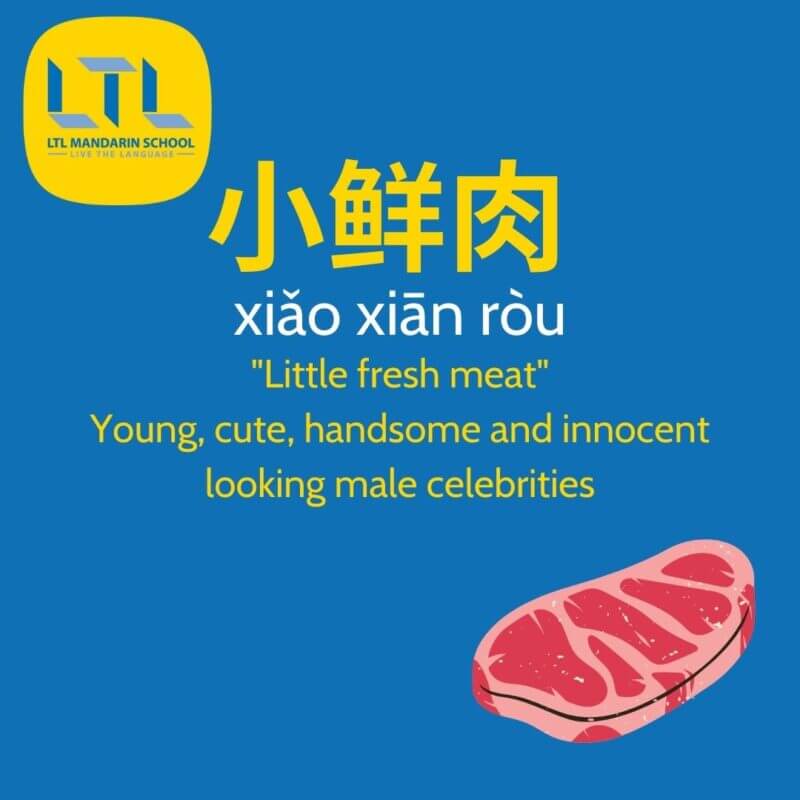
小鲜肉 (xiǎo xiān ròu) literally translates to “little fresh meat” which perhaps sounds like something you’d order off the menu at a Chinese hotpot restaurant.
However, this is actually used to describe young, cute, handsome and innocent looking male celebrities, or “male idols” as they’re often called.
They are normally between the ages of of 12 and 25.
Over the past decade, beauty standards in China have shifted so that guys with softer, more androgynous looks are often seen as the most handsome, especially by younger fans of idol groups.
Originally, it was used on celebrities such as popular K-Pop stars, but now it can refer to ordinary guys as well, as long as they fit the criteria.
比心 (bǐxīn)
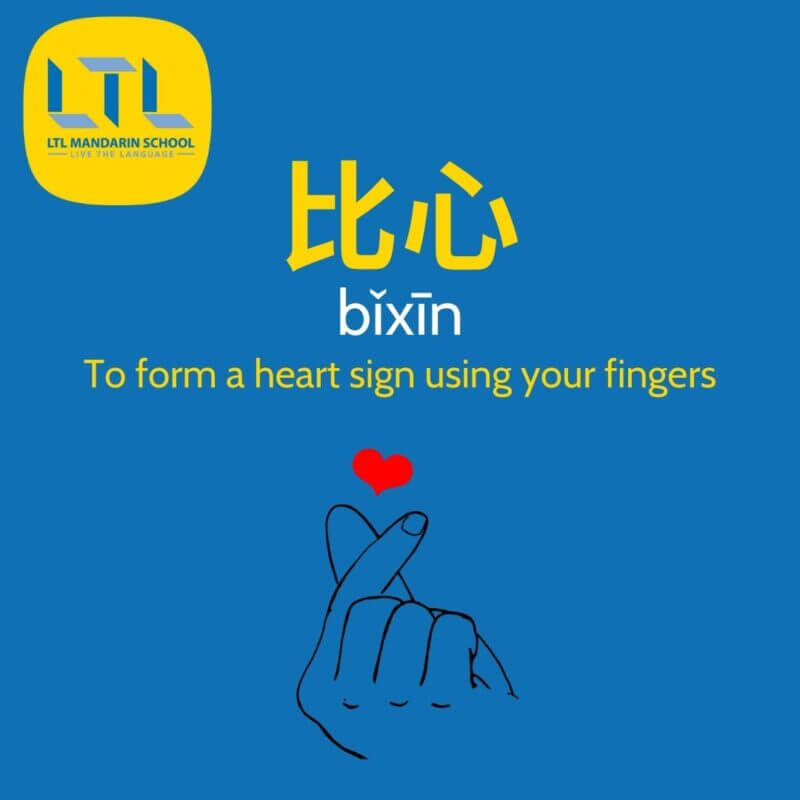
If you follow any Chinese celebrities on social media we guarantee that you will have seen them posing with a 比心 (bǐxīn).
比心 (bǐxīn) means to form a finger heart which is a gesture in which a person forms a heart shape using their fingers.
The finger heart took over Chinese social media several years ago and is now a standard photo pose alongside the classic peace sign. You’ll still see idols, livestreamers and your classmates flashing one at the camera.
一起爬山吗? (yìqǐ páshān mɑ?)

Now we have quite a funny slang that became a super popular meme in 2020.
The Chinese 一起爬山吗 (yìqǐ páshān mɑ?) seems simply like the innocuous question “Want to go on a hike?”, however it actually has much darker undertones.
What the phrase has actually come to mean is that it’s a “death invitation” or 死亡邀约 (sǐwáng yāoyuē).
It comes from the 2020 hit drama The Bad Kids where the opening scene of the first episode is of one of the main characters pushing his in-laws off a cliff (ouch).
After the series went viral memes with the caption 一起爬山吗? (yìqǐ páshān mɑ?) started popping up all over Chinese social media.
凡尔赛文学 (fáněrsài wénxué)
You might already be familiar with the word 凡尔赛 (fáněrsài) as the transliteration of the French palace Versailles. Added to this is 文学 (wénxué) meaning literature but no this slang isn’t talking about Versaille literature.
Instead it’s a term used to describe “the humble brag” it refers to people who flaunt their wealth or or success in a subtle way.
It comes from the Japanese manga series “The Rose of Versailles” a story about the lavish lifestyle of Marie Antoinette, who is linked to the phrase “let them eat cake”, although historians consider that quote wrongly attributed to her.
柠檬精 (nínɡménɡ jīnɡ)
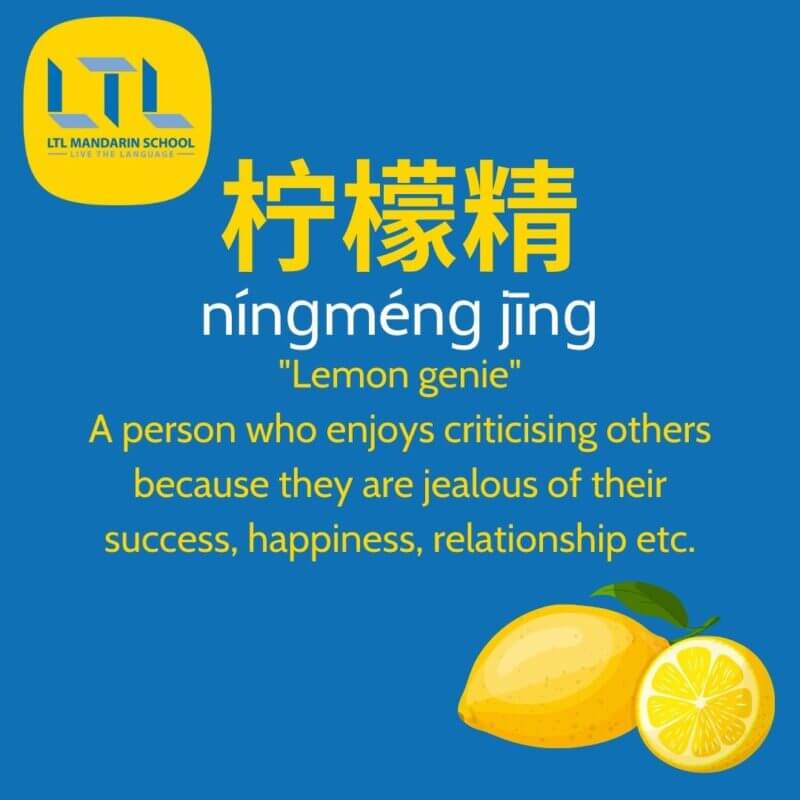
柠檬精 (níngméng jīng) can be broken down into two parts:
柠檬 (nínɡménɡ) which means lemon.
精 (jīnɡ) which means genie or spirit.
Hmmm so what on earth could “lemon genie” be a slang term for?
Well it refers to people who enjoy criticising others because they are jealous of their success, happiness, relationship etc.
我太难了 (wǒ tài nán le)
A phrase that became very popular in 2019 我太难了 (wǒ tài nán le) means “my life is really hard”.
The term originated on a Chinese video-sharing app where the celebrity Brother Giao talked about how much pressure he was under having to meet a lot of deadlines etc. and said 我太难了 (wǒ tài nán le).
The video went viral and Chinese netizens created some very funny animated emojis, some people also switch the 难 for “南” (meaning “south”) to make it even more amusing (as in things are going south).
你行你上 (nǐ xíng nǐ shàng)

你行你上 (nǐ xíng nǐ shàng) literally means “you can you up”.
In fact, sometimes you will also see it posted in English this way rather than Chinese.
The phrase originated during an argument between Chinese basketball fans and means “If you can do it, then get up and do it”.
Newer Chinese Internet Slang for 2026
Slang from 2019 and 2020 like 我太难了 still gets a laugh, but these are the words you’ll hear from younger friends and see all over Douyin, Weibo and Xiaohongshu in 2026.
| Slang | Pinyin | Meaning |
|---|---|---|
| 吃瓜 | chī guā | ‘Eating melon’: watching gossip or drama from the sidelines |
| 吃瓜群众 | chī guā qúnzhòng | The ‘melon-eating masses’, nosy onlookers |
| 社恐 | shè kǒng | Socially anxious, someone who dreads social situations |
| 社牛 | shè niú | Fearlessly outgoing, the opposite of 社恐 |
| 社死 | shè sǐ | ‘Social death’: dying of embarrassment in public |
| 破防了 | pò fáng le | ‘My defences are broken’: that hit me hard emotionally |
| 显眼包 | xiǎnyǎn bāo | A lovable show-off who always stands out |
| 淡人 | dàn rén | A super chill, unbothered person |
| 浓人 | nóng rén | An intense, highly expressive person |
| 活人感 | huó rén gǎn | Feeling genuinely human, natural and unpolished |
See them in sentences
| Chinese | Pinyin | English |
|---|---|---|
| 我就是来吃瓜的。 | Wǒ jiù shì lái chī guā de. | I’m just here for the drama. |
| 我是社恐,你帮我点菜吧。 | Wǒ shì shè kǒng, nǐ bāng wǒ diǎn cài ba. | I’m socially awkward, can you order for me? |
| 这个视频让我破防了。 | Zhège shìpín ràng wǒ pò fáng le. | This video totally got to me. |
| 他真是个显眼包。 | Tā zhēn shì ge xiǎnyǎn bāo. | He’s such a show-off (in a fun way). |
TIP💡 社恐 is usually a joke about everyday shyness, not a medical label, so it’s fine to use about yourself in casual chat. Just don’t pin it on someone you’ve just met.
Chinese Slang Using Numbers
Many Chinese numbers sound very similar to other characters, so people use them as quick homophone codes. It’s the same love of puns, wordplay and internet humour that a lot of Chinese jokes are built on.
Chinese people can be very creative in this way when they create new colloquial expressions.
This is especially true in the form of internet slang with numbers!
On that note, it’s a good idea for us to learn the numbers in Chinese.
Don’t worry it’s super quick and simple…

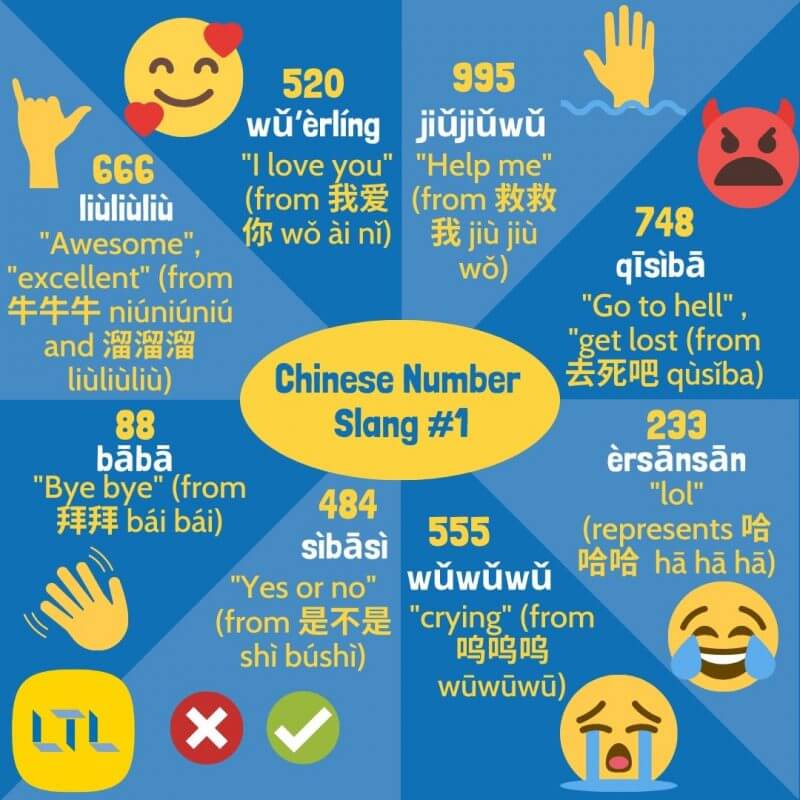
666
Probably the most common number you’ll see on the Chinese internet, 666 (liùliùliù) sounds like 溜溜溜, from 溜 (liù), a colloquial word for slick, smooth or skilled. It started as gamers’ shorthand for ‘nice move’ and now just means awesome, a bit like saying 很牛 (hěn niú).
| Chinese | Pinyin | English |
|---|---|---|
| 你这波操作太666了! | Nǐ zhè bō cāozuò tài liùliùliù le! | That move was awesome! |
Heads up: when a livestreamer messes up, a flood of 666 in the comments is usually sarcastic.
It definitely doesn’t have anything to do with the English meaning of this slang term which is often related to the Devil.
When using colloquial Chinese slang, you will also hear younger people using street slang saying this.
This can also be represented by holding your hand up to represent the number 6 in Chinese counting number language and waving it around.
777
777 (qīqīqī) is 666 turned up a notch. When someone pulls off something even more impressive, gamers and livestream viewers type 777 (or a long string of 7s) to say ‘even better than 666’.
There’s no hidden homophone behind this one. It plays on 666 and on the jackpot 777 of a slot machine, so you’ll mostly see it in gaming chats and livestream comments rather than hear it out loud.
520
Probably the second most common phrase you will see on internet slang or hear as street slang, especially around the date 5/20. (20th May). This date is Chinese internet Valentine’s Day.
This is due to the fact that 520 (wǔ’èrlíng) represents 我爱你 wǒ ài nǐ which is Chinese for “I love you”

How Many Chinese Valentine’s Days Are There? 💕 Don’t Forget the Dates!
Dealing with one Valentines Day per year is too much for many 💕 Well, count yourself lucky you’re not celebrating a Chinese Valentines Day.
995
995 (jiǔ jiǔ wǔ) stands for 救救我 (jiù jiù wǒ) meaning ‘Help me!’
Not sure why you would need to use this one on internet slang or street slang, but it a common colloquial expression used in Chinese slang – perhaps sometimes used in an amusing or ironic way.
748
748 in pinyin is qīsìbā. This represents 去死吧 (qùsǐba).
This is pretty much a translation for “Go to hell“, “Get lost”, or, more literally “Go die!”.
88
“Bye bye” in Chinese also means the same as in English, goodbye.
88 (bābā) sounds like 拜拜 (bàibài), the Chinese way of saying ‘bye bye’. Add a 6 and you get 886 (bābāliù), which sounds like 拜拜了 (bàibài le), ‘bye then!’.
Both are casual and a little old school now, so they’re fine with friends on WeChat but not in an email to your teacher.
233
233 represents the sound of laughter.
The pinyin is èr sān sān which is similar to the 哈哈哈 (used as ‘lol’) which sounds like ‘hā hā hā‘.
555
Like how 233 represents the sound of laughter 555 (wǔwǔwǔ) represents the sound of crying.
This comes from the characters 呜呜呜 (wūwūwū), which you have to admit does sound a lot like someone crying!
484
484 (sìbāsì) is similar to the 是不是 (shì búshì) meaning yes or no.

530
The pinyin for this one is wǔsānlíng which sounds like the Chinese for “I miss you” which is 我想你 (wǒ xiǎng nǐ).
1314
You’ll usually see 1314 (yīsānyīsì) after a phrase such as I love or even the slang 520, can you guess what it means?
It comes from the Chinese 一生一世 (yīshēng yīshì), which means “forever” or “for a whole lifetime”. Put the two codes together and 5201314 reads as ‘I love you forever’.
4242
Say this one aloud (sìèrsìèr) and you might be able to tell what it is.
This one represents saying “Yes” which in Chinese can be 是啊是啊 (shìa shìa).
7456
7456 is Chinese number slang that means “I’m so angry”. 7456 (qīsìwǔliù) sounds like 气死我了 (qìsǐ wǒ le), literally ‘it’s making me so angry I could die’. It’s the number version of QSWL, which you’ll meet further down.
918
Now this one you will see a lot whenever someone is sending encouraging thoughts. 918 (jiǔyāobā) represents the phrase 加油吧 (jiāyóu ba) which means “good luck” or “come on!”.
Fun fact 加油 (jiāyóu) literally means to “add oil” and can also be used to mean refuel.
514
The pinyin for this one is wǔyāosì which sounds like you’re saying 我要死 (wǒ yào sǐ) which means “I want to die”. Yes, this may seem a little over dramatic, but hey that’s the world of Chinese netizens after all!
56
If someone sends a 56 your way prepare to be insulted as 56 (wǔliù) means “boring” or 无聊 (wúliáo) in Chinese.
996
996 is an interesting one that relates to the long, hard working culture in China.
- 9 – 9am start
- 9 – 9pm finish
- 6 – 6 days a week
This is a fairly common concept in China (mainly in tech companies or startups) and for those of you not so keen on maths, that’s 72 hours every working week, with just Sunday off to enjoy.
And guess what 996 workers generally like to do on a Sunday… yep you guessed it! Sleep 😴
250
Lastly on our list of Chinese slang that uses numbers we have 250 èrbǎiwǔ which means “idiot”.
Unlike most of the other number slang phrases on our list this one doesn’t represent a phrase that it sounds similar to. Instead 250 actually refers to an ancient Chinese saying for idiot.
Basically in ancient China they used a currency called 吊 diào and 1000 was a unit or “stack” of that currency.
So half a 吊 diào was a 半吊子 bàndiàozi or 500.
To show modesty scholars would say they were a 半吊子 bàndiàozi or “half a stack” to be self deprecating.
Then half of 500 is 250, so to not even be a half stack you really must be an idiot!
Chinese Slang Using Letters
We aren’t finished there! Time to switch numbers for letters.
Here’s our favourites with explanations.
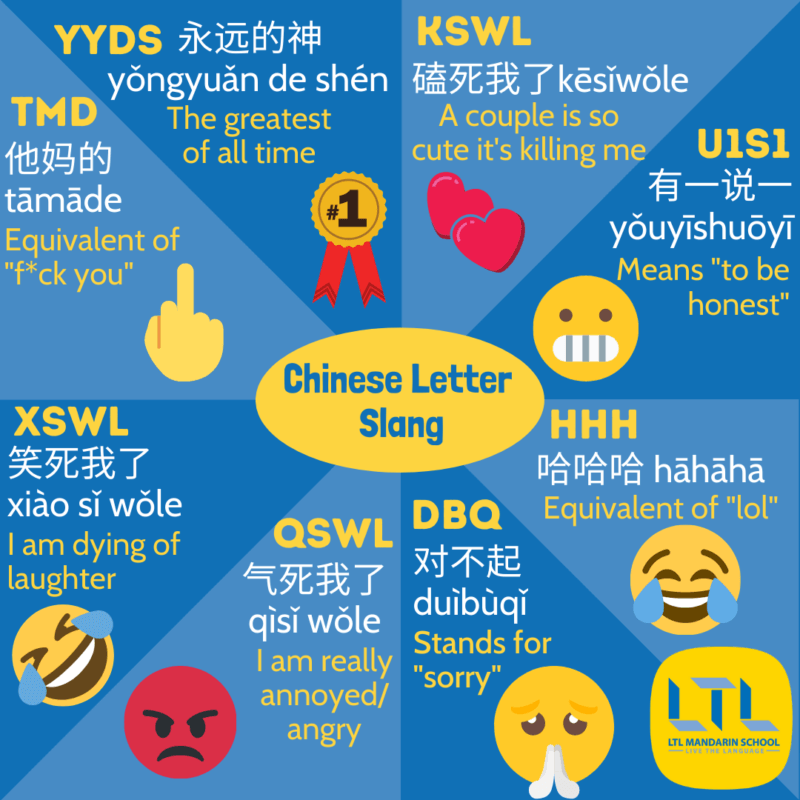
TMD
TMD stands for 他妈的 (tāmāde) and should not be thrown around and is probably best used amongst friends only…
It’s basically used as a way to express extreme annoyance, similar to saying ‘F*ck you’ in English.
We’ve got a load more featuring letters on our Chinese Swear Words blog we are sure you’ll love also!
YYDS
YYDS is like the equivalent of GOAT in English, which stands for the greatest of all time.
| Chinese | Pinyin | English |
|---|---|---|
| 这家火锅YYDS! | Zhè jiā huǒguō YYDS! | This hotpot place is the GOAT! |
It’s an abbreviation of the Chinese 永远的神 (yǒnɡyuǎn de shén) which literally means “forever the God”.
It took off around 2020, when the streamer 山泥若 (Shān Ní Ruò) praised his idol Uzi, a League of Legends star, by shouting 乌兹,永远的神 (Wūzī, yǒngyuǎn de shén), ‘Uzi, forever the god’. Fans repeated it in livestream chats until it spread far beyond gaming, and today it’s playful, informal praise for anything from a singer to a bowl of noodles.
CP粉
Here the CP stands for “couple” and 粉 means fan, so it literally translates to “couple fans”.
This is basically the equivalent of “shippers” in English (you “ship” or support two people to be in a relationship), however CP粉 perhaps a little more intense.
You can “ship” both couples of opposite sex and couples of the same sex.
KSWL
Now KSWL is a rather unique slang which doesn’t really exist in English.
It stands for 磕死我了kēsǐwǒle which is used to talk about a couple who are being so cute and sweet it’s killing you.
It’s mostly used by CP粉 (which we saw above) while they are watching their favourite couple in a Chinese drama etc.
HHH
A nice easy one next we have HHH which simply stands for 哈哈哈 (hāhāhā) or the equivalent of LOL in Chinese.
U1S1
A combination of both letters and numbers this abbreviation stands for 有一说一 (yǒuyīshuōyī) which means “to be honest”.
It’s normally used at the beginning of sentence where you’re going to be frank with someone.
XSWL
XSWL is similar to the English slang abbreviation ROFL (roll on the floor laughing).
XSWL stands for 笑死我了 (xiào sǐ wǒ le), which basically means “I’m dying of laughter”. These days people often shorten it even further to just 笑死 (xiào sǐ).
| Chinese | Pinyin | English |
|---|---|---|
| 哈哈哈,你的表情包XSWL! | Hāhāhā, nǐ de biǎoqíngbāo XSWL! | Hahaha, your sticker is killing me! |
QSWL
Next we have QSWL which is pretty much the opposite to the slang above (XSWL).
It stands for 气死我了 (qì sǐ wǒle) which means I’m extremely annoyed/angry or more literally “you’ve angered me to death”.
DBQ
To finish off we have another straight forward abbreviation DBQ which just means 对不起 (duìbùqǐ) the word for sorry in Chinese.
Chinese Slang About Society
These words and phrases will help you learn more about what is going on in China and what Chinese people are talking about.
We’ve chosen our favourite slang words and topics to share with you:
Left-Over Women 剩女 (shèngnǚ)

Characters:
剩 (shèng) – to be left over
女(nǚ) – female
Meaning:
This word relates to the issue that Chinese girls don’t get married as young as they did before. But the preconceptions still hold.
So if they aren’t married by their late twenties, people may call them ‘leftover women’.
This is a derogatory term for the girls who are usually very focused on their careers.
Left-Behind Children – 留守儿童 (liúshǒu értóng)
Characters:
留守 (Liúshǒu) – to stay behind to take care of things儿童 (értóng) – children
Meaning:
This word relates to the issue that many poor village people migrate to the factory towns far away from home
When doing this, they leave their children behind with grandparents or even on their own.
The problem is widely discussed in Chinese society, because there is sadly a high suicide rate amongst these so called “left behind” children.
Naked Marriage – 裸婚 (luǒhūn)
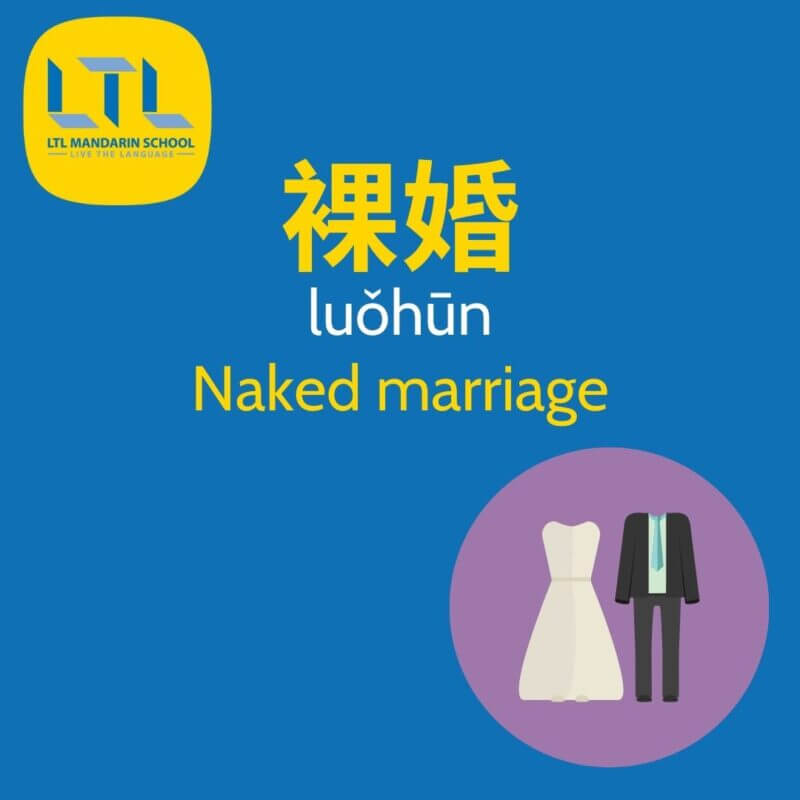
Characters:
裸 (Luǒ) – naked
婚 (hūn) – marriage
Meaning:
This is an interesting term because it originated from a girl who once said on social media that she would rather be crying in an expensive car than be happy on the back of a bike.
What she meant by this is that she was more concerned about the financial part of her future marriage than the actual love part. Since then the Chinese people have often discussed which one is more important.
Some people go for a naked marriage, which means that the boy hadn’t yet bought an apartment or car – which are usually the requirements for marriage in China.
The naked marriage is more about love and less about materialistic goods.
Dating, Flirting and What to Call People
Chinese has a whole set of playful words for flirting and for the people in your life. Here are the ones you’ll hear most.
| Slang | Pinyin | Meaning |
|---|---|---|
| 撩 | liáo | To flirt, to tease someone romantically |
| 撩妹 / 撩汉 | liáo mèi / liáo hàn | To flirt with a girl / with a guy |
| 土味情话 | tǔwèi qínghuà | Cheesy, ‘earthy’ pick-up lines |
| 男朋友 / 男票 | nán péngyou / nán piào | Boyfriend / bf (男票 is the cute internet version) |
| 女朋友 / 女票 | nǚ péngyou / nǚ piào | Girlfriend / gf |
| 对象 | duìxiàng | Partner, the person you’re dating |
| 宝贝 / 宝宝 | bǎobèi / bǎobao | Baby, babe |
| 老公 / 老婆 | lǎogōng / lǎopo | Hubby / wifey, used by many dating couples too |
| 姐姐 | jiějie | Older sister, also a fond word for a confident older woman |
| 小姐姐 | xiǎo jiějie | A friendly way to address a young woman |
| 小姐 | xiǎojiě | Miss, but use it with care (see below) |
| Chinese | Pinyin | English |
|---|---|---|
| 你是不是在撩我? | Nǐ shì bú shì zài liáo wǒ? | Are you flirting with me? |
| 我男票今晚请我吃饭。 | Wǒ nán piào jīnwǎn qǐng wǒ chīfàn. | My bf is taking me to dinner tonight. |
What Chinese girls call their boyfriend
Most women say 男朋友 (nán péngyou) when talking about their boyfriend, and call him 宝贝 (bǎobèi) or even 老公 (lǎogōng) to his face, long before any wedding. Online you’ll see 男票 (nán piào), because 男朋友 said quickly sounds a bit like nán piào.
小姐, 姐姐 and 小姐姐
小姐 (xiǎojiě) literally means ‘miss’ or ‘young lady’, and it’s still fine with a surname, like 王小姐 (Wáng xiǎojiě, Miss Wang). Shouted on its own at a stranger in many mainland cities, though, it can sound seedy, because it also became slang for women working in the sex industry. Call a waitress 服务员 (fúwùyuán) or 美女 (měinǚ) instead.
姐姐 (jiějie) means ‘older sister’, but fans now use it as a compliment for confident, successful older women. The 2020 variety show 乘风破浪的姐姐 (Chéng Fēng Pò Làng de Jiějie, ‘Sisters Who Make Waves’) helped make that use mainstream.
Geek/Nerd/Gamer 宅男/宅女 (zháinán/zháinǚ)

Characters:
宅 (Zhái) – house
男 (nán) – male
女 (nǚ) – female
Meaning:
China has turned into an internet-addicted society and there is Wi-Fi wherever you go.
Chinese people are online most of the time and of course this comes with problems as well.
Internet-addiction is a huge issue (if you search it online, you’ll find articles discussing how Chinese parents send their children to internet rehab camps – military style).
The term 宅男/宅女 literally means a person who spends all day and night at home watching TV shows, playing video games etc.
Singles Day – 光棍节 (guānggùn jié)
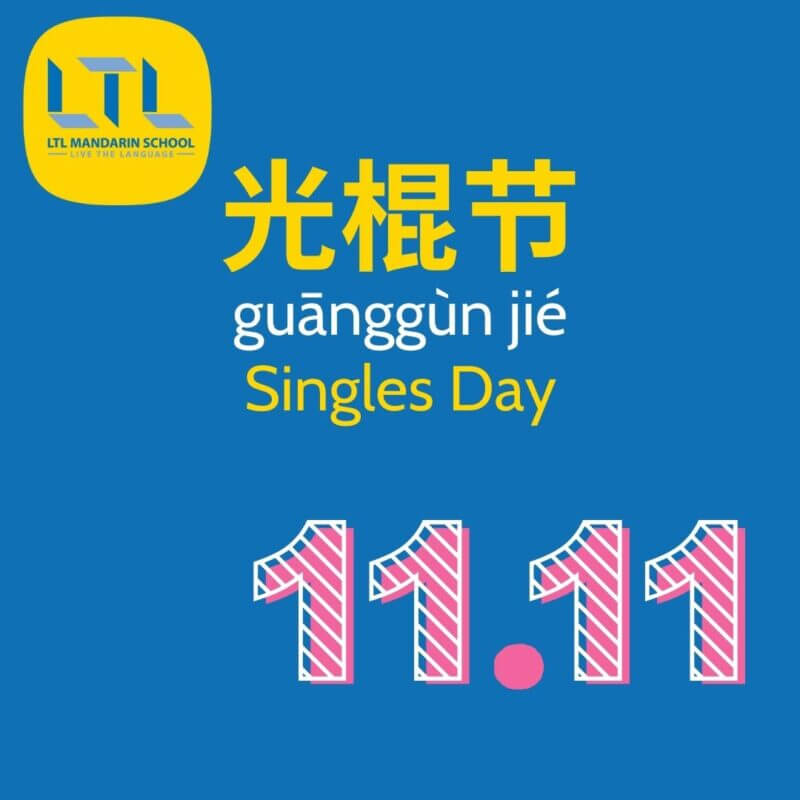
Characters:
光棍 (Guānggùn) – bachelor/single (or literally, bare stick)
节 (jié) – Festival
Meaning:
In contemporary China it is all about finding the one and only, being in a relationship, getting married and being safe and sound for the rest of your life.
Singles day is on the 11th of November every year because the date looks like four single people standing beside each other (11.11).
This day has grown into China’s biggest shopping festival, and the sales now run for weeks rather than one day. Shoppers pile into Taobao and Tmall, JD.com, Pinduoduo and livestream sales on Douyin, plus all the other shopping apps out there.
In 2025, data firm Syntun put total online sales for the festival at 1.695 trillion yuan, up 14.2% on the year before.
In the West it’s some kind of equivalent to crying and eating chocolate on Valentine’s Day and Black Friday Sales.
And speaking of that…
Eat Dirt – 吃土 (chī tǔ)
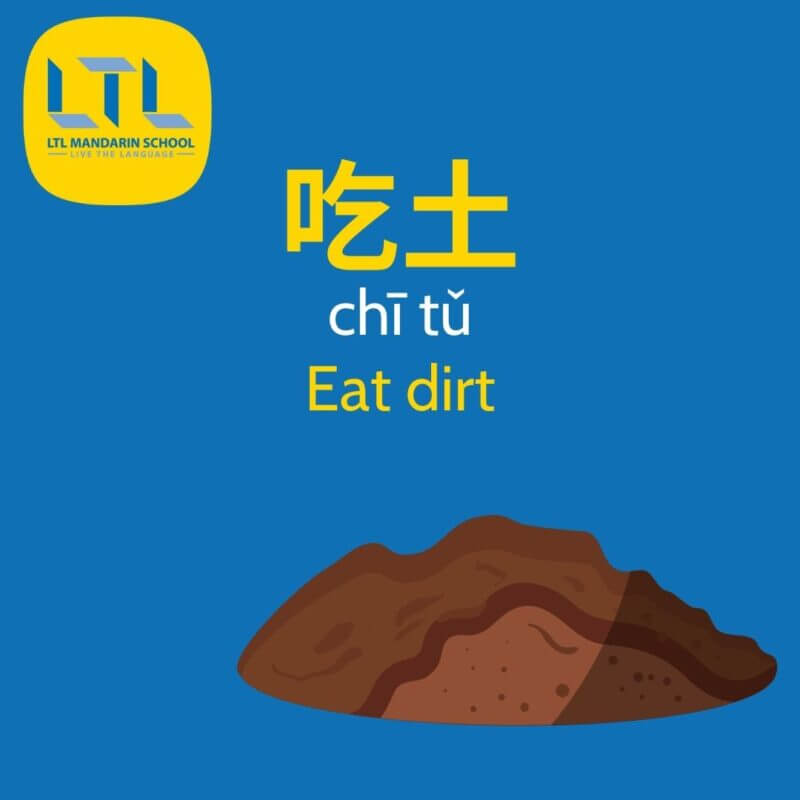
Characters:
吃 (chī): to eat
土 (tǔ): dirt/soil
This final offering comes directly from Singles Day and mainly at Chinese who spent their whole months/years wages on 11/11.
Once the world’s biggest shopping festival is over, plenty of shoppers are left with empty pockets and empty bank accounts.
So what are they left to eat?
Nothing, they can’t afford it after all!
This is where the phrase to 吃土 了 comes from.
It’s to make light of those who spent all their money, and is all they can afford until the next payday, is to eat dirt!
Chinese Work Slang // 内卷, 躺平 and Friends
Remember 996? A whole family of slang has grown up around long hours and fierce competition, and you’ll hear it from university students and office workers alike.
| Slang | Pinyin | Meaning |
|---|---|---|
| 内卷 | nèijuǎn | ‘Involution’: everyone competing harder and harder for the same small rewards |
| 躺平 | tǎng píng | ‘Lying flat’: opting out of the rat race and doing just enough |
| 打工人 | dǎgōng rén | ‘Wage worker’: a self-mocking name for anyone with a job |
| 工具人 | gōngjù rén | ‘Tool person’: someone others only use to get things done, often a crush who never dates you back |
| 班味 | bān wèi | ‘The smell of work’: the drained, tired look office life gives you |
| 佛系 | fóxì | ‘Buddha-style’: relaxed, go-with-the-flow, not fussed about results |
| 精神内耗 | jīngshén nèihào | ‘Mental friction’: wearing yourself out by overthinking |
See them in sentences
| Chinese | Pinyin | English |
|---|---|---|
| 我们公司太内卷了,大家十点才下班。 | Wǒmen gōngsī tài nèijuǎn le, dàjiā shí diǎn cái xiàbān. | My company is so competitive, everyone leaves at 10pm. |
| 卷不动了,我决定躺平。 | Juǎn bú dòng le, wǒ juédìng tǎng píng. | I can’t keep up the race, so I’ve decided to lie flat. |
| 早安,打工人! | Zǎo ān, dǎgōng rén! | Morning, fellow worker bees! |
| 放假三天,班味终于没了。 | Fàngjià sān tiān, bān wèi zhōngyú méi le. | Three days off and my work vibe is finally gone. |
| 考试嘛,我很佛系。 | Kǎoshì ma, wǒ hěn fóxì. | Exams? I’m pretty zen about them. |
TIP💡 These are fine with classmates and colleagues your own age, but 躺平 can sound like you don’t care about your job, so leave it out of interviews.
BONUS | Want to learn a couple of Chinese idioms whilst you’re here? Check this quick-fire lesson with Anastaciia if so.
Chinese Slang || Cheat Sheet
Here’s every term from the main list in one place, so you can find a word fast. The newer work, internet and dating slang has its own tables above.
| Slang | Pinyin | Meaning |
|---|---|---|
| 光想青年 | guāng xiǎng qīngnián | All talk, no action |
| 绿茶婊 | lǜchá biǎo | Fake-innocent, manipulative girl (offensive) |
| 宅 | zhái | Homebody |
| 小鲜肉 | xiǎo xiān ròu | Young, handsome male idol |
| 比心 | bǐxīn | Finger heart gesture |
| 一起爬山吗? | yìqǐ páshān ma? | ‘Want to go hiking?’ (a joking death invitation) |
| 凡尔赛文学 | fán’ěrsài wénxué | Humble bragging |
| 柠檬精 | níngméng jīng | Jealous person |
| 我太难了 | wǒ tài nán le | My life is so hard |
| 你行你上 | nǐ xíng nǐ shàng | You can you up |
| 666 | liùliùliù | Awesome |
| 777 | qīqīqī | Even better than 666 |
| 520 | wǔ’èrlíng | I love you |
| 995 | jiǔjiǔwǔ | Help me |
| 748 | qīsìbā | Go to hell (rude) |
| 88 | bābā | Bye bye |
| 886 | bābāliù | Bye then |
| 233 | èrsānsān | LOL |
| 555 | wǔwǔwǔ | Crying |
| 484 | sìbāsì | Is it or isn’t it |
| 530 | wǔsānlíng | I miss you |
| 1314 | yīsānyīsì | Forever |
| 4242 | sì’èrsì’èr | Yes, yes |
| 7456 | qīsìwǔliù | I’m so angry |
| 918 | jiǔyāobā | Go for it |
| 514 | wǔyāosì | I want to die (dramatic) |
| 56 | wǔliù | Boring |
| 996 | jiǔjiǔliù | 9am to 9pm, 6 days a week |
| 250 | èrbǎiwǔ | Idiot (insult) |
| TMD | tāmāde | Damn it (vulgar) |
| YYDS | yǒngyuǎn de shén | The GOAT |
| CP粉 | CP fěn | Shippers |
| KSWL | kē sǐ wǒ le | This couple is too cute |
| HHH | hāhāhā | LOL |
| U1S1 | yǒu yī shuō yī | To be honest |
| XSWL | xiào sǐ wǒ le | Dying of laughter |
| QSWL | qì sǐ wǒ le | So angry |
| DBQ | duìbuqǐ | Sorry |
| 剩女 | shèngnǚ | Leftover woman (derogatory) |
| 留守儿童 | liúshǒu értóng | Left-behind children |
| 裸婚 | luǒhūn | Naked marriage |
| 宅男 / 宅女 | zháinán / zháinǚ | Homebody guy / girl |
| 光棍节 | guānggùn jié | Singles Day (11.11) |
| 吃土 | chī tǔ | ‘Eat dirt’: broke after a spending spree |
Chinese Slang || Conclusion
We could keep going on and on with these slang words and hot topics in contemporary Chinese society, but for now we’ll let you take in all those examples!
TIP💡 Slang is for friends, not formal settings. Use it in WeChat chats, with classmates and with your host family once you know them well. Switch back to standard Mandarin in emails, meetings, with older people you’ve just met and in exams: HSK and TOCFL test standard Chinese, so 666 won’t win you any points in the writing section.
Check them out and you’ll learn so much more about what is going on in China at the moment!
Feel free to post your favourite Chinese slang words in the comments below.
WANT MORE – How about checking out Japans top slang words used today, the best slang in Vietnamese, Italian and Russian, plus also the most used slang in Korean.
See how it differs from slang in Chinese and your native language.

Chinese Slang || FAQs
Is 250 an insult in Chinese?
Yes it is. Calling someone 250 (èrbǎiwǔ) means calling them an idiot, so it belongs with the other Chinese swear words and insults you should use with care.
Some people even avoid 250 as a price or gift amount because of that meaning.
What is the meaning of YYDS?
YYDS is a new acronym in Chinese and is essentially the same as GOAT.
GOAT stands for Great Of All Time in English and YYDS stands for 永远的神 (yǒnɡyuǎn de shén) which literally means “forever the God”.
It took off around 2020, when the former pro player turned streamer 山泥若 (Shān Ní Ruò) praised his idol Uzi, a retired League of Legends star, by shouting 乌兹,永远的神 (Wūzī, yǒngyuǎn de shén), ‘Uzi, forever the god’. Fans repeated it in livestream chats until it spread far beyond gaming, and today it’s playful, informal praise for anything from a singer to a bowl of noodles.
What is a “leftover woman”?
This word relates to the issue that Chinese girls don’t get married as young as they did in the previous generations.
The preconceptions still hold for many families, and there can be strong pressure to marry early. A woman who is still single in her late twenties may be labelled a leftover woman, or 剩女 (shèngnǚ).
It’s a derogatory label, so it’s worth understanding but never worth using about anyone.
What is a 宅男/宅女?
This is a male or female who is addicted to being online and will never leave technology alone.
It is pronounced Zháinán/ Zháinǚ (male / female)
What is 11/11?
A huge day of discounted goods for Chinese to buy online know as Singles day.
It is on the 11th of November every year because the date looks like four single people standing beside each other (11.11).
Is 666 a good number in China?
Yes, it’s a positive number used widely on social media in China. 666 (liùliùliù) sounds like 溜溜溜, from 溜 (liù), a colloquial word for slick or skilled, so it means awesome or well done.
Six is also a lucky number in China, linked to things going smoothly. Just watch the context: a wall of 666 under a fail video is usually sarcastic.
Is 250 an insult in Chinese?
Yes it is. Calling someone 250 (èrbǎiwǔ) means calling them an idiot, so it belongs with the other Chinese swear words and insults you should use with care.
Some people even avoid 250 as a price or gift amount because of that meaning.
What is LOL in Chinese?
Chinese use the number 233 or three letters HHH as LOL.
233 represents the sound of laughter in Chinese slang.
HHH simply represents ha ha ha (哈哈哈 hāhāhā).
How do you say “I Love You” in Chinese using numbers?
Chinese use 520 to say I Love You in Chinese due to the fact the numbers 520 sounding similar to the words for I Love You in Chinese 我爱你 – Wǒ ài nǐ.
How fast does Chinese internet slang change?
Very fast. A buzzword can explode on Douyin or Weibo in a week and sound dated within a couple of years, which is why 我太难了 from 2019 already feels a bit retro.
Number codes like 520 and 88 and gaming classics like 666 have lasted for years, so learn those first and treat the newest terms as a bonus.
How can I practise Chinese slang without embarrassing myself?
Read it before you say it. Follow a few creators on Douyin or Xiaohongshu and notice who uses which words, and with whom.
Then try one new term at a time with friends your own age or with your teacher, and ask how it sounds. In LTL classes, your teacher can tell you straight away whether a phrase sounds cute, outdated or rude.
What does 777 mean in Chinese?
777 (qīqīqī) is 666 turned up a notch, meaning ‘even better than 666’. Gamers and livestream viewers type it, or a long string of 7s, when someone pulls off something extra impressive.
There’s no hidden homophone behind it. It plays on 666 and the jackpot 777 of a slot machine, so you’ll mostly see it in chats rather than hear it spoken.
What does Xiao Jie mean?
小姐 (xiǎojiě) literally means ‘miss’ or ‘young lady’, and it’s still fine with a surname, as in 王小姐 (Wáng xiǎojiě, Miss Wang).
Used on its own to call a stranger in many mainland cities, it can sound seedy, because it also became slang for women in the sex industry. To get a waitress’s attention, say 服务员 (fúwùyuán) or 美女 (měinǚ) instead.
What does “jie jie” mean?
姐姐 (jiějie) means ‘older sister’. Fans now also use it as a compliment for confident, successful older women.
The 2020 variety show 乘风破浪的姐姐 (‘Sisters Who Make Waves’) helped make that use mainstream. A related term, 小姐姐 (xiǎo jiějie), is a friendly way to address a young woman.
What is flirty in Chinese?
The key slang word is 撩 (liáo), meaning to flirt or tease someone romantically. 撩妹 (liáo mèi) is flirting with a girl and 撩汉 (liáo hàn) is flirting with a guy.
Cheesy pick-up lines are called 土味情话 (tǔwèi qínghuà), literally ‘earthy love talk’. To ask ‘Are you flirting with me’, say 你是不是在撩我 (Nǐ shì bú shì zài liáo wǒ).
What do Chinese girls call their boyfriend?
Most women say 男朋友 (nán péngyou) when talking about their boyfriend. To his face they often call him 宝贝 (bǎobèi, baby) or even 老公 (lǎogōng, hubby), long before any wedding.
Online you’ll see 男票 (nán piào), a cute version that comes from 男朋友 said quickly.
What are some funny Chinese phrases?
A few favourites are 一起爬山吗 (yìqǐ páshān ma), ‘want to go hiking’, a joking ‘death invitation’ from the 2020 drama The Bad Kids, and 柠檬精 (níngméng jīng), ‘lemon spirit’, for someone jealous.
There’s also 吃土 (chī tǔ), ‘eat dirt’, for being broke after Singles Day shopping, and 我太难了 (wǒ tài nán le), ‘my life is so hard’, often written with 南 (south) as in things going south.
Want more from LTL?
If you wish to hear more from LTL Mandarin School why not join our mailing list? We give plenty of handy information on learning Chinese, useful apps to learn the language and everything going on at our LTL schools!
Sign up below and become part of our ever-growing community!





21 comments
Great article. 三Q!
555 I am finding it so hard... feel like a 250
Haha (233), very good use of the slang there Catronus.
Keep up the studying, 666!
LTL Team
So funny! Definitely use some of these
Great isn't it, lots to remember and learn!
LTL
Some really funny ones I never saw before
Thanks for the kind words Ivan
Thanks again for the article. Really great content LTL
Thanks Giulia!
MAFAN is my fave Chinese word, not slang but so useful
👏
Lol. Thanks for the laugh!
Glad you liked it JK!
[…] The meaning of 996 […]
Cool new knowledge that helps when reading chinese articles! (≧▽≦)/ By the way you wouldn't know what the chinese slang FW stands for would you?
New one for us, we'll have an ask around the office but in "English" it means "f*** with" so it could well be that!
Excellent!
But we Chinese people use number 233 is not because its sound. 233 was an emoji code on an early (about 2000-2005) Chinese well-known social media mop.com, which means 'punching the ground and laughing out loud', quite similar to LMAO in English. 233 spread from mop.com to all over the internet. Some times we append 3s to express that we are laughing wildly, e.g. 23333333333333.
Thanks for the comment Ray, interesting to hear!
Very interesting
[…] 41 Crazy Chinese Slang (for 2021) // Speak Like a (Real … […]
[…] online posts will expose you to lots of internet slang and colloquial usage of modern […]