
How to Play Mahjong || Your Mahjong Questions, Answered
Mahjong is a four-player Chinese tile game played with 136 tiles across three suits (characters, bamboo, circles) plus honour tiles (winds and dragons).
The goal is to build a winning hand of four sets and a pair by drawing and discarding tiles. The modern game took shape in Qing Dynasty China between the 1870s and 1890s, and it is one of the most effective ways to drill Chinese number and character recognition in a real-world social setting.

Mahjong is a fun way to learn more about Chinese characters and numbers, and what they signify for language, history and culture.
But how to play Mahjong?
At any Chinese family gathering, social event and in streets across Asia, the air is punctuated with the sounds of clashing mahjong tiles.
It signifies leisure, family time and fun.
But if you’ve ever tried to play it, you’ll know it’s not just a case of “picking it up”.
We’ve given it a go at explaining this somewhat complicated Chinese Mahjong game.
Using Mahjong to Improve Chinese
What do the Rest of the Characters Represent?
What Do the Tiles Actually Mean?
Where to Experience It in Asia
How to play Mahjong || FAQs
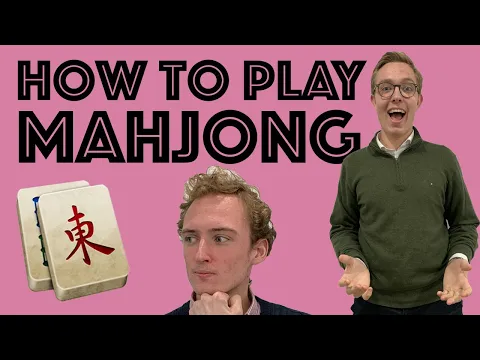
You’ll see it being played by people from all walks of life, from old men in night markets to ladies who lunch and gangsters in mafia movies.
This is an ancient game of dragons, hands and flowers, where fortunes can be lost on changing winds (Game of Thrones, anyone?)
But what can it help us learn about Chinese characters and numbers? What can it teach us about China’s language, culture and philosophy?
麻将 (májiàng) mahjong
The name 麻将 (májiàng) evolved from 麻雀 (máquè), meaning sparrow (麻 má = hemp/rough, 雀 què = sparrow).
The connection is sound: when tiles are shuffled face-down on the table in the ‘washing’ phase, the rapid clattering genuinely does resemble a flock of sparrows chattering.
It is one of those wonderfully sensory names in Chinese where the word describes the experience of the thing.
Over time, 麻雀 (máquè) shifted to 麻将 (májiàng) as the game spread.
The character 将 (jiàng) carries connotations of a general or commander in Chinese, hinting at the strategic nature of the game.
Worth noting: 将 has three possible pronunciations in Mandarin: jiāng, jiàng, and qiāng. In the context of mahjong, it is always jiàng. 💡

Chinese Numbers | The Ultimate Guide (PLUS Free Quiz Inside)
The Most Comprehensive Online Guide for Counting in Chinese & Talking About Numbers Chinese Numbers are one of the first things you’ll study when learning Chinese. So, we’ve prepared this ultimate guide to Mandarin Chinese numbers which covers numbers in…
How to Play Mahjong – Key Vocab
Before getting stuck in the game of Mahjong, let’s learn some keywords and phrases that you’ll be using to play Mahjong.
- 出牌 chū pái: play a card
- 摸牌 mō pái: get a card
- 洗牌 xǐ pái: shuffle the tiles
- 庄家 zhuāngjiā: the host, double win & double lose
- 上家 shàngjiā: to the left side
- 下家 xiàjiā: to the right side
- 对子 duìzi: a pair, such as AA
- 付子 fùzi: a set, such as (123, 456, 234, 789)
- 碰 pèng: Peng, three identical tiles (trips), such as AAA
- 杠 gāng: Gang, four identical tiles, (quads), such as AAAA
- 停牌 tíngpái: Ting, one more card to win, or Hu’s eve
- 和 hú: Hu-won
- 骰子 shǎizi: dice
- 坐庄 zuòzhuāng: keep host
- 条 tiáo: Tube
- 筒 tǒng: Odds
- 万 wàn: Million
- 幺 yāo: number 1 and 9, winds, and yuan cards
- 诈和 zhàhú: false win

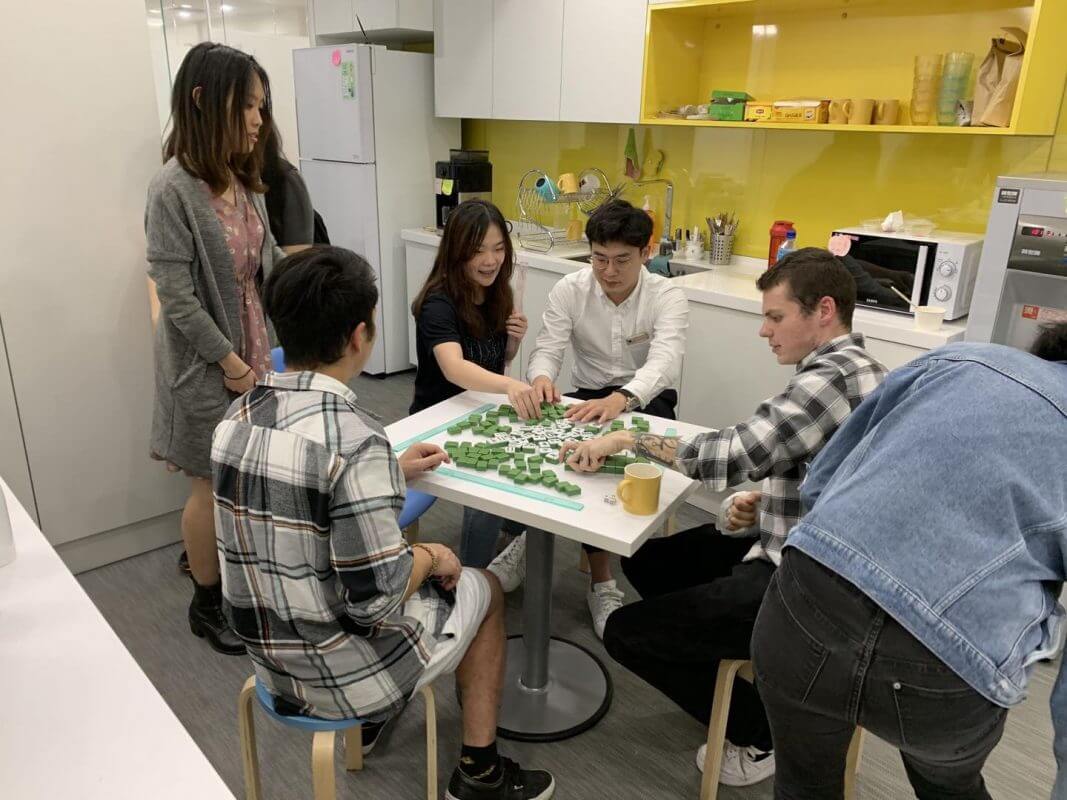
How to Play Mahjong – What is it?
The rules of mahjong are quite complex.
What’s more, how the game is played varies from place to place. Mahjong players in Hong Kong play a very different style of the game than people enjoy in Taipei for example.
There are some great online resources if you’re interested in learning the full rules, but here’s a simple explanation:
Mahjong is a game of four players and 136 tiles, engraved with a suit and a number.
There are three main suits: characters, bamboo and circles, as well as honours suits: dragons and winds. Learning to read the tile suit number characters is one of the most practical starting points for any Mandarin learner who wants to play.
The aim of the game is to gather a hand that makes ‘mahjong’.
This could be a full flush, a hand of tiles all from the same suit, or a combination of tiles where numbers, colours or suits either match or are sequential.
There are many possible mahjong combinations and each winning hand is scored depending on the tiles within it.
Just to add a layer of complexity, some mahjong games are played with ‘flower’ tiles too.
However it is played, the principles of mahjong remain the same.
So what can we learn from it?

How to Play Mahjong – Historical Ties
Mahjong is old, but perhaps not quite as old as the legends suggest.
The game as we know it today took shape during the Qing Dynasty, most likely between the 1870s and 1890s, making it roughly 150 years old in its modern form rather than 2,500.

It almost certainly evolved from earlier Chinese card and domino games, some of which were printed on paper or silk and date back several centuries.
One popular story credits Confucius himself as the inventor, pointing to the game’s three dragon tiles as representing his three virtues.
Historians have found no evidence to support this, and it is widely considered a myth.
A more credible theory points to a Chinese official named Chen Yu-Men, who is credited with codifying the game in the Ningbo region in the mid-1800s.
From there it spread rapidly from Chinese aristocrats to the general public, and was well established in Shanghai by the late 19th century before it became ingrained in Chinese culture.
In the 1900s the game travelled beyond Chinese borders, carried by migrants, which explains why there are so many versions of the game today.
American businessman Joseph P. Babcock is often credited with bringing mahjong to the United States in the early 1920s, sparking a Western craze that peaked mid-decade and helped seed the American mahjong tradition still played today.
How to Play Mahjong – Improving Chinese
Speed, in particular quick recognition of the Chinese characters and numbers, is essential to mahjong, particularly when you are fishing for one pesky tile to complete your hand.
Playing regularly is a genuinely effective way to drill number recognition and character reading in a high-stakes, social context.
The character suit is engraved with 萬 (wàn), for 10,000, and numbers 1 – 9, which helps you recognise the Chinese characters for numbers.
The wind tiles also feature the characters for north (北, běi), east (東, dōng), south (南, nán), and west (西, xī), valuable Chinese characters when you’re trying to locate an address.
If mahjong has got you curious about the language behind the tiles, that is a great starting point.
At LTL, we teach Mandarin in the cities where this game is part of everyday life: Beijing, Shanghai, Taipei, and beyond.
Find your perfect Mandarin program

How to Play Mahjong – Keeping Mentally Fit

Experts agree that playing mahjong is good for mental health.
It is a social activity that ensures interaction with other people, which helps to prevent depression that can result from loneliness.
Plus it’s great brain exercise: the mental agility and hand-eye coordination required to play mahjong is believed to ward off dementia and Alzheimer’s disease.
This makes it a simple and effective therapy for old people to help slow down cognitive decline.
How to Play Mahjong – It’s a Game of Strategy…
Mahjong definitely requires a degree of luck.
But it also requires some strategic thinking: players must quickly analyse the situation, their hand, and the reactions of fellow players, and remain observant as the game unfolds.
The winner has to pay attention to which tiles players are throwing away, and find some order in the chaos.
It’s essential to remain calm and be able to adapt your approach and strategy. This type of thinking appeals to Chinese philosophy and the Confucian tradition.
…that gets philosophical
There are nods to Confucius throughout mahjong. Let’s start with the dragons, which some people believe represent three of the five core Confucian virtues.

The red dragon tile is engraved with the Chinese character 中 (zhōng), meaning center, and relates to the Confucian virtue of loyalty.
The green dragon is represented by the character 發 (fā), for wealth. This also represents the virtue of sincerity.
Mahjong’s white dragon features a blue Chinese character 白 (bái), meaning white. This symbolizes freedom from corruption and the Confucian virtue of filial piety.
Some see the dragons in a completely different way: they call them ‘arrows’, and believe the Chinese characters hint at aspects of archery. 中 (zhōng) means hitting the centre of the target, while 白 (bái) can be interpreted as a blank score sheet.
The green 發 (fā) also symbolizes the act of firing an arrow.

What do the Rest of the Characters Represent?
Circles, also known as stones, wheels and coins are engraved with the character 筒 (tóng), to symbolize the ancient Chinese coin with a square hole in the middle.
These coins were typically threaded onto a string or stick for convenience, that’s what the hole was for.
While the bamboo suit might look like bamboo at first glance, this suit 索, (sǔo) actually symbolizes these coins strung up by the 100 (弔, diào) or 1,000 (貫, guàn).

The 萬 (wàn) suit, as we know, represents 10,000.
This means that the three main suits represent a single coin, a set of 100 or 1000 coins, and a chest of 10,000, which tells us the hierarchy of these tile sets.
The eight flower tiles bear the Chinese characters of the four seasons: winter (冬天, dōngtiān), spring (春天, chūntiān), summer (夏天, xiàtiān), and fall (秋天, qiūtiān).
The other flower tiles represent the four Confucian plants: bamboo (竹, zhú), chrysanthemum (菊花, júhuā), orchid (蘭花, lánhuā), and plum (梅, méi).
What Do the Tiles Actually Mean?
The tiles in mahjong are not just game pieces. Each one carries cultural weight worth knowing about. 🀄
Dragon tiles (中, 發, 白): The three dragon tiles represent core values in Chinese culture.
中 (zhōng, Red Dragon) means ‘centre’ or ‘middle’, associated with China itself (中国, Zhōngguó). 發 (fā, Green Dragon) means prosperity and success, and you will recognise it from the New Year phrase 恭喜发财 (gōngxǐ fācái). 白 (bái, White Dragon) represents purity.
Together they echo classic virtues, which is part of why the Confucius inventor story gained traction (even though historians discount it).
Wind tiles (東, 南, 西, 北): East, South, West, and North. Wind direction has deep significance in Chinese cosmology, feng shui, and traditional philosophy.
In mahjong, the ‘prevailing wind’ and your own ‘seat wind’ affect how tiles are scored, adding a layer of strategic meaning.
Flower and season tiles: These bonus tiles depict the four seasons and four classic flowers (plum, orchid, chrysanthemum, bamboo), all symbols of resilience and character in Chinese art and poetry.
The three suits: Bamboo (条, tiáo), Circles (筒, tǒng), and Characters (万, wàn, meaning 10,000) each reflect elements of traditional Chinese economy and daily life.
Knowing these suits is excellent practice for reading Chinese characters under time pressure.
How to Play Mahjong – The Poker Face
Like many parlour games, mahjong is often played for money, even among families.
This means that the best players have to give a great poker face. As your game can depend on your opponents discarding the tiles you need, it’s essential that they don’t know which tiles you have or what you need.
The concept of walls, the stacks of tiles in the center of the table, was probably an innovation aimed at reducing opportunities to cheat.

We can’t talk about mahjong without mentioning THAT scene in Crazy Rich Asians (spoiler alert).
It’s the main showdown between two of the lead characters and it takes place over a game of mahjong.
Leading the action is the fearsome mother Eleanor, played by Michelle Yeoh, who confronts her son’s girlfriend Rachel, played by Constance Wu, both serving spine-tingling poker face.
The game becomes a metaphor for the scenario being played out between the two women; Rachel and Eleanor need the same tile to win and Rachel draws it.
However, instead of using it in her hand to win she walks away from the game, just as she reveals to Eleanor that she has won their struggle for Nick’s commitment but is walking away to protect his family.
In mahjong and in love, she holds the winning tile but is prepared to give it up. You don’t have to understand the game to appreciate the parallel to the storyline.
There are added layers of nuance: Rachel is an American-born Chinese woman, and Eleanor has judged her harshly for this.
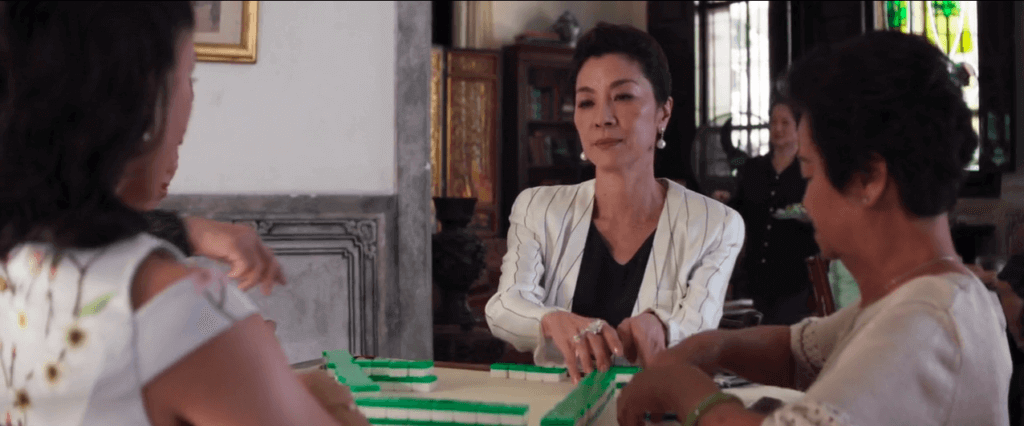
The fact that she knows how to play mahjong surprises Eleanor, and it shows that Chinese in the diaspora share the same culture and values as families ‘back home’.
She is the daughter of a single mother, and Eleanor looks down at her social status. Her actions on and off the table show that she behaves with integrity, compassion and dignity.
Eleanor believes she is better than Rachel but around the mahjong table, everyone is equal.
Having explained all of that, we have to show you the scene if you’ve not yet seen it…!
![Crazy Rich Asians - Mahjong Scene [Official HD]](https://ltl-school.com/wp-content/uploads/yt-thumbs/H_CJXuMxc8U.webp)
How to play Mahjong – It’s a Game for Everyone
Are most mahjong players thinking about Confucian virtues, symbolism and movie metaphors while throwing their tiles around?
We doubt it.
Mahjong is a window to the Chinese language and history, a great way to learn more about Chinese characters, culture and tradition, keep your brain sharp and most importantly, have fun.
Give it a try!
Where to Experience It in Asia
If you want to experience mahjong properly, you really need to be in Asia. 🌏
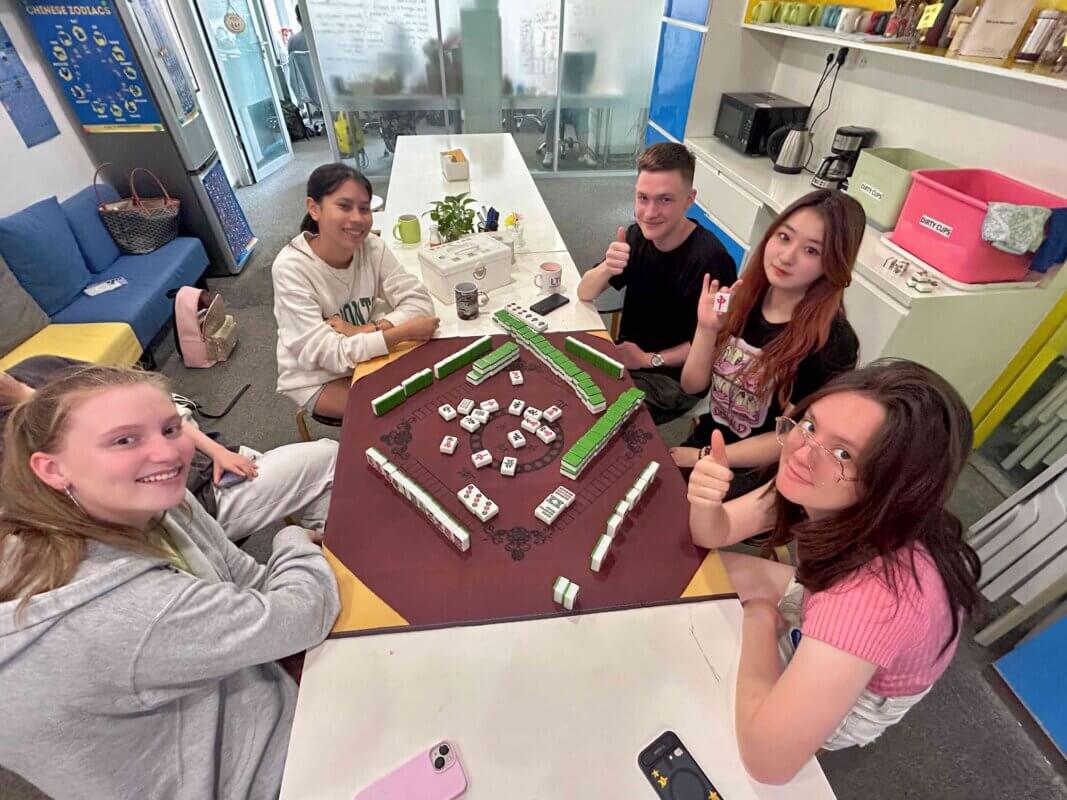
In Beijing and Shanghai, you will find people playing in parks, teahouses, and community centres on any given afternoon. The sound of tiles being shuffled (that distinctive clatter) is part of the background noise of daily life.
In Taipei, mahjong parlours are a social institution, and the game is often played late into the night.
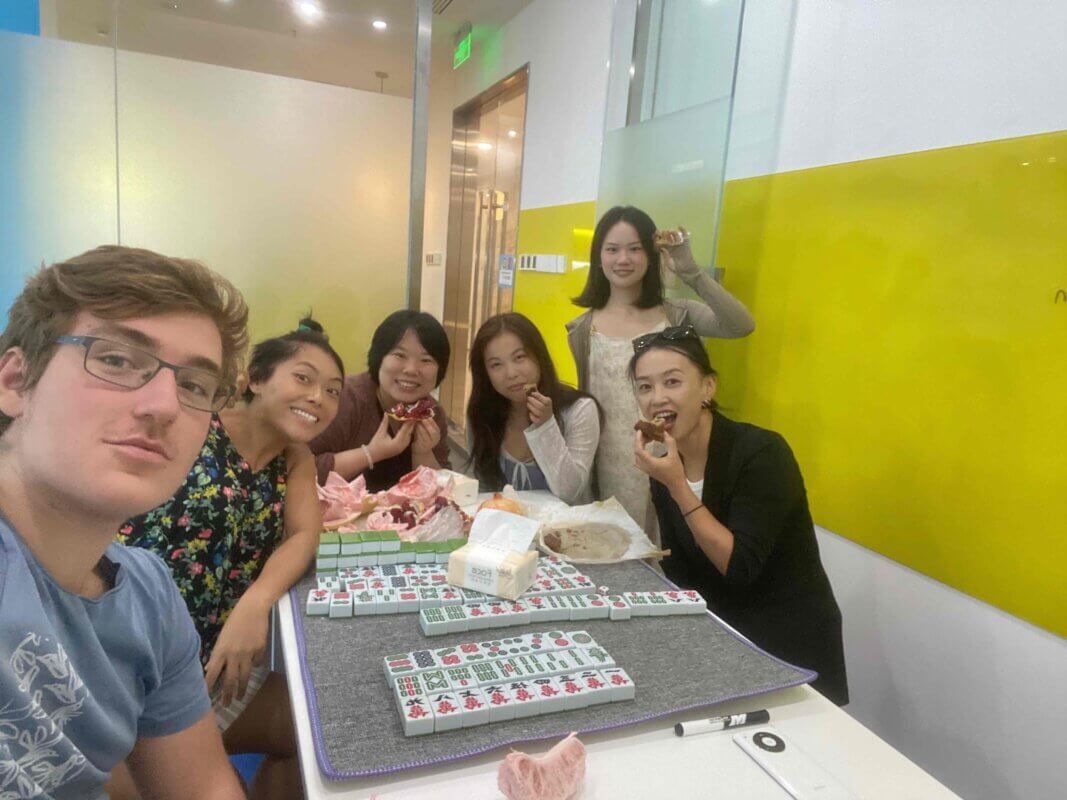
Our students in Taipei regularly get invited to games by host families. It is one of the fastest ways to practise your Chinese numbers and characters in a real, pressure-tested environment.
Singapore has its own vibrant mahjong scene that reflects the city’s Chinese heritage, and Tokyo is home to hundreds of dedicated mahjong parlours (known as 雀荘, jansō) where Riichi mahjong is played competitively.
If you are studying with LTL in any of these cities, ask your teacher or host family to show you a game. There is no better cultural classroom.
Find your perfect Mandarin program
Mahjong || FAQs
How do you say Mahjong in Chinese?
It’s not quite the same, but very similar to how you’d say it in English. 麻将 (májiàng).
How many players in a game of Mahjong?
In total there are four players.
How many tiles used per Mahjong game?
In total 136 tiles are used per game.
How many suits are there in Mahjong?
In Mahjong there are three main suits: characters, bamboo and circles.
How do you say Dice in Chinese?
Dice in Chinese is 骰子 shǎizi.
Why is mahjong so addictive?
Mahjong combines skill, strategy, memory, and an element of chance in a way that keeps players genuinely engaged.
Each game is different because of the random tile draw, but success depends heavily on reading your opponents, adapting your strategy mid-game, and making quick decisions.
That blend of control and unpredictability is a classic recipe for engagement.
Do neurologists recommend mahjong?
Some neurologists and occupational therapists do recommend mahjong, particularly for older adults, as a mentally stimulating activity.
Research has suggested it may help maintain cognitive function, improve memory, and reduce the risk of dementia.
The combination of pattern recognition, strategic thinking, and social interaction makes it a genuinely rich mental workout.







10 comments
Love mahjong, fun way to learn about language and culture
We agree, very fun and great to learn!
[…] Read More […]
You did a fantastic job at writing it, and your thoughts are excellent. This article is superb!
Thank you Mike, super kind 🙂
Is it allowed to pick up a discarded singleton in order to mahjong?
Typically no, but the game has many variations depending on region.
Hi! Thank you for your clear instructions on how to play mahjong!
Is it common to play the game without the flowers? I think there are eight of them. Thank you in advance for your response!
都可以!Flower tiles are considered optional typically Judi 🙂
Glad you enjoyed the guide.
Use to play years ago we lived in Boca raton FL played 3 times a week. We moved to Kentucky no one played so I play bridge now. I miss my tiles,would like to’ play again . I -have a set . Would like to learn again.