
The Complete Guide to Yoga in Chinese with 89 Words
If you’ve ever wanted to take a Yoga class in China, but have been too afraid to go because you don’t know any yoga in Chinese, then this is the list for you!
Or perhaps you’re just both a China and yoga enthusiast and are looking to broaden your vocabulary.
Either way our complete guide to yoga in Chinese will teach you everything you need to know.
From basic yoga instructions that are useful in class to some of the more obscure poses we cover them all!
Yoga in Chinese – Different Types of Yoga
Yoga in Chinese – Yoga Instructions
Yoga in Chinese – Nature Poses and Salutations
Yoga in Chinese – Animal Poses
Yoga in Chinese – Standing Poses
Yoga in Chinese – Other Common Yoga Poses
Yoga in Chinese – Quiz
Be sure to check out some of our other great vocabulary posts:
Yoga in Chinese – Different Types of Yoga

Yoga in Chinese is 瑜伽 yújiā which is one of those Chinese loanwords which they use a lot of in China.
(If you’re unsure of what a loanword is just think of the translation of coffee 咖啡 kāfēi.)
Sometimes Yoga is also translated with a different character for jia and is written as 珈 instead to make 瑜珈 yújiā. However, both characters for jia are first tone so they sound the same when spoken.
There are also lots of different types of yoga so let’s have a look at some of the most popular ones:
| HANZI | PINYIN | ENGLISH |
|---|---|---|
| 流瑜伽 | liúyújiā | Flow Yoga (Vinyasa) |
| 阿斯汤伽 | āsītāngjiā | Ashtanga Yoga |
| 热瑜伽 | rèyújiā | Hot Yoga (Bikram) |
| 高温瑜伽 | gāowēn yújiā | Hot Yoga (Bikram) |
| 诃陀瑜伽 | hē tuó yújiā | Hatha yoga |
| 哈達瑜伽 | hādá yújiā | Hatha yoga |
Now that we’ve got basic yoga names down, let’s have a look at useful instructions that you’ll likely hear in a class.
Yoga in Chinese – Yoga Instructions
Anyone who is familiar with yoga knows how important breathing is to the practice, so first of all let’s have a little look at how you say different breathes in Chinese.
- Breathe – 呼吸 hūxī
- Inhale – 吸气 xīqì
- Exhale – 吐气 tǔqì or 呼气 hūqì
You might hear instructions such as:
-
深深吸一口气
shēnshēn xī yī kǒu qì
Draw in a deep breath -
要记得呼吸,做瑜伽最重要的就是呼吸
yào jìde hūxī,zuò yújiā zuì zhòngyào de jiùshì hūxī.
Remember to breathe, breathing is the most important part of yoga.
Another common yoga instruction of course is being told to relax – 放松 fàngsōng

Along with breathing, yoga is of course also about stretching, and stretch in Chinese is 伸展 shēnzhǎn.
It’s also important to know your directions for yoga, as you’ll often be told to move left or right, up or down etc.
Although, I’m sure many people often get their left and right muddled even in their own language, I know I do!
| Hanzi | Pinyin | ENGLISH |
|---|---|---|
| 往前 | wǎng qián | Move forward |
| 往后 | wǎng hòu | Move backward |
| 往上 | wǎng shàng | Move up |
| 往下 | wǎng xià | Move down |
| 往右 | wǎng yòu | Move right |
| 往左 | wǎng zuǒ | Move left |
Often in yoga you’ll be told to straighten a part of your body, to say this in Chinese is 打直 dǎ zhí.
The body part to straighten is then added before 打直 dǎ zhí.
For example you might be told to straighten your legs 脚打直 jiǎo dǎ zhí or straighten your back 背打直 bèi dǎ zhí.
Then opposite that is to arch your back which is 拱背 gǒng bèi.

Another common instruction in yoga is soft bend 微弯 wēi wān (you might recognise 微 from 微博 wēi bó the Chinese version of Twitter).
So a soft bend in the knees would be 膝盖微弯 xīgài wēi wān. A full forward bend is 前弯 qiánwān, you’ll see that this also features in one of the yoga poses.
If you don’t know your body parts in Chinese, it might be a good idea to brush up on them!
Yoga also focuses on engaging certain muscles such as your core or glutes, to say this in Chinese is 缩紧 suō jǐn which meant to tighten.
The body part to engage is then added after:
- Engage (tighten) the core – 缩紧下腹 suō jǐn xiàfù
- Engage (tighten) the glutes – 缩紧臀部 suō jǐn túnbù
Yoga in Chinese – Nature Poses and Salutations
Now that you’ve learned some basic instructions for yoga in Chinese lets have a look at some of the most common poses, starting with poses about nature.
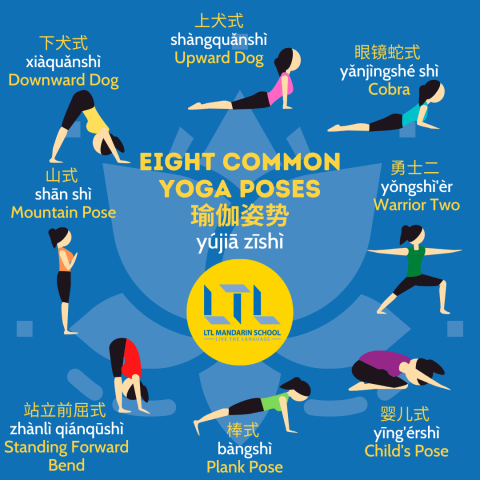
The most important character you’ll need to learn is 式 shì as it’s used in almost all yoga pose names.
Pose = 式 shì
Yoga poses = 瑜伽姿势 yújiā zīshì
You’ll see that most yoga poses are just direct translations of the English with 式 shì added afterwards so they’re pretty easy to understand:
| Hanzi | Pinyin | ENGLISH |
|---|---|---|
| 山式 | shān shì | Mountain Pose (Tadasana) |
| 半月式 | bànyuè shì | Half Moon (Ardha Chandrasana) |
| 新月式 | xīnyuèshì | Crescent Moon Pose (Anjaneyasana) |
| 树式 | shùshì | Tree Pose (Vrksasana) |
| 莲花式 | liánhuā shì | Lotus Pose (Padmasana) |


For salutations the word for worship 拜 bài is then added to the beginning:
- Sun Salutation (Surya Namaskar) – 拜日式 bài rì shì
- Moon Salutation (Chandra Namaskar) – 拜月式 bàiyuèshì
This makes the literal translations “sun worshipping pose” and “moon worshipping pose”.
Pretty straight forward right!
Yoga in Chinese – Animal Poses
As we’ve already seen with the nature poses, animal poses are also mostly direct translations of the animal name with 式 shì added.
Here are some of the most common animal poses:
| HANZI | PINYIN | ENGLISH |
|---|---|---|
| 牛式 | niú shì | Cow Pose (Bitilasana) |
| 猫式 | māo shì | Cat Pose (Marjariasana) |
| 鹰式 | yīngshì | Eagle Pose (Garudasana) |
| 乌鸦式 | wūyā shì | Crow (Bakasana) |
| 鸽式 | gēshì | One-legged Pigeon Pose (Eka Pada Rajakapotasana) |
| 眼镜蛇式 | yǎnjìngshéshì | Cobra (Bhujangasana) |
| 蛇式 | shéshì | Shortened version of Cobra pose |

However, one yoga pose to watch out for is yoga’s most famous pose: downward dog.
Here instead of using the common word for dog 狗 gǒu the more formal word 犬 quǎn is used instead.
This translates more directly as canine in English.
- Downward Dog Pose (Adho Mukha Śvānāsana)
下犬式 xiàquǎnshì - Upward Dog Pose (Ūrdhva Mukha Śvānāsana)
上犬式 shàngquǎnshì - Three Legged Downward Dog Pose
單腿下犬式 dān tuǐ xià quǎn shì
(the Chinese actually translates to one legged downward dog)
How about some of the less common animal poses:
| Hanzi | Pinyin | ENGLISH |
|---|---|---|
| 鱼式 | yú shì | Fish Pose (Matsyasana) |
| 人面狮身式 | rén miàn shī shēn shì | Sphinx Pose (Salamba Bhujangasana) |
| 骆驼式 | luòtuó shì | Camel Pose (Ustrasana) |
| 海豚式 | hǎitún shì | Dolphin Pose (Ardha Pincha Mayurasana) |
| 蛙式 | wā shì | Frog (Mandukasana) |
Yoga in Chinese – Standing Poses
Next, let’s have a look at some of the most well known standing poses:
- Warrior 1 Pose (Virabhadrasana 1)
勇士一(式) yǒngshìyī (shì) - Warrior 2 Pose (Virabhadrasana 2)
勇士二(式) yǒngshì’èr (shì) - Warrior 3 Pose (Virabhadrasana 3)
勇士三(式) yǒngshìsān (shì) - Reverse Warrior/Peaceful Warrior (Viparita Virabhadrasana)
反战士式 fǎn zhànshì shì

You might notice that for the warrior poses 式 shì doesn’t have to be included as part of the name. Instead they can simply be referred to as warrior ( 勇士 yǒngshì) followed by the number.
| Hanzi | Pinyin | ENGLISH |
|---|---|---|
| 三角式 | sānjiǎoshì | Triangle Pose (Trikonasana) |
| 侧角式 | cèjiǎoshì | Extended Side Angle (Utthita Parsvakonasana) |
| 舞者式 | wǔzhěshì | Dancer Pose (Natarajasana) |
| 椅子式 | yǐzishì | Chair Pose (Utakatasan) |


In the yoga instructions section we already saw the word for forward bend (前弯 qiánwān) which appears in the next two yoga poses:
- Standing Forward Bend (Uttanasana)
站立前屈式 zhànlì qiánqūshì or
站立前弯式 zhànlì qiánwān shì - Half Forward Bend (Ardha Uttanasana)
半前弯 bànqiánwān
For the last of our standing poses we have the names for a couple of lunges, lunge in Chinese is 弓步 gōngbù.
So High Lunge (Utthita Ashwa Sanchalasana) is 高弓步式 gāogōngbùshì and Low lunge (Anjaneyasana) is 低弓步式 dīgōngbùshì.
Yoga in Chinese – Other Common Yoga Poses
To finish off we have the remaining most common yoga poses, starting with one of the most dreaded ones:
- Plank (Kumbhakasana)
棒式 bàngshì or 平板支撑 píngbǎn zhīchēng - Low Plank (Chaturanga Dandasana)
平板式 píngbǎnshì - Forearm Plank
肘板支撑 zhǒu bǎn zhīchēng or 手臂平板式 shǒubì píngbǎn shì - Side Plank
简易侧板式 jiǎnyì cè bǎnshì - Upward Plank/Reverse Plank (Purvottanasana)
反长凳 fǎn cháng dèng

Of course we couldn’t leave off one of the most important yoga positions: Table Top Position (Bharmanasana) 四足跪姿 sìzúguìzī.
Here the Chinese translation is actually “four foot kneeling position” rather than “table pose” as you might expect.
Instead Reverse Table Pose (Ardha Purvottanasana) is translated directed to “table pose” 桌子式 zhuōzishì.
Along with this we have some of the other more relaxed yoga pose:
| Hanzi | Pinyin | ENGLISH |
|---|---|---|
| 简易坐 | jiǎnyì zuò | Easy Pose (Sukhasana) |
| 婴儿式 | yīng’érshì | Child’s Pose (Balasana) |
| 快乐婴儿式 | kuàilèyīng’érshì | Happy Baby Pose (Ananda Balasana) |
| 英雄坐 | yīngxióng zuò | Hero Pose (Virasana) |
| 仰卧式 | yǎngwòshì | Corpse Pose (Shavasana) |


And some of the more challenging yoga poses:
- Reclining Hero Pose Supta Virasana
卧英雄 wò yīngxióng - Bridge Pose (Setu Bandha Sarvangasana)
桥式 qiáoshì - Bow Pose (Dhanurasana)
弓式 gōng shì - Boat Pose (Navasana)
船式 chuán shì - Wheel Pose (Urdhva Dhanurasana)
轮式 lún shì


Yoga in Chinese – Quiz

Yoga in Chinese – FAQs
How do you say yoga in Chinese?
Yoga in Chinese is 瑜伽 yújiā (this is actually a loanword in Chinese).
How do you say downward dog in Chinese?
Downward dog in Chinese is 下犬式 xiàquǎnshì.
How do you say Flow Yoga in Chinese?
Flow Yoga (Vinyasa) in Chinese is 流瑜伽 liúyújiā.
How do you say Ashtanga Yoga in Chinese?
Ashtanga Yoga in Chinese is 阿斯汤伽 āsītāngjiā.
Want more from LTL?
If you wish to hear more from LTL Language School why not join our mailing list? We give plenty of handy information on learning Chinese, useful apps to learn the language and everything going on at our LTL schools!
Sign up below and become part of our ever-growing community!
⭐ Download our free ebook, your starter pack of essential Mandarin learning resources!
BONUS || Want to study Chinese with us in China? Why not check out our group and individual classes here






Awesome post now I might br brave enough to take a yoga class in China...
Thanks Susan, hopefully this post will give you the confidence you need!
The LTL Team
NICE! Will learn these during quarantine