How to Learn Chinese Words | The Hack You Never Knew
The fastest way to learn Chinese words is to master a few dozen high-frequency characters, then combine them into compound words.
Because Mandarin has no alphabet, characters act like building blocks: once you know 电 (diàn = electricity), you can decode 电脑 (computer, “electric brain”), 电影 (movie, “electric shadow”) and 电话 (phone, “electric speak”).

Pair this character-cluster method with pinyin, the four tones, and spaced-repetition flashcards, and vocabulary starts sticking in days rather than months.
This guide walks you through the exact system LTL uses with our students, including free flashcards, core word lists (numbers, pronouns, verbs, greetings) and 10 essential character families.
Chinese is a unique language. There is no alphabet, and from the start that gives newbies a headache when learning Chinese words.
However, this can actually play to your advantage in so many ways going forward. Once you’ve gotten your head around the fact Mandarin is made up of thousands of pictograms, you’ll discover there is actually an ingenious way to learn this language…
Today we are going to teach you our favourite way to learn new Chinese words, equipped with free flashcards from our Instagram channel.
In fact, it was from our very own Instagram channel that we realised just how popular these flashcards were.
Off the back of their extraordinary feedback on Instagram, we wanted to give them further context on our website too, hence the inspiration for this blog post.
You may well be wondering what these flashcards look like. Here is a prime example.

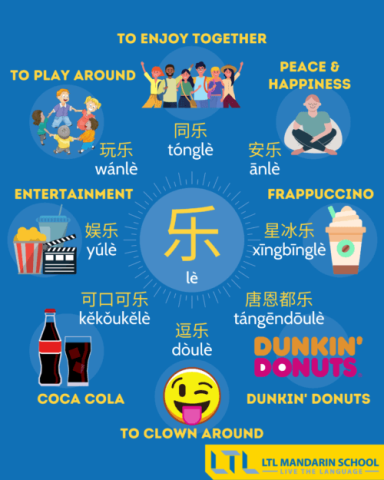
Now, depending on your Chinese level, that may or may not make sense to you. So before going into further detail, we’ll give some background.
Most of this information was taken from our mammoth guide to the Chinese alphabet (or perhaps more accurately, how the Chinese alphabet doesn’t actually exist).
WE KNOW HOW IT’S DONE || LTL has been teaching Mandarin since 2007 across cities including Beijing, Shanghai, Taipei, and Singapore. We are accredited by IALC and recognised by universities worldwide, with a 98% HSK pass rate, so when we say this method works, we have the results to back it up.
Chinese Words | A Brief Introduction
Chinese Words | Tones and Pinyin // What You Need to Know First
Chinese Words | Our Flashcards
Chinese Words | Numbers in Chinese // 1 to 10 and Beyond
Chinese Words | Pronouns and Question Words
Chinese Words | Greetings and Courtesy Phrases
Chinese Words | Introducing Yourself in Chinese
Chinese Words | Tips for Remembering New Vocabulary

Chinese Words | A Brief Introduction
Let’s take the most basic Chinese character: 一 (Yī, means one)
Great, we’ve learnt our first Chinese character. That means every time I see ‘一’ it means that it’s one of something, right? Wrong.
As there is no Chinese alphabet, the characters can be joined together to make another word.
This does follow logic generally. Let us explain:
This is the character meaning common or general: 共 Gòng
So we’ve now learnt two Chinese characters but we are about to learn our third Chinese word, and that is simply by putting these two characters together to make…
一共 (Yī Gòng)
Anyone take a guess at the meaning of 一共?
It means altogether.
Let’s do the same with two more characters: 时 (Shí means time) and 区 (Qū means Area)
So we have two characters with their own meaning individually, time and area.
But what happens when we put these two characters together?
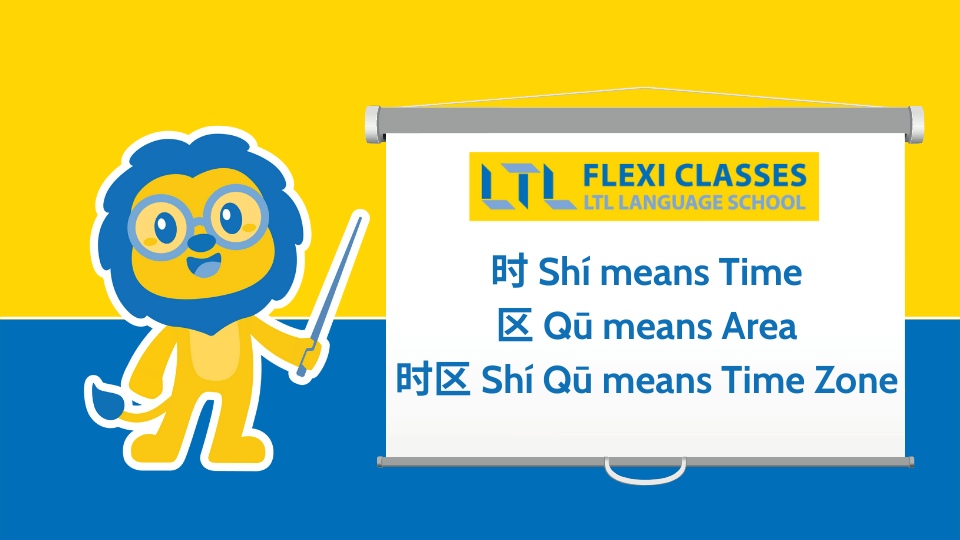
What could the word 时区 mean?
时区: Shí Qū means Time Zone
Time and area together, mean time zone in Chinese.
So, despite the lack of a physical Chinese alphabet, there is a large element of consistent thinking when it comes to learning Mandarin.
Tones and Pinyin // What You Need to Know First
Before you start loading up flashcards, there is one thing you absolutely must understand: Mandarin is a tonal language.
That means the pitch you use when saying a syllable completely changes its meaning.
There are four tones in Mandarin, plus a neutral (fifth) tone:
| Tone | Mark | Description | Example |
|---|---|---|---|
| 1st tone | ā | High and flat | mā (妈 = mother) |
| 2nd tone | á | Rising, like asking a question | má (麻 = hemp) |
| 3rd tone | ǎ | Dips down then rises | mǎ (马 = horse) |
| 4th tone | à | Sharp falling | mà (骂 = to scold) |
| Neutral | a | Short, unstressed | ma (吗 = question particle) |
Say all four with the wrong tone and you have said four completely different words. It is genuinely challenging, but with enough practice it becomes second nature.
Pinyin is the official romanisation system for Mandarin.
It uses the Latin alphabet plus tone marks to represent how each syllable sounds. You’ll see it throughout this article above every character.
For example, 水 is written as shuǐ in pinyin. Pinyin is not a pronunciation shortcut you drop later; fluent speakers still use it to type on phones and computers every day.
Struggling with tones? You are not alone, it is the part every new learner finds toughest. Our Pronunciation Trainer gives you real-time feedback on all four tones so you can correct mistakes before they become habits.
Of course, the fastest way to build Chinese vocabulary is not through a screen alone.
When you live, breathe and dream the language, studying in Beijing, Shanghai, Taipei, or Singapore with a native-speaking teacher and a host family around you, new words stick in days rather than weeks.
If that kind of immersive learning appeals to you, find your perfect Mandarin program and see what is possible.

Chinese Words | Our Flashcards
We spent plenty of time researching some of the most common (and useful words), picked some equally common Chinese characters and started to get creative.
The end result, is images like this:


They immediately became hugely popular, well-shared and even downloaded by students from all over the world.
So in this blog post, we want to bring some of these Chinese words to life even further by providing some examples of sentences which relate to these flashcards.
NOTE | We haven’t included every single LTL flashcard, quite frankly there are too many and we are creating new ones every week.
🤔 Curious what your name looks like in Chinese characters? Every character in a Chinese name carries its own meaning, just like the vocabulary compounds we cover in this article.

Numbers in Chinese // 1 to 10 and Beyond
Numbers are some of the first Chinese words any learner picks up, and the good news is that Mandarin numbers follow a beautifully logical pattern.
Here are the numbers 1 to 10:
| Number | Character | Pinyin |
|---|---|---|
| 1 | 一 | yī |
| 2 | 二 | èr |
| 3 | 三 | sān |
| 4 | 四 | sì |
| 5 | 五 | wǔ |
| 6 | 六 | liù |
| 7 | 七 | qī |
| 8 | 八 | bā |
| 9 | 九 | jiǔ |
| 10 | 十 | shí |
Once you know 1 to 10, larger numbers build on top of them. 11 is 十一 (shí yī, literally ‘ten-one’), 20 is 二十 (èr shí, ‘two-ten’), and so on up to 100: 一百 (yī bǎi).
For a full breakdown of counting words and Hanzi characters, including how to say hundreds, thousands, phone numbers, and prices, head to our dedicated numbers guide.
Pronouns and Question Words
Good news: Chinese pronouns do not change based on grammatical case. 我 (wǒ) is always ‘I’ or ‘me’, there is no ‘him’ versus ‘he’ conjugation to worry about.
| Character | Pinyin | English |
|---|---|---|
| 我 | wǒ | I / me |
| 你 | nǐ | You (singular) |
| 他 | tā | He / him |
| 她 | tā | She / her |
| 它 | tā | It |
| 我们 | wǒmen | We / us |
| 你们 | nǐmen | You (plural) |
| 他们/她们 | tāmen | They / them |
Essential Question Words. These eight words will let you ask almost anything.
| Character | Pinyin | English |
|---|---|---|
| 什么 | shénme | What |
| 谁 | shuí | Who |
| 哪里 | nǎlǐ | Where |
| 什么时候 | shénme shíhòu | When |
| 怎么 | zěnme | How |
| 多少 | duōshao | How much / how many |
| 为什么 | wèishénme | Why |
| 哪个 | nǎge | Which |
Core Verbs
Mandarin verbs do not conjugate for tense or person, the same form works for ‘I eat’, ‘she eats’, ‘they ate’. Context (and time words) do the heavy lifting.
This makes verbs surprisingly quick to learn.
| Character | Pinyin | English |
|---|---|---|
| 是 | shì | To be |
| 有 | yǒu | To have |
| 去 | qù | To go |
| 来 | lái | To come |
| 吃 | chī | To eat |
| 喝 | hē | To drink |
| 要 | yào | To want |
| 说 | shuō | To speak / say |
| 看 | kàn | To look / watch |
| 做 | zuò | To do / make |
Greetings and Courtesy Phrases
These are the words you will use on day one.
Learn them early and practise them with everyone, shopkeepers, taxi drivers, classmates.
| Character | Pinyin | English |
|---|---|---|
| 你好 | nǐ hǎo | Hello |
| 早上好 | zǎoshang hǎo | Good morning |
| 晚上好 | wǎnshang hǎo | Good evening |
| 再见 | zàijiàn | Goodbye |
| 晚安 | wǎn’ān | Good night |
| 你好吗? | nǐ hǎo ma? | How are you? |
| 我很好 | wǒ hěn hǎo | I am fine |
Courtesy and Polite Phrases. Polite phrases go a long way in Chinese culture. Do not skip these.
| Character | Pinyin | English |
|---|---|---|
| 谢谢 | xièxiè | Thank you |
| 不客气 | bú kèqì | You are welcome |
| 对不起 | duìbuqǐ | Sorry / I apologise |
| 没关系 | méi guānxi | No problem / It is fine |
| 请 | qǐng | Please |
| 我爱你 | wǒ ài nǐ | I love you |
| 不好意思 | bù hǎoyìsi | Excuse me / I am embarrassed |
TIP💡 There is a subtle difference between 对不起 (duìbuqǐ), a sincere apology, and 不好意思 (bù hǎoyìsi), which is more like a polite ‘excuse me’ or a light apology for a minor inconvenience. Locals will immediately notice if you use the right one.
Introducing Yourself in Chinese
Knowing how to introduce yourself unlocks your first real conversations. Here are the phrases you will use most:
| Character | Pinyin | English |
|---|---|---|
| 我叫… | wǒ jiào… | My name is… |
| 我是… 人 | wǒ shì… rén | I am from… (nationality) |
| 我住在… | wǒ zhù zài… | I live in… |
| 我是学生 | wǒ shì xuésheng | I am a student |
| 我在学中文 | wǒ zài xué zhōngwén | I am learning Chinese |
| 很高兴认识你 | hěn gāoxìng rènshì nǐ | Nice to meet you |
| 我今年…岁 | wǒ jīnnián… suì | I am … years old |
TIP💡 When you say where you are from, just add your nationality before 人 (rén = person). For example, 我是英国人 (wǒ shì yīngguó rén) means ‘I am British’.
Chinese Words with 水
Our first lesson comes with the character 水 which means water in Chinese on its own.
However, we can discover a lot of new Chinese words that also include 水, some related to water, others not so much!
Let’s take a look
| Chinese Word | Meaning | Example Sentence |
|---|---|---|
| 水果 | Fruit | 我最喜欢的水果是苹果 My favourite fruit is apple |
| 水星 | Mercury (planet) | 水星是第一颗行星 Mercury is the first planet |
| 水平 | Level | 我的中文水平很差 My Chinese level is bad |
| 开水 | Boiling Water | 壶里是开水 There is boiling water in the pot |
| 水母 | Jellyfish | 水母很可怕 Jellyfish are scary |
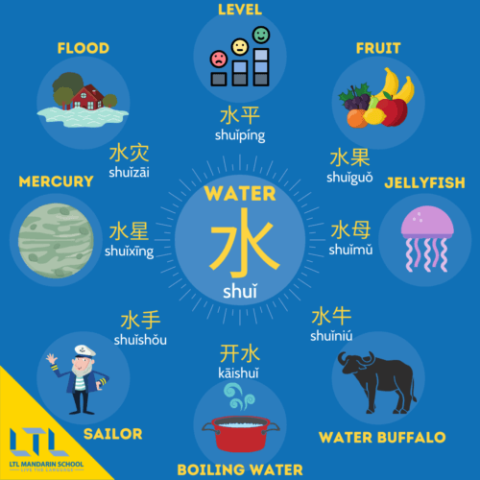
As you can see, despite the lack of an alphabet in Mandarin, the language can be hugely logical.
The key is to learn the most commonly used characters and build from there. Our video above is the perfect tool to help you there.
Once you are beyond this stage, learning new Chinese words actually becomes easier.
Chinese Words with 金
Our second focal Chinese word is 金 which means gold on its own.
金 can actually also represent money, wealth or something highly respected so there are multiple meanings, all generally good ones though!
Here are some useful Chinese words with the character 金 included in them.
| Chinese Word | Meaning | Example Sentence |
|---|---|---|
| 租金 | Rent | 这套房间每月租金一千元 The rent for this flat is 1,000 yuan a month |
| 罚金 | Fine | 他被罚款 He was fined |
| 金牌 | Gold Medal | 中国队获得金牌 China won the gold medal |
| 金融 | Finance | 我在金融工作 I work in finance |
| 税金 | Taxes | 税金很贵 Tax is expensive |

Chinese Words with 电
Onwards we move to character number three.
This is a popular one that appears all over the place.
电 means electricity on its own and therefore has an important place in the hearts of all Mandarin learners because we get important words like these below that stem from 电.
Let’s take a look at some here.
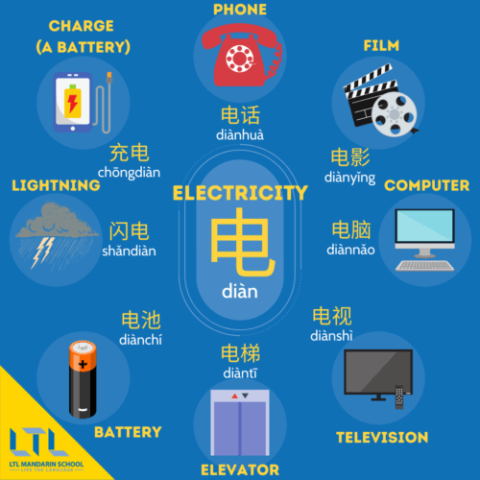
Now let’s put some of these into context with some example sentences.
| Chinese Word | Meaning | Example Sentence |
|---|---|---|
| 电视 | TV | 你喜欢看电视吗? Do you like to watch TV? |
| 电脑 | Computer | 我有一台苹果电脑 I have an Apple computer |
| 电影 | Movie | 你昨天看过那部电影吗 Did you see that movie yesterday? |
| 电话 | Telephone | 请给他打个电话 Please give him a call |
| 充电 | Charge (Battery) | 我可以给手机充电吗? Can I charge my phone? |
Notice the literal translations make Mandarin so logical to learn:

- Computer = Electric + Brain
- Movie = Electric + Shadow
- Phone = Electric + Speak
This is the beauty of Mandarin, even if you don’t know a word you can always have an educated guess. More often than not you will surprise yourself and be correct.
Let’s put you to the test and see if you can guess one.
Any idea what 电车 means?
Let’s break it down:
- 电 we know is electricity
- 车 means vehicle
Electric Vehicle? Hmm… what could it be.
The answer is….
Tram 🚉
Did you get it? Even if you didn’t I bet you were along the right lines (excuse the pun) 😅
Chinese Words with 口
Another essential Chinese character here.
口 means mouth on its own (an easier one to remember given it’s shape and resemblance to an open mouth also).
口 is also a commonly used Chinese radical which you’ll see in many instances.
Can you spot the 口 in these Chinese words?
- 说 | To speak
- 和 | And
- 可 | Can, May
- 后 | Back, Behind, After
All of these words are essential Chinese words.
Let’s take a look at some words that directly include 口 now.
| Chinese Word | Meaning | Example Sentence |
|---|---|---|
| 口罩 | Mask | 你带口罩了吗? Did you bring your mask? |
| 口红 | Lipstick | 你喜欢这款口红吗? Do you like this lipstick? |
| 人口 | Population | 人口在增长 The population is growing |
| 出口 | Exit | 出口在哪里? Where is the exit? |
| 门口 | Entrance | 在门口等候 Wait at the entrance |
You’ll often see 出口 when you go to a shop, supermarket or restaurant in China.
Look out for it next time.
To discover more about radicals, check out our guide super handy video guide here.
Chinese Words with 中
Another very widely used character (and radical) next.
It’s time to learn about 中.
中 is a key character to learn, not least because it’s one-half of the name for China.
中国 literally means middle kingdom and is the name of China.
There are plenty more Chinese words including 中, and here is just a small handful of them.

| Chinese Word | Meaning | Example Sentence |
|---|---|---|
| 其中 | Among | 其中有位老爷爷 Among them was an elderly man |
| 心中 | In the heart / mind | 你在我心中的地位 You have a place in my heart |
| 折中 | Compromise | 他不会折中 He wouldn’t compromise |
| 途中 | En route | 我在途中 I’m on my way |
| 暗中 | In the dark / secret | 我在暗中什么也看不见 I couldn’t see anything in the dark |
Chinese Words with 眼
眼 means eye so you can imagine there are many eye-based vocabulary that include this character.
Here are some of the more useful ones to learn.
| Chinese Word | Meaning | Example Sentence |
|---|---|---|
| 眼睛 | Eye | 我有蓝色的眼睛 I have blue eyes |
| 眼镜 | Glasses | 你喜欢我的眼镜吗? Do you like my glasses? |
| 眼皮 | Eyelid | 你喜欢单眼皮还是双眼皮? Do you like single eyelids or double eye lids? |
| 眼影 | Eyeshadow | 我喜欢这个眼影 I like this eyeshadow |
| 眼罩 | Eye patch | 我必须戴上眼罩 I have to wear an eye patch |
You can learn more about different body parts in Chinese here.
We teach you over 70 body parts and provide even more excellent flashcards, just like this one.
Chinese Words with 火
火 is probably one of the easier Chinese words to remember.
What does 火 look like? A burning flame by any chance?
You could also remember it by thinking of a person running with their arms up in the air, away from the fire!
After all 人 does mean person so the story checks out!
Anyway, there’s far more to 火 than just fire.
Here are some of our favourites you should learn.
| Chinese Word | Meaning | Example Sentence |
|---|---|---|
| 焰火 | Fireworks | 你看到焰火了吗? Did you see the fireworks? |
| 火车 | Train | 快,我们的火车来了 Quick, our train is coming |
| 火锅 | Hotpot | 我们去吃中国火锅吧 Let’s go for Chinese hotpot |
| 火机 | Lighter | 你有打火机吗? Do you have a lighter? |
| 火星 | Mars | 火星是第四颗行星 Mars is the forth planet |

One of the great things about China is the hotpot.
火锅 is easy to remember because the literal translation is the same, hot pot.
TOP TIP | If you come to China, get yourself to 海底捞火锅 and experience hotpot like you never have before.
Be sure to ask for the “dancing noodles”…!
Chinese Words with 钱
It’s time to talk money!
There are plenty of Chinese words that include 钱 and here are some of the most important you need to know.

| Chinese Word | Meaning | Example Sentence |
|---|---|---|
| 换钱 | Exchange money | 我在哪里可以换钱? Where can I exchange money? |
| 取钱 | Withdraw money | 您可以在银行取钱 You can withdraw money at the bank |
| 借钱 | Borrow money | 妈妈,我可以借钱吗? Mum, can I borrow some money? |
| 省钱 | Save money | 我可以在新工作中省很多钱 I can save a lot of money at my new job |
| 存钱 | Deposit money | 我可以存点钱吗? May I please deposit some money? |
If you love learning about money (and who doesn’t), check out this video guide where we introduce you to even more words relating to money.
See how many you can spot that include 钱.

Chinese Words with 乐
Coming towards the end of today’s lesson but we’ve got two more popular Chinese characters to go yet.
First up 乐.
We’ve doubled up on this one because it’s such a happy word, as you’ll see below! 😃
| Chinese Word | Meaning | Example Sentence |
|---|---|---|
| 可口可乐 | Coca Cola | 你喜欢可口可乐还是百事可乐? Do you like Coca-Cola or Pepsi? |
| 星冰乐 | Frappuccino | 我喜欢夏天的星冰乐 I like having a summer frappuccino |
| 乐观 | Optimistic | 我不是很乐观 I am not very optimistic |
| 乐透 | Lottery | 你做过乐透吗 Have you ever done the lottery? |
| 乐土 | Happy Place | 去我们乐土的地方吧 Let’s go to our happy place |
You’ll have seen a few brand names include 乐.
This is actually a very smart move on their part to try and win over the Chinese market.
DID YOU KNOW | The choice of brand name in China can make or break its success factor and there are some fascinating stories.
Coca-Cola is one of our favourites though, you can find out more about their naming story in our brand names article here.
Chinese Words with 快
Our final Chinese word is 快 which can mean fast, quick or soon on its own.
Let’s take a look and see how many of those words relate to speed below…

| Chinese Word | Meaning | Example Sentence |
|---|---|---|
| 快嘴 | Blabbermouth | 他是个快嘴 He is a blabbermouth |
| 快步 | Fast pace | 快步走 Let’s go quick |
| 快刀 | Sharp Knife | 你有一把快刀吗? Do you have a sharp knife? |
| 快意 | Pleased | 她对自己的考试成绩很快意 She was so pleased with her exam result |
| 快乐 | Happy | 生日快乐 Happy birthday |
Tips for Remembering New Chinese Words
Knowing a word once is not the same as knowing it for life. Here is what actually works:
Spaced repetition is the single most evidence-backed method for retaining vocabulary. Apps like Pleco and Skritter use it automatically. You review a character just before you are about to forget it, which cements it far more efficiently than nightly cramming sessions.
Flashcards with context beat naked character drilling. Notice how our LTL flashcards always show the character, the pinyin, the English meaning, and a compound word that uses it. That extra layer of context doubles retention.
Use what you learn the same day. If you pick up 喝 (hē = to drink) in the morning, find a reason to use it before dinner. Order a drink, tell someone you are thirsty, write a sentence in your notebook.
Immersion accelerates everything. When you study in a city where every sign, every menu, and every conversation is in Chinese, you are getting hundreds of vocabulary repetitions a day without even trying.
TIP💡 Our Flexi Classes platform lets you practise new vocabulary in live classes, 24/7, with native-speaking teachers. Start your 7-Day Free Trial on Flexi Classes.
How Many Words Do You Actually Need?
This is one of the most common questions new learners ask, and the answer is more encouraging than you might expect.
For everyday conversation, most linguists agree that around 2,000 to 3,000 words covers roughly 95% of spoken Mandarin. For HSK purposes, the Chinese Testing International (CTI) has set clear benchmarks:
| HSK Level | Vocabulary Required | Equivalent Level |
|---|---|---|
| HSK 1 | 150 words | Absolute beginner |
| HSK 2 | 300 words | Elementary |
| HSK 3 | 600 words | Pre-intermediate |
| HSK 4 | 1,200 words | Intermediate |
| HSK 5 | 2,500 words | Upper-intermediate |
| HSK 6 | 5,000+ words | Advanced |
HSK 4 is broadly equivalent to a conversational level that will get you through daily life comfortably. HSK 6 is the level many employers and universities look for.
At LTL we have a 98% HSK pass rate across all levels. If you want to reach a specific HSK target, our structured programs in Beijing, Shanghai, Taipei, and Singapore are built around exactly that.
BONUS // Free Quiz
Now we’ve done our bit, it’s time for you to do yours!
Ready to put yourself to the test?
We’ve prepared a quick fire 20 question quiz to see how many of the above you remembered!
Results are instantly shown on the screen for you.
If you get a good score, why not share it below?

Chinese Words FAQs
What does 火锅 mean?
火锅 means hotpot in Chinese.
The translation from character to English is almost exactly the same – fire (火) pot (锅).
What is money in Chinese?
钱 means money in Chinese and it’s a popular character!
There are plenty of Chinese words that include 钱 as it is one of the more common Chinese characters.
How logical is Mandarin?
Mandarin is actually a very logical language to learn.
Essentially, it is built up of thousands of building blocks (Chinese characters).
Words can be created be putting other words together.
For example:
Computer = Electric + Brain
Movie = Electric + Shadow
Phone = Electric + Speak
All the above words start with 电, the word for electricity.
What is lipstick in Chinese?
Lipstick in Chinese is 口红.
This literally means mouth-red when translated!
Is there a Chinese alphabet?
Chinese is a unique language, there is no alphabet and from the start that gives newbies a headache when learning Chinese words.
However, this can actually play to your advantage in so many ways going forward and once you’ve gotten your head around the fact Mandarin is made up of thousands of pictograms, you’ll discover there is actually an ingenious way to learn this language.
We explain that in this very blog post.
What are some basic Chinese words?
The most essential Chinese words for beginners include greetings (你好 nǐ hǎo = hello), courtesy phrases (谢谢 xièxiè = thank you, 对不起 duìbuqǐ = sorry), pronouns (我 wǒ = I, 你 nǐ = you), and core verbs (吃 chī = to eat, 去 qù = to go, 要 yào = to want).
Starting with these high-frequency words gives you the fastest practical foundation.
How do you say 1, 2, 3, 4, 5, 6, 7, 8, 9, 10 in Chinese?
The numbers 1 to 10 in Mandarin are: 一 yī, 二 èr, 三 sān, 四 sì, 五 wǔ, 六 liù, 七 qī, 八 bā, 九 jiǔ, 十 shí.
Once you know these ten, all other numbers up to 99 are combinations of them, for example, 11 is 十一 (shí yī) and 21 is 二十一 (èr shí yī).
What are the 100 most common Chinese words?
The 100 most common Mandarin words include the pronouns (我, 你, 他, 她, 我们), core verbs (是, 有, 去, 来, 说, 吃, 喝, 要), question words (什么, 谁, 哪里, 怎么, 为什么, 多少), numbers 1 to 10, time words (今天 jīntiān = today, 明天 míngtiān = tomorrow), and particles like 的 (de), 了 (le), and 吗 (ma).
HSK 1 and HSK 2 vocabulary lists from Chinese Testing International are the most reliable source for a ranked list.
How do Chinese say sorry?
The most common way to say sorry in Mandarin is 对不起 (duìbuqǐ), used for genuine apologies.
For a lighter, more polite ‘excuse me’ or minor sorry, like accidentally bumping into someone, use 不好意思 (bù hǎoyìsi).
Knowing the difference matters: using 对不起 for trivial situations can sound overly dramatic to native speakers.
How do you say I love you in Mandarin?
我爱你 (wǒ ài nǐ) is ‘I love you’ in Mandarin. 我 means I, 爱 (ài) means love, and 你 means you.
It is used in the same contexts as in English, romantic relationships and close family.
In everyday speech, Chinese people more often express affection through actions than words, so saying it out loud carries real weight.
Want more from LTL?
If you wish to hear more from LTL Language School why not join our mailing list? We give plenty of handy information on learning Chinese, useful apps to learn the language and everything going on at our LTL schools!
Sign up below and become part of our ever-growing community!
⭐ Download our free ebook, your starter pack of essential Mandarin learning resources!
BONUS || Want to study Chinese with us in China? Why not check out our group and individual classes here