
Become an Expert on How to Read Chinese Menus

Eating at a Chinese restaurant can be an exciting and delicious experience, but if you can’t read Chinese characters, the menu can seem overwhelming.
However, with a few tips and tricks, you can decode a Chinese menu like a pro and order with confidence.
To read a Chinese menu, look for picture or QR-code menus first, use prices to judge dish size, and learn a handful of key characters: 面 (miàn, noodles), 饭 (fàn, rice), 菜 (cài, dish or vegetable), 肉 (ròu, meat), 鱼 (yú, fish) and 汤 (tāng, soup).
Most Chinese dish names follow a simple formula of cooking method or flavour plus main ingredient, so 炒饭 (chǎofàn) is simply stir-fried rice.
Chinese cuisine is definitely not something you want to miss out on, and in this post we are going to walk you through everything you need to know when reading a Chinese menu.
Find the Basic/Comfort Characters
The Ones You Will Actually See on Menus
Starters and Soups You Will See on Chinese Menus
Common Sauces on a Chinese Menu
Have you ever run into this situation?
You sit down in a restaurant, you’re handed a menu, and everything is Chinese! Not a word of English to be found. Granted, this is more likely to happen while eating at smaller, local restaurants (which also happen to have some of the cheapest and most delicious foods!)
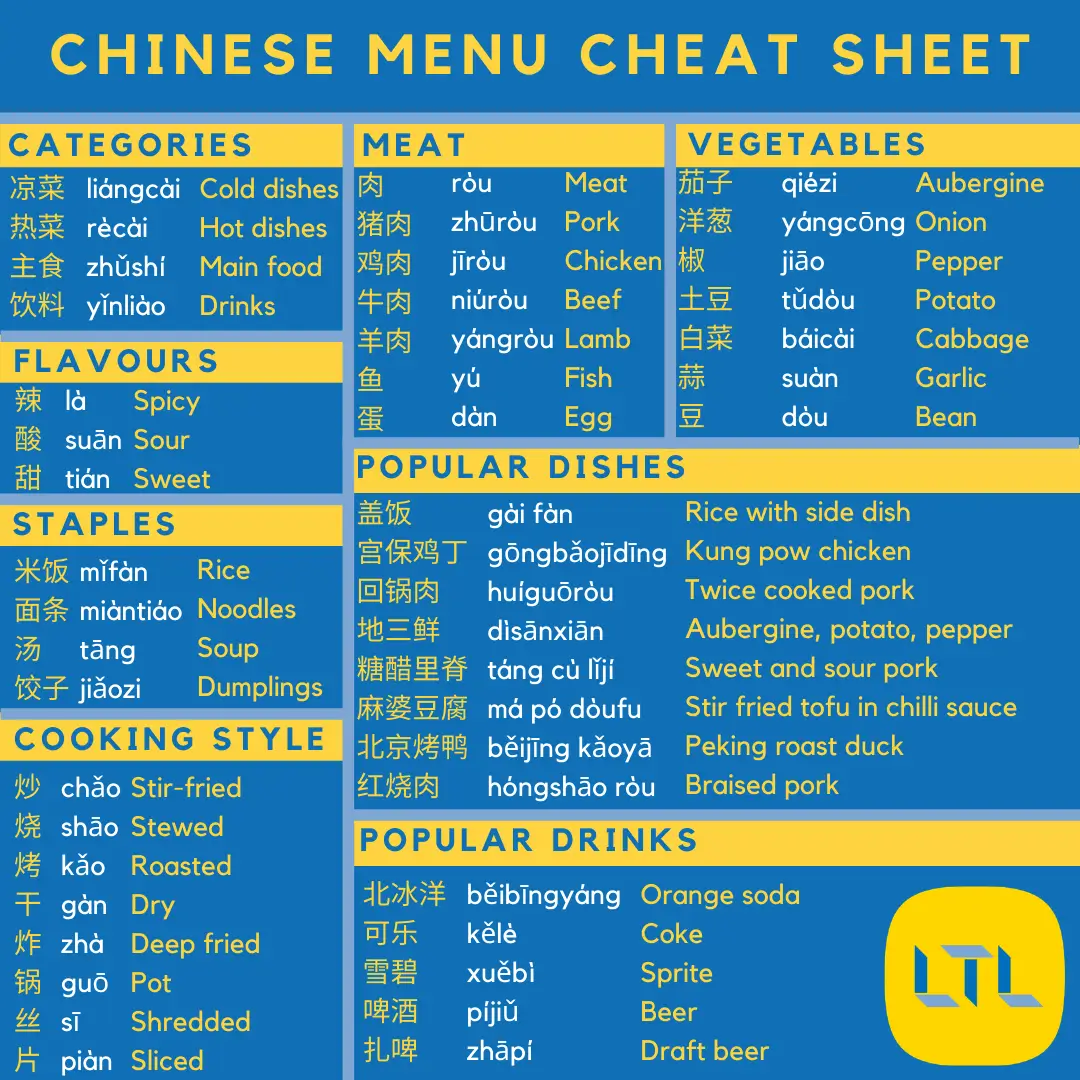
Well fear no more, we are here to help with our guide on reading Chinese menus… and to show you we are serious, here is an ultimate cheat sheet to get you going.
The cheat sheet covers the key characters. Below, you will also find the cooking method formula, flavour words, must-know dishes, sauces and ordering phrases. By the end, a Chinese menu will feel a lot less like a puzzle.
Download it, save it, use it!
If you’re a beginner Chinese student, a Chinese food menu can be extremely intimidating. They probably look nothing like what you’ve seen in your beginner textbooks!
Fortunately, you don’t need to be able to read every single character on the menu to order something you like.
In this blog, I’ll teach you some of the basics of reading a Chinese menu. These tips should help you make educated guesses about what you order, so you’ll be sure to end up with something that suits you!
How to Read a Chinese Menu || Find a Picture Menu
This is one of the most basic tips, but if you’re at a total loss, try to find a restaurant that has Chinese menus with pictures!
Of course, not every restaurant has this, but pictures can be super helpful.
Additionally, check to see if your restaurant has QR code you can scan and order from.
In my experience, lots of restaurants have this kind of code. You can scan from WeChat or Alipay, and then order and pay on your phone. Even if you don’t have an online wallet set up, you can still scan just to see the menu.
Not only is it super quick and convenient, these types of order forms generally have pictures!
So you can choose your food based on looks instead of characters.
This can take a lot of pressure off you, especially if you can’t communicate with the waiter or waitress very well.
If you’re ever ordering food for delivery, through Meituan (美团) or Eleme (饿了么), menus online also generally have pictures.
BONUS – Alipay is a life saver for foreigners in China because it means you can benefit from all the cashless things here like coffee at Luckin’ and the aforementioned Meituan. It can be linked to your foreign bankcard using the steps in this video.
How to Read a Chinese Menu || Check Prices
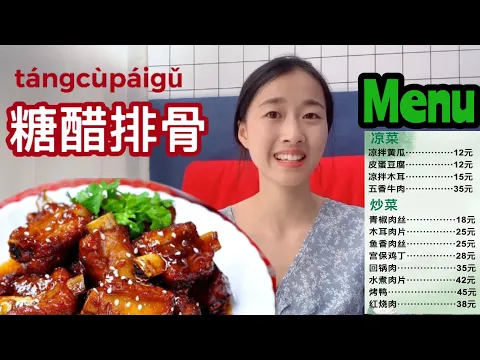
Another basic tip is to scan the prices on the menu quickly.
This can be helpful if you’re a beginner and have no clue what anything on the menu means (except the numbers!)
The prices can clue you into the size of dish.
For example, don’t choose something that’s only 2 RMB from a menu where there’s a whole list of dishes for 20-30 RMB.
How to Read a Chinese Menu || Find the Basic/Comfort Characters
Let’s talk about some of the most basic food characters, these are the ones you’ll find on almost any menu.
Unlike English (where you wouldn’t be able to read a menu without knowing the specific names for each type of food), a lot of food groups share the same character, which means that you don’t need to learn every ingredient to decide on a dish.
Just recognizing these few main characters can help you narrow down your options considerably. If you want to go deeper on how Chinese characters are built, our guide on reading Chinese characters and radicals is a great next step.
For example if you like noodles, you need to be looking for 面 or 面条. If you dislike egg, avoid anything with 鸡蛋 . This can be a big help in narrowing the options down.
面条 (miàntiáo): noodles
You’re actually more likely to just find the character 面 (miàn) at the end of the dish’s name.
This character, along with 饭 (fàn, next up!) is probably the one you’ll find the most often on a menu.
Noodles are also one of your most basic choices. Here in Shanghai, noodles or rice are served with almost every dish.
米饭 (mǐfàn): rice
Similarly with noodles, you’ll probably find the single character 饭 (fàn) at the end of the dish’s name to show that the dish is served with rice.
菜 (cài): dish OR vegetable

SPOILER – This character has more than one meaning.
On a menu, it will probably be used in the name of dish to mean vegetable, for example 四川泡菜 (sìchuān pàocài, which means Sichuan pickled vegetables).
You might also find this character used in headings such as:
- 凉菜 (liángcài, cold dishes)
- 热菜 (rècài, hot dishes)
青菜 (qīngcài) / 蔬菜 (shūcài): vegetable
These characters more specifically mean vegetables (not “dish”), but you’re not as likely to find these on a menu, just as you’d be more likely to find the word “broccoli” than “vegetable” on an English menu.
Instead, this could be helpful if you’re asking for a vegetable dish!
BONUS – Not so sure on your Vegetables in Chinese yet, let us help you out with a super quick, super helpful tutorial.
肉 (ròu): meat
More specifically, you might find these characters on a menu:
| Hanzi | PINYIN | TRANSLATION |
|---|---|---|
| 猪肉 | zhūròu | pork |
| 牛肉 | niúrò | beef |
| 羊肉 | yángròu | lamb |
| 鸡肉 | jīròu | chicken |
One more to add to your list: 虾 (xiā) means shrimp or prawn, and it is one of the most common proteins you will spot on a Chinese menu.
This is especially useful if you specifically want to order a certain type of meat, or if you’re a vegetarian (like me!) and you want to avoid these!
鱼 (yú): fish
鱼 (yú) goes along with meat, and I’ve added it in because I know that fish can be a bit polarizing (some love it, some hate it)!
So now you can recognize it whether you’re craving or avoiding fish.
汤 (tāng): soup
Soups are often an important part of Chinese cuisine, so you are likely to run across 汤 (tāng) on any menu. A few soups have their own flavour-word names: 酸辣汤 (suānlà tāng) is Hot and Sour Soup, and 馄饨汤 (húntun tāng) is Wonton Soup. Both are great entry points for beginners.
饮料 (yǐnliào): drinks
饮料 (yǐnliào) often refers specifically to soft drinks.
You can find this on a menu as one of the headings, which can help you categorize the menu options. This is can help you feel a little less overwhelmed!
鸡蛋 (jīdàn): egg
Specifically chicken eggs! Eggs are commonly used, so you’ll find them on a lot of menus.
豆腐 (dòufu): tofu
While tofu is seen as more of a vegetarian option in America, Chinese cuisine utilizes tofu in many different ways, even incorporating them in dishes with meat.
As a vegetarian, knowing these characters was especially helpful.
BONUS – If you are walking along the street and see the characters 臭豆腐 (chòu dòufu), RUN FOR YOUR LIFE!
臭豆腐 (chòu dòufu) is Stinky Tofu and often gives off a rather pungent smell that most westerners struggle to deal with.
More Key Ingredients to Recognise
A few more ingredients turn up again and again on Chinese menus. Spot these and you will have a much clearer picture of what lands on your table:
| ENGLISH | HANZI | PINYIN |
|---|---|---|
| bamboo shoots | 竹笋 | zhúsǔn |
| bean sprouts | 豆芽 | dòuyá |
| hoisin sauce | 海鲜酱 | hǎixiānjiàng |
| five-spice powder | 五香粉 | wǔxiāngfěn |
TIP💡 海鲜酱 literally means ‘seafood sauce’, but hoisin contains no seafood. It is a thick, sweet sauce made from soybeans. 五香粉 (five-spice) is a warm blend, usually star anise, cloves, cinnamon, Sichuan peppercorn and fennel seed.
How Chinese Dish Names Work || The Formula
Here is a pattern worth memorising: most Chinese dish names follow the formula [Cooking Method] + [Main Ingredient] or [Flavour/Sauce] + [Main Ingredient].
So 炒饭 (chǎofàn) = stir-fried + rice. 红烧肉 (hóngshāo ròu) = soy-braised + pork. Once you spot the cooking method character at the front, you already know half the story.
炒 (chǎo): fried
炒 (chǎo) doesn’t mean deep-fried, just fried shallowly in oil.
This character is often combined with others, such as:
| HANZI | PINYIN | TRANSLATION |
|---|---|---|
| 炒饭 | chǎofàn | fried rice |
| 炒面 | chǎomiàn | fried noodles, or “chao mein” as you might see it in some Westernized Chinese restaurants |
| 炒蛋 | chǎo dàn | scrambled eggs, not fried eggs like you might think |
Common Cooking Method Characters
Beyond 炒 (chǎo), here are the cooking method characters you will see most often:
| HANZI | PINYIN | MEANING | EXAMPLE |
|---|---|---|---|
| 炸 | zhá | deep-fried | 炸鸡 zhájī = fried chicken |
| 蒸 | zhēng | steamed | 蒸饺 zhēngjiǎo = steamed dumplings |
| 烤 | kǎo | roasted / grilled | 烤鸭 kǎoyā = roast duck |
| 红烧 | hóngshāo | soy-braised (literally ‘red-cooked’) | 红烧肉 hóngshāo ròu = braised pork belly |
| 煮 | zhǔ | boiled / simmered in liquid | 煮面 zhǔmiàn = boiled noodles |
| 拌 | bàn | tossed / dressed cold | 凉拌黄瓜 liángbàn huángguā = cold cucumber salad |
TIP💡 Red-braising (红烧 hóngshāo) is one of the most comforting styles in Chinese cooking. Ingredients are slow-cooked with soy sauce, rock sugar, Shaoxing wine and spices until deep and glossy. Pork belly (红烧肉) is the classic example.
Flavour Descriptors to Watch For
Beyond cooking methods, menus also use flavour words as prefixes:
| HANZI | PINYIN | MEANING |
|---|---|---|
| 麻辣 | málà | numbing and spicy (Sichuan-style) |
| 酸辣 | suānlà | sour and spicy |
| 糖醋 | tángcù | sweet and sour |
| 鱼香 | yúxiāng | ‘fish-fragrant’ (no fish involved: a Sichuan sauce of garlic, ginger, chilli and vinegar) |
TIP💡 The numbing sensation in 麻辣 dishes comes from the Sichuan peppercorn (花椒 huājiāo). It contains a compound called hydroxy-alpha-sanshool, which triggers a tingling, electric feeling on your lips and tongue. It is not heat-spicy. It is a completely different sensation.
酸辣 (hot and sour), by contrast, pairs vinegar with white pepper or chilli for a sharp, tangy kick, found in dishes like 酸辣汤 (hot and sour soup, usually spiced with white pepper) and 酸辣土豆丝 (hot and sour potato shreds, usually made with dried chilli).
主食 (zhǔshí): main food
主食 (zhǔshí) usually includes rice or noodles.
These characters will show up as a heading on a menu, you can use them as a helpful guide for choosing a filling dish, as opposed to a small side dish.
Must-Know Dishes || The Ones You Will Actually See on Menus
Knowing characters is useful. Knowing what the actual dishes look, taste and feel like is even better. Here are the ones you will encounter most often.
Kung Pao Chicken || 宫保鸡丁 (gōngbǎo jīdīng)
One of the best-known Chinese dishes worldwide. Diced chicken (丁 = diced pieces) wok-tossed with dried chillies, peanuts and Sichuan peppercorn in a savoury, slightly sweet sauce. Expect a bit of heat and a little numbing sensation.
The 宫保 part refers to an imperial court official. This dish has a 19th-century origin story.
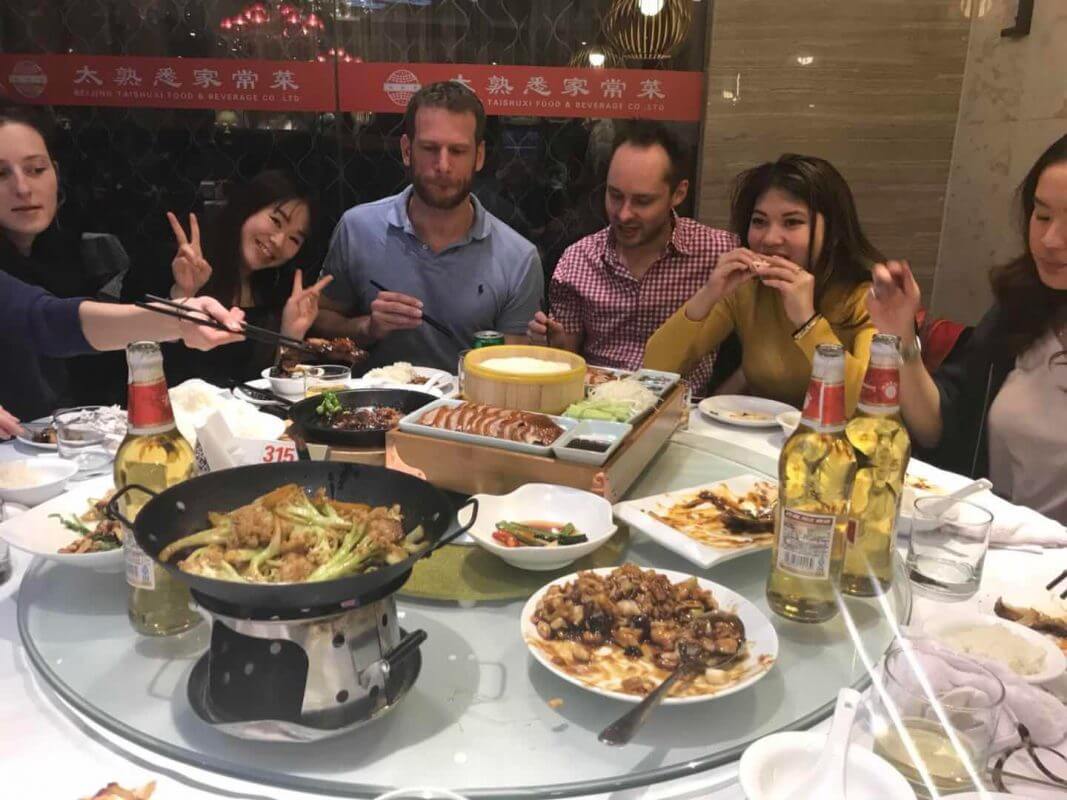
Peking Duck || 北京烤鸭 (Běijīng kǎoyā)
Roasted duck (烤鸭 = roast duck) with lacquered crispy skin, served with thin pancakes, cucumber, spring onion and hoisin sauce. You wrap it yourself at the table.
In Beijing, Peking Duck is a full ceremonial meal. The skin is the star, not the meat.
Mapo Tofu || 麻婆豆腐 (mápó dòufu)
Soft tofu (豆腐) cooked in a fiery, oily Sichuan sauce with minced pork, fermented black bean paste, garlic and a generous handful of Sichuan peppercorn.
The name literally means ‘pock-marked old woman’s tofu’, named after the cook who invented it. If you see 麻婆 on a menu, expect serious heat and numbness.
Red-Braised Pork Belly || 红烧肉 (hóngshāo ròu)
Pork belly slow-cooked in soy sauce, rock sugar, Shaoxing wine and five-spice until meltingly tender and deeply glossy. One of the most comforting dishes in Chinese cooking. Mao Zedong’s personal favourite, according to legend.
Dumplings || 饺子 (jiǎozi)
The word 饺子 (jiǎozi) covers a huge family of dough parcels. Here are the main types you will see on menus:
- 饺子 (jiǎozi): boiled or pan-fried dumplings, usually minced pork and cabbage
- 锅贴 (guōtiē): potstickers, pan-fried on one side for a crispy base
- 馄饨 (húntun): wontons, thinner dough, often in broth
- 小笼包 (xiǎolóngbāo): soup dumplings from Shanghai, filled with pork and hot broth inside, so bite carefully!
Dumplings are often ordered as a starter or a full meal. They come with a vinegar-soy dipping sauce (and sometimes chilli oil).

Chow Mein vs Lo Mein || 炒面 vs 捞面
This is a classic first-timer confusion:
- 炒面 (chǎomiàn) = Chow Mein: noodles stir-fried in a wok until slightly dry, with bean sprouts, onion and a light soy finish. Expect some bite and a little char.
- 捞面 (lāomiàn) = Lo Mein: noodles tossed with sauce rather than fried. Softer, heavier on the sauce, more like a dressed noodle dish.
Both are delicious. If you want more texture, go chow mein. If you want something saucier and softer, go lo mein.
Fried Rice || 炒饭 and Yeung Chow Fried Rice || 扬州炒饭 (Yángzhōu chǎofàn)
Plain fried rice (炒饭 chǎofàn) is wok-tossed rice with egg and soy sauce. Yeung Chow fried rice (扬州炒饭, also written ‘Special Fried Rice’ on Western menus) is the upgraded version: diced char siu pork, shrimp, peas, egg and spring onion, all tossed together in a very hot wok.
Fried rice is the default ‘safe choice’ for newcomers.
Singapore-Style Vermicelli || 星洲炒米 (xīngzhōu chǎomǐ)
Thin rice vermicelli (米粉 mǐfěn) stir-fried with curry powder, which gives the noodles their bright yellow colour. It usually comes with char siu pork, shrimp, egg, peppers and onion.
Despite the name, it is a Cantonese-style dish rather than a Singapore staple. Expect it to be fragrant and mildly spicy, a nice change from soy-based noodles.
Sweet and Sour || 糖醋 (tángcù)
The 糖醋 flavour profile is built on vinegar (醋) and sugar (糖): tangy, bright and slightly sticky. In China, the classic is 糖醋里脊 (tángcù lǐji), crispy pork tenderloin strips in a glossy sauce.
On Western Chinese menus you will see it as battered balls of pork, chicken or prawn with a bright orange sauce and pineapple chunks. Either way, if you see 糖醋 on the menu, you know what to expect.

17 Chinese Dumplings Every Dumpling Fan Needs to Try
Steamed, boiled, fried and baked, there’s not a type of dumpling China doesn’t have. So get ready dumpling fans, today we’re looking at 17 of the best
Starters and Soups You Will See on Chinese Menus
Spring Rolls || 春卷 (chūnjuǎn)
Crispy deep-fried rolls (炸 zhá) filled with shredded vegetables and sometimes minced pork or shrimp. Spring rolls tend to have a light, thin, crackly wrapper.
If you see 蛋卷 (dànjuǎn, egg rolls) on a more Western menu, they are thicker and bubblier. Both are excellent with chilli sauce.
Wontons || 馄饨 (húntun)
Delicate, thin-skinned dough parcels filled with pork or prawn, usually served floating in a clear broth. Wonton soup (馄饨汤 húntun tāng) is one of the lightest, most comforting things on a Chinese menu. Great as a starter.
Prawn Crackers || 虾片 (xiāpiàn)
Deep-fried puffed crackers made from dried prawn and tapioca starch. They arrive as a free side at many Western Chinese restaurants. Light, crispy and mildly savoury.
Hot and Sour Soup || 酸辣汤 (suānlà tāng)
A thick, warming broth built on white pepper, vinegar, mushrooms (木耳 mù’ěr, wood ear), bamboo shoots, soft tofu and egg ribbons.
The 酸 (sour) comes from vinegar, the 辣 (spicy) from white pepper and chilli. If you see 酸辣 on a menu, expect this combination.
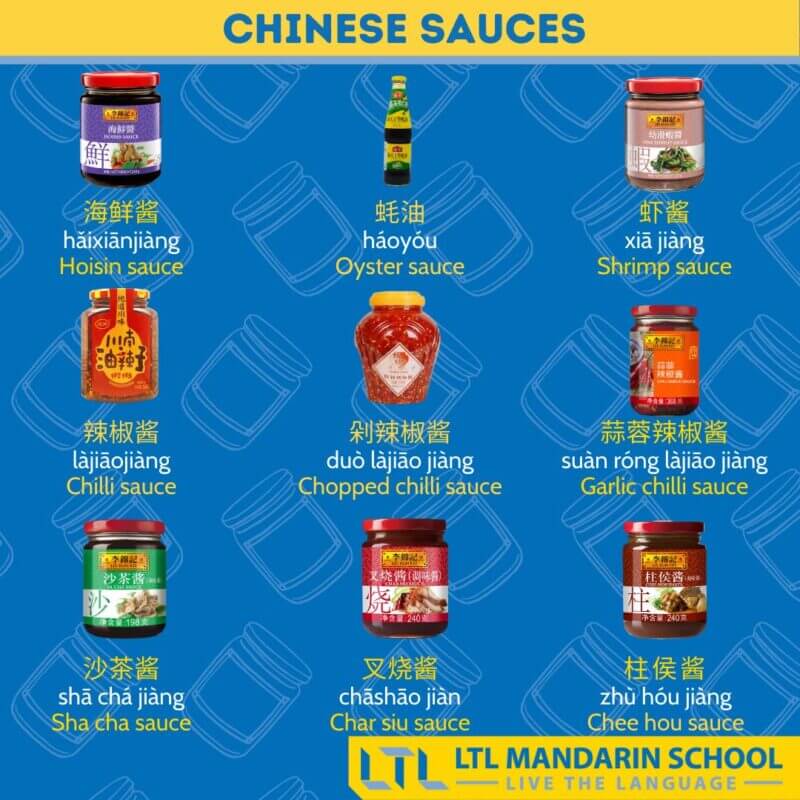
Common Sauces on a Chinese Menu
Sauces are often the key to understanding a dish. If you can read the sauce name, you can picture the flavour:
| HANZI | PINYIN | WHAT IT IS |
|---|---|---|
| 豆豉酱 | dòuchǐjiàng | black bean sauce: fermented black soybeans, garlic, ginger. Rich and savoury |
| 海鲜酱 | hǎixiānjiàng | hoisin sauce: thick, sweet, slightly smoky. Used as a dipping sauce for Peking Duck |
| 蚝油 | háoyóu | oyster sauce: thick, dark, umami-rich. Used in stir-fries and as a finishing glaze |
| 梅子酱 | méizijiàng | plum sauce: sweet-tart, used as a dipping sauce for duck and fried starters |
| 沙爹酱 | shādiējiàng | satay sauce: peanut-based, mild and nutty, popular in Cantonese and Southeast Asian-influenced menus |
| 糖醋汁 | tángcùzhī | sweet and sour sauce: vinegar, sugar, ketchup. The orange sauce on battered meats |
Dim Sum and Cantonese Cuisine || 粤菜 (Yuècài) and 点心 (diǎnxīn)
Cantonese cuisine (粤菜 Yuècài) comes from Guangdong province and the cities of Guangzhou, Hong Kong and Macau. It is built on freshness, light seasoning and precise technique.
Where Sichuan food hits you with numbing heat, Cantonese food is subtle and clean, letting the quality of the ingredient speak.
Dim Sum (点心 diǎnxīn, literally ‘touch the heart’) is the Cantonese tradition of small shared plates served during morning and lunchtime tea sessions called yum cha (饮茶 yǐnchá, ‘drink tea’).
Dim sum is fundamentally different from a standard Chinese dinner: instead of ordering one or two large dishes, you order many small ones to share across the table.
Common dim sum items on the menu:
| HANZI | PINYIN | WHAT IT IS |
|---|---|---|
| 虾饺 | xiājiǎo | steamed prawn dumplings in a translucent wrapper |
| 烧卖 | shāomài | open-topped steamed dumplings, pork and prawn |
| 叉烧包 | chāshāobāo | steamed or baked bun filled with barbecue pork |
| 萝卜糕 | luóbogāo | fried turnip cake, crispy outside, soft inside |
| 肠粉 | chángfěn | steamed rice noodle rolls, often filled with prawn or beef |
| 蛋挞 | dàntǎ | egg custard tart, Cantonese-style, with a flaky or shortcrust pastry |
TIP💡 At a traditional dim sum restaurant, dishes arrive on trolleys or are ticked on an order sheet. You will see 蒸 (zhēng, steamed) and 炸 (zhá, fried) appear a lot, as both are standard dim sum cooking methods.
Chinese Regional Cuisines || Why the Menu Looks Different Everywhere
China does not have one cuisine. It has dozens of regional traditions, each with its own flavour logic, key ingredients and cooking style. Here is a fast guide to the ones you are most likely to encounter on menus:
Cantonese (粤菜 Yuècài): Guangzhou, Hong Kong
Light, fresh, delicate. Steaming and quick stir-frying preserve the natural flavour of ingredients. Famous for dim sum, roast meats (char siu, roast duck) and seafood. Less chilli, more soy and oyster sauce.
Sichuan (川菜 Chuāncài): Chengdu
Bold, numbing and spicy. Built on 麻辣 (málà): Sichuan peppercorn + dried chilli. Mapo Tofu, Kung Pao Chicken and 水煮鱼 (shuǐzhǔyú, water-boiled fish in chilli oil) are all Sichuan originals. If a menu has a lot of 红油 (hóngyóu, chilli oil) and 花椒 (huājiāo, Sichuan peppercorn), you are in Sichuan territory.

Beijing (京菜 Jīngcài): Beijing
Richer, saltier, heavier. Wheat-based dishes (dumplings, noodles, steamed buns) dominate alongside the city’s most iconic export: Peking Duck. Beijing cuisine also features a lot of braising and slow-cooking.
Shanghai (沪菜 Hùcài): Shanghai
Known for sweetness and depth. Red-braising (红烧 hóngshāo) is everywhere. Shanghai cuisine uses more sugar than most other regional styles, giving dishes a sweeter, more caramelised edge. Xiaolongbao (小笼包 soup dumplings) are a Shanghai export loved worldwide.

Western Chinese Takeaway vs Authentic Chinese Food
If you have grown up ordering from Chinese takeaways in the UK or US, some dishes may not exist in China at all. Chop Suey (杂碎 zásuì), Egg Foo Young (芙蓉蛋 fúróng dàn) and Crispy Aromatic Duck with pancakes are Western adaptations.
- Chop Suey (杂碎 zásuì): the name literally means ‘mixed bits’. It is a stir-fry of meat or prawn with bean sprouts, cabbage, celery and other vegetables, all brought together in a thickened, savoury sauce.
- Egg Foo Young (芙蓉蛋 fúróng dàn): a fluffy Chinese-style omelette packed with bean sprouts, onion and meat or prawn. On Western menus it often comes with a brown gravy poured over the top.
- Crispy Aromatic Duck: duck rubbed with five-spice, cooked until the skin is crispy, then shredded at the table. You wrap it in thin pancakes with cucumber, spring onion and hoisin sauce, much like a takeaway cousin of Peking Duck.
- Crispy Shredded Beef: thin strips of beef coated, deep-fried until crunchy, then tossed in a sticky, sweet chilli sauce. A takeaway favourite you are unlikely to find under that name in Beijing or Chengdu.
None of these dishes are bad. They are delicious in their own right.
But walking into a restaurant in Beijing or Chengdu and ordering them will get you a blank stare.
The reverse is also true: plenty of dishes you will find in China (stinky tofu, pig’s trotters, thousand-year-old eggs) never made it onto Western menus.
Chinese Street Food and Snacks
Some of the best food in China never appears on a restaurant menu at all. You will find it at street stalls, night markets and snack windows. Here are three to look out for:
| ENGLISH | HANZI | PINYIN |
|---|---|---|
| BBQ skewers (often lamb with cumin and chilli) | 串儿 | chuànr |
| candied hawthorn on a stick | 糖葫芦 | tánghúlu |
| mooncakes | 月饼 | yuèbing |
TIP💡 串儿 (chuànr) is a late-night favourite in Beijing. Look for 羊肉串 (yángròu chuàn, lamb skewers). 糖葫芦 (tánghúlu) has a crunchy sugar shell over sour fruit, and 月饼 (yuèbing) are the rich, filled pastries everyone eats around the Mid-Autumn Festival.
How to Read a Chinese Menu || Food Restrictions
Sometimes reading the menu is more important than just getting a dish you prefer.
If you have any sort of food restriction or allergy, being able to pick something suitable from the menu is essential.
I’m vegetarian myself, and I also went a period of time being gluten-free. Here are some of the characters I’ve found most useful (and then some)!
过敏 (guòmǐn): allergy
Although you won’t find this on a menu, you can use this word when ordering.
If you have an allergy, you can tell the waiter or waitress, “我对______ 过敏” (wǒ duì _____ guòmǐn), meaning “I’m allergic to ______” and just fill in the blank.
For example, [🔊 我对花生过敏] (wǒ duì huāshēng guòmǐn), meaning “I’m allergic to peanuts.“
素 (sù): vegetable/vegetarian
Again, you may not find this on a Chinese menu, but it’s something you can ask the waiter or waitress.
If the menu is overwhelming and you want to know if the restaurant serves anything vegetarian, we have a hack.
You can ask the restaurant staff:
这里有没有素的菜?
is there vegetarian food here?Alternatively, you can ask if a dish has meat in it (something I ask on a regular basis!)
You can ask:
这个菜有没有肉?
does this dish have meat in it?小麦 (xiǎomài) / 面粉 (miànfěn): wheat/flour
When I went gluten-free for a while, I used these characters to help me.
Gluten-free diets aren’t very common in China, so if I wanted to know if something was gluten free, I asked:
这个用面粉/小麦做的吗?
Is this made with flour/wheat?小麦 (xiǎomài) and 面粉 (miànfěn) are good to know, especially if you buy a pre-packaged food with ingredients listed on the back.
As a tip, if you are very strict about eating gluten free, pretty much all soy sauce is made with wheat, and soy sauce is in a lot of dishes. So make sure your dishes don’t have soy sauce in them!
BONUS – Soy Sauce in Chinese is [🔊 酱油] jiàng yóu
花生 (huāshēng): peanut
Peanuts are sometimes served in Chinese restaurants as a side dish.
This word is important to know if you have a peanut allergy and need to avoid them.
Asking for Recommendations
If worst comes to worst, and you find that the menu is giving you a headache or you simply don’t have time to make a decision, you can always ask the waiter or waitress what they recommend!
I’ve done this plenty of times, and they are always willing to recommend something to me, especially the restaurant’s 招牌菜 (zhāopái cài, signature dish).
This can be particularly helpful if you have a food restriction.
This way, the waiter or waitress can pick something out for you, instead of you trying to scan the menu yourself.
BONUS – If you want to ask for a recommendation, you can say 你推荐什么菜? (nǐ tuījiàn shénme cài?), which means, “what dish do you recommend?”
Time to Order!
When it comes to ordering, the most basic way to order is simply by pointing, if you don’t know how to say anything.
If you want to flex a little Chinese, you can say 我要一个这个 (wǒ yào yīgè zhège), meaning “I want one of this”.
Once you are comfortable with that, check out ordering two of something in Mandarin. Chinese numbers are surprisingly useful at a restaurant.
It’s easy to learn and useful on a daily basis.
Wrapping things up…
Those are my biggest tips for reading a Chinese menu (and ordering) when you’re a beginner.
Hopefully some of these were helpful or reassuring, especially if you are planning a trip to Beijing, Shanghai, Chengdu or any of the other cities we teach in!
If you have been studying Chinese for a while, did I miss any important characters? What other tips do you have for reading Chinese menus? Leave them in the comments below!
And if reading this has made you want to actually use these phrases at a real restaurant, rather than just memorising them from a screen, that is exactly what studying with LTL is about. You live, breathe and dream the language from day one.
If you enjoy this kind of content why not also check out our guide on learning how to read a Korean menu and how to order in Spanish as well!
How to Read Chinese Menus || FAQs
How do you say Menu in Chinese?
Menu in Chinese is 菜单 càidān.
How do you say “I am allergic to…” in Chinese?
You should tell the waiter or waitress – “我对______ 过敏” (wǒ duì _____ guòmǐn)
You just need to add in your allergy where the space is. So for example, if you are allergic to peanuts. You would say “我对花生过敏” (wǒ duì huāshēng guòmǐn).
How do you say “Does this dish have meat” in Chinese?
You should ask the waiter or waitress – “这个菜有没有肉?” zhège cài yǒu méi yǒu ròu?
How do you say Rice in Chinese?
Rice in Chinese is 米饭 (mǐfàn).
How do you say Noodles in Chinese?
Noodles in Chinese is 面条 (miàntiáo) but commonly you’ll just see and use 面 (miàn).
What is the Chinese character for meat?
The Chinese character for meat is 肉 and is pronounced ròu.
What are the 10 most popular Chinese dishes?
The ten dishes you will find most consistently on Chinese menus worldwide are:
1. Kung Pao Chicken (宫保鸡丁 gōngbǎo jīdīng)
2. Peking Duck (北京烤鸭 Běijīng kǎoyā)
3. Mapo Tofu (麻婆豆腐 mápó dòufu)
4. Dumplings / Jiǎozi (饺子)
5. Dim Sum (点心 diǎnxīn)
6. Sweet and Sour Pork (糖醋里脊 tángcù lǐjǐ)
7. Fried Rice (炒饭 chǎofàn)
8. Chow Mein (炒面 chǎomiàn)
9. Red-Braised Pork Belly (红烧肉 hóngshāo ròu)
10. Hot and Sour Soup (酸辣汤 suānlà tāng)
What is the most ordered item on a Chinese menu?
Fried Rice (炒饭 chǎofàn) and Kung Pao Chicken (宫保鸡丁 gōngbǎo jīdīng) are among the most commonly ordered dishes at Chinese restaurants around the world.
In China itself, dumplings (饺子 jiǎozi) and various forms of noodles give them strong competition depending on the region.
What is the big 3 in Chinese cooking?
The ‘big 3’ aromatics that form the flavour base of most Chinese dishes are: garlic (蒜 suàn), ginger (姜 jiāng), and spring onion / scallion (葱 cōng).
You will find all three in stir-fries, braises, soups and dipping sauces. Spot them on a menu or in a kitchen, and you know a dish is going to be deeply flavourful.
What is the best Chinese dish to order if it is your first time?
For a first visit, start with something approachable: Yang Zhou Fried Rice (扬州炒饭 yángzhōu chǎofàn) is a safe crowd-pleaser.
Kung Pao Chicken (宫保鸡丁) adds a little heat.
Dumplings (饺子 jiǎozi) with vinegar dipping sauce are hard to dislike.
If you want something more adventurous, ask the staff for 招牌菜 (zhāopái cài), the signature dish. They will know what they do best.
Want more from LTL?
If you wish to hear more from LTL Language School why not join our mailing list? We give plenty of handy information on learning Chinese, useful apps to learn the language and everything going on at our LTL schools!
Sign up below and become part of our ever-growing community!
⭐ Download our free ebook, your starter pack of essential Mandarin learning resources!
BONUS || Want to study Chinese with us in China? Why not check out our group and individual classes here








[…] in literal terms, are quite different for this proverb. In Chinese 一口 means one mouthful, 吃 (chī) eat, 不成 (bùchéng) impossible, and 胖子 (pàngzi) means a fat person (fatty). Altogether, […]
[…] Menu, please: 请给我菜单 – qǐng gěi wǒ cài dān […]
[…] On the menu are French classics such as Duck Confit and Foie Gras. […]
[…] there would be no other foreigners to turn to when I was struggling to order food in a restaurant, where I would be placed completely out of my comfort zone and thrown into the deep end in terms of […]
[…] menu with all kinds of dishes, such as old Beijing style tofu, savoury pancakes, steamed buns with […]
[…] looking for e.g. noodles (面条 miàntiáo) then it may be useful to learn some basic Chinese characters found in menus. This will enable you to search directly for what you […]
[…] lovely Manchurian restaurant offers amazing Manchu cuisine in a nice, relaxed atmosphere. If the Chinese menu looks intimidating, don’t worry the also have an English one […]
[…] lovely Manchurian restaurant offers amazing Manchu cuisine in a nice, relaxed atmosphere. If the Chinese menu looks intimidating, don’t worry the also have an English one […]
I appreciated that you mentioned that you do not need to know all the characters that are found on the menu to be able to order something. My sister told me that she would love to take me to a Chinese restaurant when she is in town, so I am looking and weighing our options.
We are hoping that we will find a place where we will feel comfortable ordering and we will be able to figure out exactly what we like.
Hi Faylinn,
Yes you can get a good grasp of a menu by just know some key characters, but of the course the more you know, the easy the puzzle becomes!
Good luck and don't forget to download or screenshot our cheatsheet above!
LTL Team
[…] sure to have a look at guide to reading a Chinese menu, for more tips on ordering food at restaurants. We also have a hand menu cheat sheet, which you can […]
[…] and guess what, it’s all cashless. You don’t need to know any Chinese either. So what’s on the menu at […]
[…] who has been in China or to a Chinese restaurant during the Spring Festival period will have seen some New Year decorations. They traditionally […]
[…] many among us. Although a Western drink, mulled wine has become a popular winter addition to many drinks menus all over […]
ZhSnap can help you accurately translate the Chinese food menu.