
Chinese Stroke Order // The Key Rules to Become a Master at Chinese Writing
Do you look at a Chinese character and have no idea how you should start writing it? Then this guide is for you!
Chinese stroke order follows a small set of rules. The two foundations are top to bottom and left to right. On top of these, you write horizontal before vertical strokes, left-falling before right-falling strokes, and the frame before its contents.
You also close a box last, write bottom enclosures and cutting vertical strokes last, draw the centre first in symmetrical characters, and put upper-left dots first and upper-right dots last.
In Chinese, stroke order is called 笔顺 (bǐshùn), literally the ‘stroke sequence’. Because there’s no such thing as a Chinese alphabet, every character is built from individual strokes written in a set order.
We’ll take you through 11 key rules for Chinese stroke order, starting with the two foundations: top to bottom and left to right. We’ll also introduce the eight basic Chinese strokes, so you can write characters that look right and are easy for others to read.
Chinese Stroke Order || Why Chinese Stroke Order Is Important
Chinese Stroke Order || The 11 Key Rules of Chinese Stroke Order
Chinese Stroke Order || Stroke Order in Simplified and Traditional Characters
Chinese Stroke Order || The 8 Basic Chinese Strokes
Chinese Stroke Order || Best Apps and Websites to Practice Chinese Stroke Order
Check out this video of our teacher Alwin taking you through the basics of Chinese stroke order 👇.
Why Chinese Stroke Order Is Important
You might be thinking that well with technology today, how important is it really to know the correct Chinese stroke order?
Well if you plan on being able to write, clear legible Chinese characters that can be understood by others then the answer is very important.

Incorrectly joining up strokes or writing a character in the wrong order can lead to unintelligible handwriting with the proportions all wrong.
Of course, learning correct Chinese stroke order isn’t going to mean you immediately have perfect handwriting, however it does help a lot and means that even if it isn’t that neat your teacher should still be able to understand it.
Stroke order also isn’t just about trying to master neat handwriting. Did you know that apps like Pleco pay close attention to stroke order if you want to search for a character by writing it?
If you’ve ever drawn what looks like a perfect character into Pleco and the right suggestion just won’t appear, stroke order is a likely culprit. Pleco says its handwriting recognizer is fairly tolerant of stroke order mistakes, but it’s noticeably more accurate when you write strokes in the correct order.

Check out the two GIFs on the side to see how important the stroke order is even for a simple character like 文 (wén).
And it’s not just apps that will rely on stroke order to often recognise characters, many Chinese people do it too.
Another reason stroke order matters is that it shows you how characters are built. Most characters are made of smaller components, and the rules tell you to finish one component completely before starting the next.
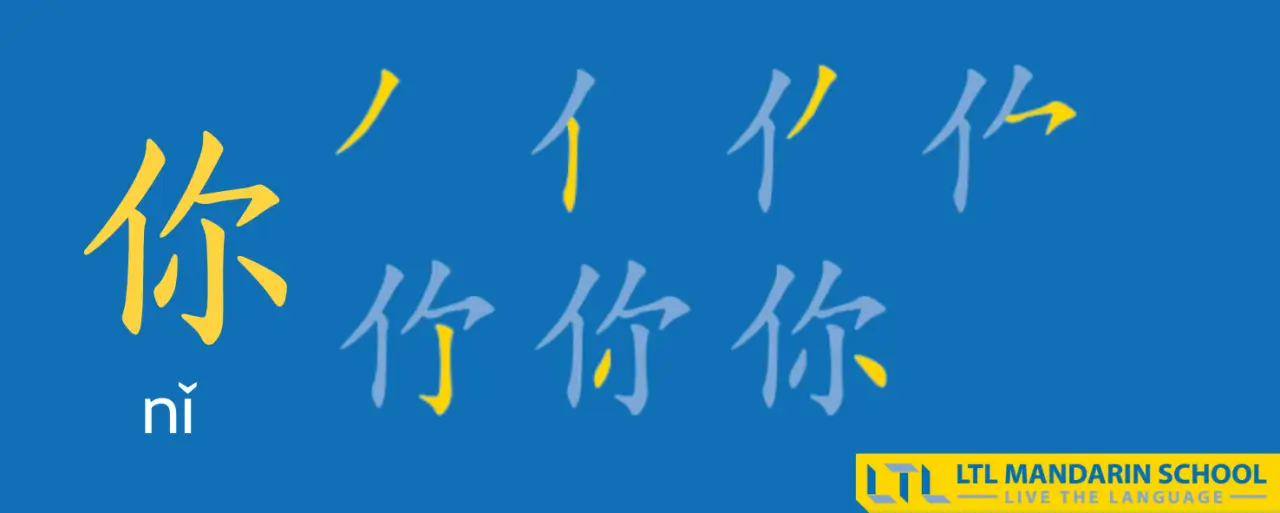
Take 你 (nǐ, ‘you’): you write the person radical 亻 on the left first, then 尔 on the right, each one top to bottom. Once you can spot components like this, picking out the radical in a new character gets much easier. Our guide to the 214 radicals and their meanings is a great next step.
Learning Chinese stroke order will also really help you memorise characters better. If you’re just typing a character into a computer or phone using pinyin you’re not really learning the character in the same way as writing it out.
Instead, you’re learning to recognise the character rather than to write it from memory. Stroke order also helps you tell apart similar characters like 末 (mò, ‘end’) and 未 (wèi, ‘not yet’): in 末 the top horizontal stroke is the longer one, while in 未 it’s the shorter one.
💡 TIP: Want more techniques? Try our tips for memorizing characters.
Once you’ve got stroke order down, picking up everyday phrases feels a lot smoother. If you’d like to build on that foundation with practical speaking and listening skills, a Chinese Crash Course in Shanghai can give you a fast, hands-on introduction.
The 11 Key Rules of Chinese Stroke Order
When it comes to Chinese stroke order there are some key rules that you can apply to make sure you’re doing it correctly. There are two general foundation rules which are: top to bottom and left to right.
However, with more complicated characters this can be confusing to figure out and there are also other rules which can apply so let’s have a look at eleven key rules to help you master Chinese stroke order!
Top to bottom
Our first foundation rule is that most characters should be written from top to bottom. Think of some basic characters like 二 (èr), 工 (gōng) or 三 (sān) and you can clearly see the order these characters should be written in.
This rule also applies to more complicated characters that are “stacked” such as 茶 (chá).

Left to right
The second foundation rule we have for you is that characters should be written left to right. Many Chinese characters are made up of two or three components, so each of these should be finished before moving on to the next one.
When writing each component also remember that the top to bottom rule also applies. Some examples are 你 (nǐ), 谢 (xiè), 做 (zuò), you should be able to see how these characters can be broken down into separate parts.
Horizontal strokes before vertical strokes
Next up we have the rule that horizontal strokes come before vertical strokes. The most simple example of this is 十 (shí) where the horizontal stroke is written before the vertical one, some other examples are 大 (dà) and 天 (tiān).

Left-sloping stroke before right-downward stroke
When a left-falling stroke, 撇 (piě), meets a right-falling stroke, 捺 (nà), you write the left-falling one first. Straightforward examples are 人 (rén), 八 (bā) and 六 (liù), which also follow the usual left to right rule.
It’s less obvious in characters like 父 (fù) and 文 (wén), where the two strokes cross. Even here, the left-sloping stroke still comes before the right-downward one.

Framing strokes before contents
The Framing strokes of characters such as characters that are enclosed by the 囗 (wéi) radical are drawn first, apart from the closing stroke (more about that in the next rule).
Basically you want to write the outside of the stroke before you write the contents inside, here are a few examples: 间 (jiān), 回 (huí), 日 (rì), 月 (yuè).

Box is closed last

As we just saw the frame of a character is written first, however if there is a bottom horizontal stroke then this is always written last.
This means the contents of the enclosure come before the last stroke of the enclosure. Some examples are 因 (yīn), 国 (guó), 目 (mù) and 园 (yuán).

Bottom enclosures come last
Similar to the Chinese stroke order rule of how the box or enclosure is closed at the bottom last, bottom “enclosures” also come last such as 远 (yuǎn), 脑 (nǎo) and 延 (yán).

Vertical stroke cutting through comes last
When there is a vertical stroke that cuts through many other strokes it is generally the finishing stroke. One of the most obvious examples is 中 (zhōng) where the 口 (kǒu) is written first and then the vertical stroke is written last.
A few other examples are 半(bàn), 手(shǒu) and 串(chuàn).

In vertically symmetrical characters the centre goes before the outside
Contrary to the left to right rule, if a character is vertically symmetrical then the centre should be drawn first, think of 小 (xiǎo) or 永 (yǒng).
A character that follows this rule that you should also look out for is 承 (chéng), here although there is a stroke that cuts through vertical lines it doesn’t follow our previous rule, and the 了 in the middle is drawn first.

Upper-left and upper-centre dots come first
Following the top to bottom and left to right rules, it makes sense that upper-left and upper-centre dots are drawn first. A few examples are 六 (liù), 文 (wén), 请 (qǐng), 间 (jiān) and 弟 (dì).

Upper-right and inside dots come last
The last Chinese stroke order rule we have for you is that upper right dots should come last like 玉 (yù), 书 (shū), 求 (qiú), 寸 (cùn), 太 (tài).
But there are a few characters where this doesn’t apply which is when there are two dots (they normally actually look more like dashes than dots) on the top such as 弟 (dì) and 兰 (lán).

Stroke Order in Simplified and Traditional Characters
The 11 rules above work for both simplified and traditional characters. Whether you’re learning simplified characters in Beijing or traditional characters in Taipei, you still write top to bottom, left to right, frame before contents and close the box last.
What changes is how many strokes you write. Many simplified components have fewer strokes than their traditional forms, but the sequence follows the same rules:
| Simplified | Traditional | Pinyin | English | Strokes (simplified / traditional) |
|---|---|---|---|---|
| 门 | 門 | mén | Door | 3 / 8 |
| 车 | 車 | chē | Vehicle | 4 / 7 |
| 讠 | 言 | yán | Speech (radical) | 2 / 7 |
Is there an official stroke order standard?
Yes. For simplified characters, the reference is 《通用规范汉字笔顺规范》 (Stroke Orders of the Commonly Used Standard Chinese Characters, GF 0023-2020), published by the Ministry of Education and the State Language Commission. It sets the stroke order for 8,105 characters, has applied since March 2021 and replaced the earlier 1997 standard.
For traditional characters, the Ministry of Education in Taipei runs its own stroke order reference, and the Education Bureau in Hong Kong publishes another list. Because these references were drawn up separately, a small number of characters are written in a slightly different order depending on which one your textbook follows.
💡 TIP: Follow the standard your textbook or teacher uses and stick with it. Arch Chinese lets you switch between character standards, while Pleco’s stroke order diagrams show traditional characters but use the same stroke order as their simplified forms.
The 8 Basic Chinese Strokes
As well as Chinese stroke order it’s also good to know some of the basic Chinese strokes along with the direction in which the stroke should be written. As we mentioned earlier this will help you a lot when trying to use a written input method like on Pleco to look up a character.
There are eight basic strokes when it comes to Chinese characters and you can see the names of them all below:
| Chinese Name | Pinyin | English Name |
|---|---|---|
| 点 | diǎn | Dot |
| 横 | héng | Horizontal |
| 竖 | shù | Vertical |
| 提 | tí | Rising stroke |
| 捺 | nà | Press (right-falling) |
| 撇 | piě | Throw away, slant (left-falling) |
| 折 | zhé | Turning stroke |
| 钩 | gōu | Hook |
In the graphic below you can also see what the stokes look like as well as the direction that they should be written in.


As you can see from the graphic above with the two hook variations there are many more strokes you can learn. However knowing the basic eight set a strong foundation for learning Chinese stroke order.
There is actually one character that contains all eight basic strokes which is 永 (yǒng).
This idea is known as the Eight Principles of Yong (永字八法, yǒngzì bāfǎ), a traditional calligraphy method that uses 永 to teach the basic strokes. Copying 永 and making sure to follow the correct directions of the strokes is a great way to practice your Chinese handwriting. Once you become familiar with the right direction this will make writing much easier and faster.
Best Apps and Websites to Practice Chinese Stroke Order
There are absolutely loads of apps and websites that you can use to learn Chinese stroke order so we’ve just picked out our top five favourites:
#1 Skritter
Number one on our list has to be Skritter which is one of the best apps out there for learning Chinese characters. Using Skritter the rules of Chinese stroke order will become like second nature to you.

The writing practice feature enables you to write characters with your finger following prompts (as you progress these prompts will disappear).
Skritter is also great as it uses Spaced Repetition Software which is the most effective way to learn Chinese characters and make sure they stay in your memory long-term.
Skritter is a paid for app, with a number of monthly subscriptions available, they also offer a 7 day free trial so you can try it out and see if you want to make the commitment to pay for it or not.
#2 Pleco
A must have for any Chinese learner the free dictionary app Pleco enables you to look up the stroke order for characters.
The free version of Pleco shows stroke order animations for 500 characters. For everything else, you’ll need the paid Stroke Order Diagrams add-on, a one-time purchase that covers about 28,000 characters.
#3 StrokeOrder.com
StrokeOrder.com does exactly what its name promises. Type in any Chinese character and you’ll get an animated, stroke-by-stroke guide showing how to write it, which makes it a handy free check whenever you’re unsure.
💡 TIP: If you’d like a second option, Hanzi Studio works in a similar way. Look up a character or word, watch the animation, then practice writing it yourself.
#4 Chineseconverter.com
Chineseconverter.com has many great features for Chinese learners. Here not only can you look up any Chinese character and get an animation of the stroke order but you can also print customised practice worksheets.
And to top it all off, every resource on the site is free to use. An optional Patreon membership removes the ads and adds a few worksheet extras.
#5 Archchinese.com
Arch Chinese gives you free stroke order animations for every character in the standard simplified character set, plus around 8,000 frequently used traditional characters, with native-speaker audio. You can also switch between character standards, which helps if your textbook uses traditional characters.
Arch Chinese’s printable worksheets with stroke sequences are mainly a paid membership feature, so if you want free worksheets, Chinese Converter is the better pick.
Chinese Stroke Order // FAQs
What is the Chinese stroke order?
The two basic rules of Chinese stroke order are top to bottom and left to right. The other nine rules in this guide build on these two.
What are the six basic rules of stroke order?
The six rules most guides start with are top to bottom, left to right, horizontal before vertical, left-falling before right-falling, frame before contents, and close the box last.
Those six cover most everyday characters. We teach 11 in this guide because the extra five (bottom enclosures last, a cutting vertical stroke last, centre before sides, and the two dot rules) handle the characters that tend to trip learners up.
How do Chinese count strokes?
In order to learn how the Chinese count strokes you first need to learn the eight basic strokes which will then help you break characters down.
What are the basic strokes of Chinese characters?
The eight basic strokes are 点 (diǎn, dot), 横 (héng, horizontal), 竖 (shù, vertical), 撇 (piě, left-falling), 捺 (nà, right-falling), 提 (tí, rising), 折 (zhé, turning) and 钩 (gōu, hook).
You’ll find a table of all eight in the basic strokes section above, and many more variations build on them.
Is stroke order important?
Yes, if you want to properly learn and understand how to write Chinese characters learning the correct stroke order is important.
Is stroke order the same for simplified and traditional Chinese characters?
Yes, the same stroke order rules apply to both simplified and traditional characters. You still write top to bottom, left to right, frame before contents and close the box last.
What changes is the number of strokes, since many simplified components have fewer strokes. The official references for simplified and traditional characters were drawn up separately, so a small number of characters are written in a slightly different order depending on which standard your textbook follows.
Which Chinese character contains all eight basic strokes?
The character 永 (yǒng), meaning ‘eternal’, contains all eight basic strokes. This is the basis of the traditional calligraphy method known as the Eight Principles of Yong (永字八法).
Copying 永 while following the correct direction of each stroke is a great way to practice Chinese handwriting.
What is the best app to practice Chinese stroke order?
Skritter is one of the best apps for practicing Chinese stroke order. You write characters with your finger following prompts that disappear as you progress, and it uses spaced repetition to help characters stick.
Skritter is paid, with a 7 day free trial. For free options, Pleco shows stroke order animations for 500 characters, while StrokeOrder.com and Chineseconverter.com offer free animated guides.
Want more from LTL?
If you wish to hear more from LTL Language School why not join our mailing list? We give plenty of handy information on learning Chinese, useful apps to learn the language and everything going on at our LTL schools!
Sign up below and become part of our ever-growing community!
⭐ Download our free ebook, your starter pack of essential Mandarin learning resources!
BONUS || Want to study Chinese with us in China? Why not check out our group and individual classes here





3 comments
[…] Stroke order is also very important in Chinese. […]
[…] However, we want to learn to write them as well! […]
[…] Related link: https://ltl-shanghai.com/chinese-stroke-order/ […]