
The Chinese Family Tree || How Does It Work?
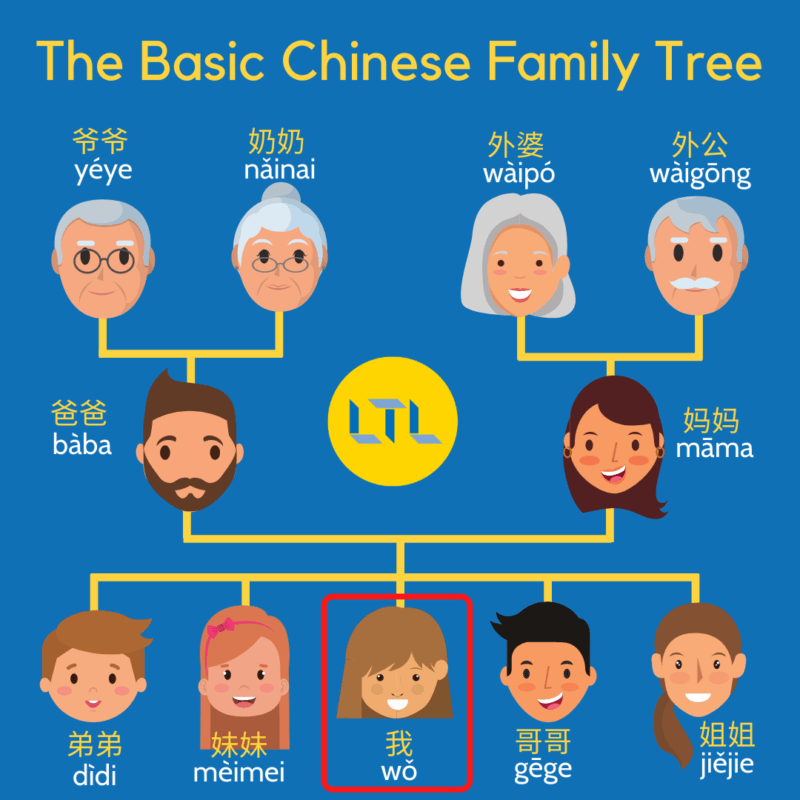
The Chinese family tree uses a separate word for almost every relative, encoding four things at once: which side of the family (maternal or paternal), the relative’s gender, their age relative to your parent, and sometimes their age relative to you.
Whereas in English we can condense it down to something much easier to understand, it isn’t the case with Mandarin.
That is why the single English word “aunt” can map to 姑妈, 姑姑, 舅妈, or 阿姨 in Chinese.
The complicated Chinese family tree is one that leaves you scratching your head, but don’t worry.
We’ve broken it all down below, with tables, images to save, and a logic system that makes the whole thing click. It’s genuinely one of the trickier parts of learning Chinese, but you’ll get there. 💡
BONUS || Curious what your own name would be in Chinese? Get your free Chinese name, it takes about 30 seconds. 🎉
How to Introduce Your Family in Chinese
Why Is the Chinese Family Tree So Complex?
Importance of Address in Chinese
How to Introduce Your Family in Chinese
Knowing the terms is one thing. Being able to use them in a real conversation is another. Here are some example sentences to get you started:
这是我妈妈。 (Zhè shì wǒ māma.) = This is my mum.
他是我哥哥。 (Tā shì wǒ gēge.) = He is my older brother.
她是我姑姑。 (Tā shì wǒ gūgu.) = She is my (dad’s younger) aunt.
我有一个弟弟和两个姐姐。 (Wǒ yǒu yīgè dìdi hé liǎng gè jiějie.) = I have one younger brother and two older sisters.
我外婆住在上海。 (Wǒ wàipó zhù zài Shànghǎi.) = My maternal grandmother lives in Shanghai.
TIP💡 When introducing family to a Chinese host family or new colleagues, Chinese people often ask about your family structure early in conversation. Having these sentences ready will make a great first impression, especially if you’re studying with a host family in Beijing or Shanghai.

Does your head hurt yet?
Whilst you shouldn’t worry too much about memorising all of these, it’s something fun to learn and will definitely impress your Chinese (and foreign) mates.
Plus, it will certainly make a good impression if you’re meeting a Chinese family over Chinese New Year!
You can further expand your knowledge of how the family tree grows by checking out our post about Chinese pregnancy traditions to read bout traditions female family members will follow!
Why Is the Chinese Family Tree So Complex?
In English, one word, ‘uncle’, covers your mum’s brother, your dad’s brother, and your parents’ brothers-in-law. Chinese doesn’t work like that. 🤔
Every family relationship in Chinese has a dedicated term that encodes four pieces of information at once: which side of the family (maternal or paternal), the relative’s gender, their age relative to your parent, and sometimes even their age relative to you.
That means a single English word like ‘aunt’ can map to 姑妈 (gūmā), 姑姑 (gūgu), 舅妈 (jiùmā), or 阿姨 (āyí), depending entirely on context.
Why?
Because Chinese family culture places huge importance on hierarchy, lineage, and knowing exactly where everyone stands.
You’ll find this precision runs through the language at every level, and once you understand the logic, the system actually starts to make sense.
Importance of Address in Chinese
When you first arrive in Beijing or Shanghai, you’ll quickly notice the importance of addressing people correctly, from learning about etiquette and traditions.
Depending on your age, whether you are male or female, and in what capacity you’re meeting somebody, you will be addressed as something else.
Upon first coming to China, I was horrified with the number of people calling me ‘ 美女 (Měinǚ)’ which literally translates to ‘beautiful woman’.
I’m pretty confident… But to be called this several times a day…
In England, it would be pretty creepy. But, I soon learned that it is just a polite form of address.
Others you’ll come across in day to day life include:
帅哥 – shuàigē: Used towards a male in a friendly way (lit. handsome guy)
大哥 – dàgē: Said towards any male to show respect
小姐姐 – xiǎo jiějie: This is a newer term that crept up in Chinese social media, said to younger women
师傅 – shīfù: A term of respect said towards workers e.g. taxi driver
叔叔 – shūshu: A term of respect said to an older person
阿姨 – āyí: Said to older women
老外 – lǎowài: The Chinese word for ‘foreigner’ – you’ll hear this a lot! Lit. Old outsider
同事 – tóngshì: You’ll hear this at work, meaning ‘colleague’
Interestingly enough, you will also hear Chinese people referring to their “brothers 哥哥 gēge” and “sisters 姐姐 jiějiě” meaning that they are just close friends, but not actually family members.
So it is always confusing when someone introduces a group of guys as their “brothers” and you wonder just how many kids are in their family…!
This is also said for “Uncle 叔叔 shūshu” and “aunt 阿姨 āyí”.
Still with us?!
Using the correct terminology is very important in Chinese culture, and this doesn’t stop with family members either!
So, let’s start with the basics.

Immediate Family Members
| English | Characters | Pinyin |
|---|---|---|
| Mom | 妈妈 | māma |
| Dad | 爸爸 | bàba |
| Wife | 妻子 / 老婆 | qīzi / lǎopó |
| Husband | 丈夫 / 老公 | zhàngfū / lǎogōng |
| Older brother | 哥哥 | gēge |
| Older sister | 姐姐 | jiějie |
| Younger brother | 弟弟 | dìdi |
| Younger sister | 妹妹 | mèimei |
| Son | 儿子 | érzi |
| Daughter | 女儿 | nǚ’ér |
Chinese Family Tree: Grandma/Grandpa
Dad’s side:
| Grandmother | 奶奶 | Nǎinai |
| Grandfather | 爷爷 | Yéye |
Mum’s side:
| Grandmother | 外婆 | Wài pó |
| Grandfather | 外公 | Wàigōng |
Chinese Family Tree: Great-Grandparents
For those wanting to go further up the family tree, Chinese also has specific terms for great-grandparents, again split by paternal and maternal sides.
Dad’s Side:
| English | Characters | Pinyin |
|---|---|---|
| Great-grandfather (paternal) | 曾祖父 | zēng zǔ fù |
| Great-grandmother (paternal) | 曾祖母 | zēng zǔ mǔ |
Mum’s Side:
| English | Characters | Pinyin |
|---|---|---|
| Great-grandfather (maternal) | 外曾祖父 | wài zēng zǔ fù |
| Great-grandmother (maternal) | 外曾祖母 | wài zēng zǔ mǔ |
TIP💡 In everyday spoken Chinese, most people simply say 太爷爷 (tài yéye) for paternal great-grandfather and 太奶奶 (tài nǎi nai) for paternal great-grandmother. The formal 曾祖 terms appear more in written or formal genealogical contexts.
Chinese Family Tree: Uncle
Dad’s Side:
| Older brother | 伯伯 | Bóbo |
| Younger brother | 叔叔 | Shūshu |
| Older sister’s husband | 姑父 | Gūfù |
| Younger sister’s husband | 姑父 | Gūfù |
Mum’s Side:
| Older or younger brother | 舅舅 | Jiùjiu |
Chinese Family Tree: Aunt
Dad’s Side:
| Older sister | 姑妈 | Gūmā |
| Younger sister | 姑姑 | Gūgu |
| Older brother’s wife | 伯母 | Bómǔ |
| Younger brother’s wife | 婶婶 | Shěnshen |
Mum’s Side:
| Older sister | 姨妈 | Yímā |
| Younger sister | 阿姨 | Āyí |
| Brother’s wife | 舅母 | Jiùmǔ |

Things That Shocked Me About China
Culture Shock in China can happen to anyone at any time, and it affects everyone differently. China, however, is in a whole different league. We explain why.
Chinese Family Tree: Cousins (堂 vs 表)
Cousins in Chinese are split into two main categories based on which side of the family they come from, and then broken down further by gender and age. Yes, it’s detailed. But it’s also logical once you see the pattern. 💡
堂 Cousins (Paternal Side, Dad’s Brothers’ Children)
| English | Characters | Pinyin |
|---|---|---|
| Male cousin (older) | 堂兄 | táng gē |
| Male cousin (younger) | 堂弟 | táng dì |
| Female cousin (older) | 堂姐 | táng jiě |
| Female cousin (younger) | 堂妹 | táng mèi |
表 Cousins (Maternal Side, Mum’s Siblings’ Children, or Dad’s Sisters’ Children)
| English | Characters | Pinyin |
|---|---|---|
| Male cousin (older) | 表哥 | biǎo gē |
| Male cousin (younger) | 表弟 | biǎo dì |
| Female cousin (older) | 表姐 | biǎo jiě |
| Female cousin (younger) | 表妹 | biǎo mèi |
TIP💡 The second character is the same as the sibling terms you already know: 哥, 弟, 姐, 妹. So once you’ve got immediate family down, cousins follow naturally.
Chinese Family Tree: Nieces and Nephews
Like cousins, Chinese distinguishes nieces and nephews by which side of the family they belong to.
Niece:
| Brother’s daughter (paternal line) | 侄女 | zhínǚ |
| Sister’s daughter (maternal line) | 外甥女 | wàishengnǚ |
Nephew:
| Brother’s son (paternal line) | 侄子 | zhízi |
| Sister’s son (maternal line) | 外甥 | wàisheng |
TIP💡 外 (wài) meaning ‘outside’ or ‘maternal’ appears again here, the same character you saw in 外婆 (wài pó) and 外公 (wài gōng) for maternal grandparents.
Chinese Family Tree: The In-Laws
In-laws in Chinese differ depending on whether you are the husband or the wife.
This trips up a lot of learners, and honestly, it trips up a lot of native speakers visiting new families too. 😄
Father-in-law:
| Husband’s father | 公公 | gōnggong |
| Wife’s father | 岳父 | yuèfù |
Mother-in-law:
| Husband’s mother | 婆婆 | pópo |
| Wife’s mother | 岳母 | yuèmǔ |
Brother-in-law:
| Your older sister’s husband | 姐夫 | Jiěfū |
| Your younger sister’s husband | 妹夫 | Mèifū |
| Husband’s older brother | 大伯子 | dà bó zi |
| Husband’s younger brother | 小叔子 | xiǎo shū zi |
| Wife’s older brother | 大舅子 | dà jiù zi |
| Wife’s younger brother | 小舅子 | xiǎo jiù zi |
Sister-in-law:
| Your older brother’s wife | 嫂子 | Sǎo zi |
| Your younger brother’s wife | 弟妹 | Dìmèi |
| Husband’s older sister | 大姑子 | dà gū zi |
| Husband’s younger sister | 小姑子 | xiǎo gū zi |
| Wife’s older sister | 大姨子 | dà yí zi |
| Wife’s younger sister | 小姨子 | xiǎo yí zi |
So, that’s about it (!)
What makes it more complicated, however, is that in different Mandarin Chinese dialects – things change around, and different areas in China have different preferences of how to refer to their family members.
Chinese Family Values // Why Hierarchy Matters
Understanding the vocabulary is only half the story. The reason Chinese has so many distinct family terms comes down to one deeply held value: 孝顺 (xiào shùn), filial piety.
Filial piety means honouring and respecting your parents and ancestors above almost everything else. It’s been central to Chinese society for thousands of years, rooted in Confucian philosophy, and it shapes how families interact every single day.
A few things you’ll notice in Chinese family life:
- Elders are addressed first. In group settings, you greet the oldest person before anyone else.
- Multi-generational living is common. Grandparents often live with or near their children’s families, especially to help raise grandchildren.
- Age is encoded in the language. Terms like 哥哥 (gēge, older brother) and 弟弟 (dìdi, younger brother) aren’t interchangeable, getting them wrong signals disrespect.
- The paternal line traditionally takes precedence. That’s why terms for dad’s relatives are more granular than terms for mum’s side in classical usage.
This cultural context also shows up in naming. Virtue and family values are often woven directly into Chinese given names, something you can explore in our guide to virtue and family values in naming.
Want to put all of this into practice with a real Chinese family? Our host family immersion programs in Beijing, Shanghai, and across China are one of the best ways to live, breathe and dream the language.
Why not come to China and start using these terms for real.
BONUS | Chinese Relatives Calculator
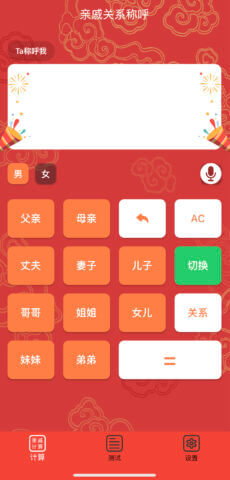
When there’s a problem, the internet usually has a solution! Introducing: the Chinese Relatives Calculator.
This will certainly make things a lot easier when in doubt!
These app allow you to check a relative’s title, so you don’t call them by the wrong one.
Enter a few details such as gender and type of relation with the person, the proper title name will appear for you to use immediately!
Download here:
Enjoy!
FREE POSTER DOWNLOAD
Ready for the big one?
It took our star sales/marketing wizard Katie hours on end to make this so we hope you appreciate it! 👇👇👇
Chinese Family Members – Quiz

If you enjoyed this article, why not check out how to say:
Chinese Family Tree – FAQs
How do you say Mother in Chinese?
Mother in Chinese is – 妈妈 (māma).
How do you say Father in Chinese?
Dad in Chinese is – 爸爸 (bàba).
How do you say Older Brother in Chinese?
Older brother in Chinese is – 哥哥 (Gēgē).
How do you say Older Sister in Chinese?
Older sister in Chinese is – 姐姐 (Jiějiě).
How do you say Wife in Chinese?
Wife actually has two words you can use in Chinese. Either suffice, they are 妻子 (Qīzi) or 老婆 (lǎopó).
How do you say Husband in Chinese?
Husband actually has two words you can use in Chinese. Either suffice, they are 丈夫 (Zhàngfū) or 老公 (lǎogōng).
Is the Chinese surname first or last?
In Chinese, the family name (surname) comes first, followed by the given name.
So 王芳 (Wáng Fāng), Wang is the surname and Fang is the given name. When writing names in English, Chinese people often reverse the order to match Western convention, which can cause confusion. Want to go deeper?
Our guide to Chinese family names and generation names covers this in full.
Why does Chinese have so many words for family members?
Because Chinese family culture encodes hierarchy, lineage, and respect directly into the language.
Each term tells you the person’s side of the family, their gender, and their age relative to your parent, information that matters deeply in a culture shaped by Confucian values of filial piety (孝顺, xiào shùn).
What is 家谱 (jiāpǔ)?
家谱 (jiāpǔ) means family genealogy record, essentially a Chinese family tree book.
Historically, Chinese clans maintained detailed 家谱 documenting lineage across dozens of generations. Some families trace their records back over a thousand years.
It’s one reason Chinese family terminology is so precise: knowing exactly who is who in the family tree has always mattered.
Do Chinese people use formal and informal terms for family members?
Yes. Many terms have formal and colloquial variants. For example, ‘mother’ can be 妈妈 (māma, informal/everyday) or 母亲 (mǔqīn, formal/written).
‘Father’ can be 爸爸 (bàba, informal) or 父亲 (fùqīn, formal). You’ll encounter the formal versions more in writing, official documents, and respectful speech.






13 comments
That was A.W.E.S.O.M.E !!! And I don't even think I can name that many people in my own family, whether in French or English!!! 哈哈哈! Thank you!
So good isn't it but my word what a headache!
Suppose we best get memorising them as fast as possible!
you left out mum's side (mum's) sister's husband (姨夫)!
Nice spot! There are just so many aren't there!
Thanks a lot
what's your wife brother called then?
i don't think you should call it "unnecessarily" complicated, that's kind of a mean thing to call a language that this entire website is about. it's very specific, so you know exactly who you're talking about, and when you say "my cousin" your friends will know exactly who you're talking about and whose side they're on.
Your mum in Chinese?
你的妈妈 😁
[…] Chinese Family Tree 👨👨👧👦 – Complete Guide to The Whole … […]
[…] this day Chinese men usually buy flowers and presents for their wives, daughters, mothers, and the important women in their lives. Female employees usually get half a day off on this […]
[…] She also fought against the belief that women should follow the three obediences: to their fathers, their husbands, and their sons. […]
[…] She also fought against the belief that women should follow the three obediences: to their fathers, their husbands, and their sons. […]
[…] from very basic Chinese, it’s ideal for anyone looking to master basic topics like greetings, family members, directions, visiting the pharmacy, […]