
Discover Chinese New Year 🥳 Chinese Traditions and 10 Surprising Superstitions
Chinese New Year 2026 falls on Tuesday 17 February and marks the Year of the Horse (马年, Mǎ Nián).
The official public holiday runs for 7 days, while the full Spring Festival (春节, Chūn Jié) celebration lasts 15 days and ends with the Lantern Festival on Wednesday 4 March 2026. Below you’ll find the origins, traditions, food, taboos, greetings, and firsthand foreigner accounts of the biggest holiday in China.
Chinese New Year, the biggest moment of the year in China!
Families all across China will celebrate in their own traditional ways.
Many will make Chinese dumplings (jiǎozi, 饺子) as a family and hand out red envelopes (hóngbāo, 紅包) of money to their nearest and dearest.
The amounts inside aren’t random: lucky numbers and auspicious dates shape everything from how much goes in the envelope to which day you give them.
However, these local traditions go much further than gifts of money and eating dumplings and vary greatly from region to region.
China is a vast place with a huge population and contains many different ethnic minorities.
Traditions not only vary from region to region but also from family to family.
First and foremost, let’s get the big questions out of the way:
When is Chinese New Year?
2026: Tuesday 17 February, Year of the Horse
2027: Sunday 7 February, Year of the Goat
Quick Chinese New Year FAQs
How long is Chinese New Year?
The official public holiday in China runs for 7 days.
But the full celebration period lasts 15 days, beginning on the first day of the lunar new year and ending with the Lantern Festival. Many families begin preparations, cleaning, cooking and shopping, a week before the new year arrives.
Why is it called Spring Festival
In Chinese, the festival is officially called 春节 (Chūn Jié), which translates directly as ‘Spring Festival’.
This is the name used throughout mainland China, and it reflects the festival’s agricultural roots: it marks the end of winter and the coming of spring planting season. Outside mainland China, in many diaspora communities and in global media, the term ‘Chinese New Year’ (中国新年, Zhōngguó Xīn Nián) is more commonly used.
Both are correct, and neither is considered offensive.
How is the date set?
Chinese New Year falls on the first day of the first month of the Chinese lunisolar calendar, which is always the day of a new moon.
This places the date somewhere between 21 January and 20 February each year.
Because the lunar calendar doesn’t align perfectly with the Gregorian (Western) calendar, the date shifts every year, which is why some years it feels early and others late.
Where Did Chinese New Year Come From? The Legend of Nian
The Family Reunion Dinner // Nian Ye Fan
Chinese New Year Taboos // What NOT to Do
The Lantern Festival // How Chinese New Year Ends
Chinese New Year Food Traditions // What to Eat and Why
Dragon and Lion Dances // The Street Performances of Spring Festival
Honouring Ancestors // A Tradition Often Overlooked
How to Say Happy New Year in Chinese
10 Chinese New Year Superstitions
New Year Resolutions in Chinese
Chinese New Year as a Foreigner // Sonia’s Story
Chinese New Year as a Foreigner // Noah’s Story
Chinese New Year || FAQs

Where Did Chinese New Year Come From? The Legend of Nian
Chinese New Year has roots stretching back over 3,500 years, with the earliest evidence of New Year celebrations traced to the Shang Dynasty (c. 1600 to 1046 BCE), when people performed ritual sacrifices to honour gods and ancestors at the year’s start.
The Han Dynasty (206 BCE to 220 CE) is when the festival took its modern shape. Emperor Wu fixed the first day of the lunar calendar’s first month as the official start of the new year, a date that still holds today.
But ask any Chinese person why fireworks are lit and red decorations go up, and they’ll tell you about Nian (年).
The Nian is a mythical beast said to emerge at the start of each new year, attacking villages and devouring livestock and crops, and occasionally, people. Villagers discovered that Nian was terrified of three things: loud noises, fire, and the colour red.
From that night forward, families would hang red lanterns, paste red paper on their doors, and set off firecrackers to scare Nian away. The beast never returned.
That’s why red is everywhere during Chinese New Year. It’s not just decoration, it’s protection.
TIP💡 The Chinese word for year, 年 (nián), shares its pronunciation with the name of the beast. So when you celebrate the new year, you’re also symbolically ‘defeating’ Nian one more time.
Over the centuries the festival evolved further. The Zhou Dynasty formalised the lunar calendar; the Tang and Song Dynasties added public celebrations, poetry, and lanterns; the Qing Dynasty cemented many of the family reunion traditions still observed today.
In order to introduce you to different local Chinese New Year Traditions from different parts of China, we asked 3 of our teachers at LTL Mandarin School to tell us all about their own regional traditions and family traditions.

Want to experience Spring Festival in China yourself? There’s nothing quite like living through it with a host family in Beijing or Chengdu.
Find your perfect Mandarin program and plan your trip around the festival.
Chinese New Year Traditions
Chinese New Year Traditions #1 – Thomas from Beijing
My name is Tongda (Thomas), a Chinese teacher from LTL.
I’m an “old” Beijinger, generations of my family have lived here. I grew up in the Tian’anmen area, in a Hutong house.
Different places have different culture and I would like to share with you some traditional culture of Beijing for celebrating the Chinese New Year.
Before Spring Festival’s Eve, people who live in the Hutongs put couplets with blessings on each side of the gate to their courtyard and also put one on the top of gate.
For example: Welcome the New Year, Happy Year of Sheep, all the best and luck in the New Year and so on.
We also put The Door God on the gate of courtyard, which is used to scare away evil spirits.
We eat dumplings together with the family on New Year’s Eve, watch the Spring Festival TV gala and then watch fireworks through the window.
Tongda (Thomas), LTL Teacher

The Great Race 🐯 Ultimate Guide to Chinese Zodiacs
Have you ever wondered about the origin of the Chinese Zodiacs and how the animal were selected? Did you know there was a Chinese Zodiac Race? Who won it?
Chinese New Year Traditions #2 – Emma from Fuzhou

My hometown is in a county town called Yongtai which belongs to Fuzhou city in southern China.
The days before Chinese New Year’s Eve, every family starts to prepare for the celebration. First of all, we do the spring-cleaning to embrace a new and clean year. The next step is to prepare food for the New Year’s Eve feast.
We don’t have dumplings but Tangyuan (汤圆) which is a kind of round and white food indicating Tuanyuan (团圆, the family reunion).
We also eat another white and round dish but this one is a flat cake made of rice called Niangao (年糕).
A fish dish is a necessity on the table every year, because fish (鱼 yu) indicates 年年有余 (nian nian you yu) which means every year we will have plenty of food.
Every year, we also enjoy a kind of traditional noodle made from eggs and a kind of sweet potato which is called Longyan (蛋燕).
Before we start the dinner of the New Year’s Eve, we offer some sacrifices to the Goddess of kitchen.
We believe she will bless and protect us. Every year I enjoy the food on the table and I know my mother has already kept half of the delicious food in the kitchen which we will enjoy again on the first day of the New Year. To eat the food that is kept from the last day of last year is another way to improve nian nian you yu.

Traditional Food in China 🥟 14 Of The Very Best (Not Sweet and Sour Chicken)!
Traditional Food in China // There is an endless list of incredible Chinese dishes but what are the best? Here’s the top 10 you simply cannot miss.
After the spring-cleaning, every family starts to decorate their house, like posting new year’s scrolls and the Fu 福 character which normally should be upside and down to show that Fu is arriving.
When it comes to the evening of New Year’s Eve, the children will be very excited as they get the “lucky money” from the senior members of the family and they love the fireworks display.
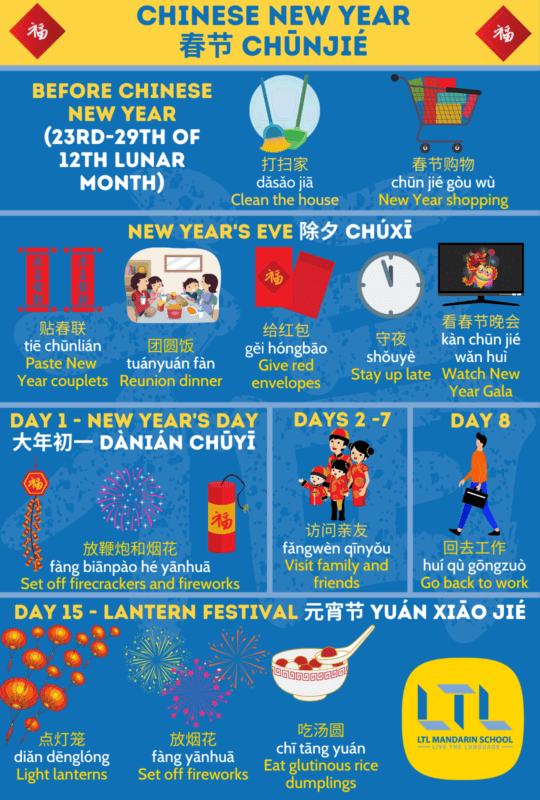
On the first day of the new year, fathers will set off fireworks to “wake up the New Year”.
Meanwhile mothers start to prepare the big breakfast. Every one should wake up by themselves and appear at the table with their new dresses.
We cannot knock at other people’s door to wake them up as it will bring bad luck to them.
On the first day just family members spend time together.
From the second day onwards, every family will start to welcome the visitors and they can enjoy the get-together time which is really nice.
These are the things my spring festival consists of.
Emma Chen, LTL teacher.
Chinese New Year Traditions #3 – Cynthia from Liaocheng
My name is Zhang Xin (my English name is Cynthia), I come from Liaocheng city of Shandong province, east of China.
Because Shandong province is the hometown of the Confucius, the spring festival customs are very important for us.
Spring Festival runs from Laba Festival (the eighth day of the twelfth lunar month) to Lantern Festival (the fifteenth day of the first lunar moon).
On Laba Festival, people like to eat Laba rice porridge which is rice porridge with nuts and dried fruit.
From that day on, people start to clean and clear out their house, buy new clothes and delicious food to prepare for Spring Festival.
On the “small new year” (the twenty third day of the twelfth lunar moon), people need to eat dumplings and “free the kitchen god” who, according to myth, goes to visit the Jade Emperor and reports on the family’s performance in the last year.
The most important day of Spring Festival is New Year’s Eve.
This day of the year is also known as the “big thirty”.
After noon, people will paste couplets and paste the character of “Fortune” upside down as this means fortune will arrive in the future.
In the evening, there will be the family reunion dinner and afterwards the custom of giving gifts of money. When it is 12:00am, every family will light fireworks.
The first day of the new year is also very important. People should get up early in the morning to visit relatives, pay a new year call, and adults need to give children “Ya sui” money for a gift.
From now on, people would visit relatives until Lantern Festival, especially the married women who visit parents on the second day.
On Lantern Festival (the fifteenth day of the first lunar moon), we will eat Yuanxiao (rice glue ball) and appreciate all the beautiful lanterns.
Cynthia, LTL teacher
From all of the teachers and staff here at LTL, 新年快乐
The Family Reunion Dinner // Nian Ye Fan
The most important meal of the Chinese year has a name: 年夜饭 (Nián Yè Fàn), the New Year’s Eve Reunion Dinner.
For hundreds of millions of Chinese families, this is the meal everything else builds towards. Train tickets sell out months in advance because people will travel any distance to be home for Nian Ye Fan. The annual Spring Festival travel rush, 春运 (Chūn Yùn), is the largest annual human migration on the planet, with billions of journeys made in the weeks around the holiday. All of it, ultimately, for this one meal.
The table is set with dishes chosen for their symbolic names and shapes.
The whole family gathers: grandparents, parents, children, aunts and uncles. The generations eat together, pour baijiu (白酒) or tea for the elders, and watch the CCTV Spring Festival Gala (春晚 Chūn Wǎn), a nationally televised variety show that has run since 1983 and regularly attracts over a billion viewers.
At midnight, or just before, the firecrackers start. In cities where fireworks are restricted, families now often watch online streams of displays from other cities, or step outside to see distant lights over the skyline.
If you’re fortunate enough to be invited to a Chinese family’s Nian Ye Fan, say yes. It is, without question, one of the most memorable experiences you can have in China.
We also eat New Year’s cake, which in Chinese is called “nian gao” (nian – year, gao – high). Eating this ensures everything will get better and better, year after year.
On the first day of the New Year, we start to visit relatives. However, girls can’t visit relatives on the first day, they normally start on the second day.
We don’t sweep the floor, throw out the rubbish, take a shower or have our hair cut on the first day of New Year.
Chinese New Year Taboos // What NOT to Do
On Chinese New Year’s Day (in 2026, that’s Tuesday 17 February), there are a number of things you should avoid. These aren’t just superstitions to the people who observe them, they’re taken seriously across generations.
Don’t sweep or take out the rubbish. Sweeping on New Year’s Day is believed to sweep away your good luck and fortune along with the dirt. Wait until the second day at the earliest.
Don’t wash your hair. In Mandarin, hair (发 fà) shares its pronunciation with the character for prosperity (发 fā). Washing it away on New Year’s Day symbolically washes away your wealth.
Don’t use scissors, knives, or sharp objects. Sharp objects can ‘cut’ your luck, relationships, or prosperity for the year ahead.
Don’t say unlucky words. Words associated with death, sickness, poverty, or ghosts are strictly off the table. This extends to numbers too: avoid gifting money in amounts containing 4 (四 sì), which sounds like death (死 sǐ).
Don’t wear black or white. Both colours are associated with mourning and funerals. Red, gold, and bright colours are what you want.
Don’t break anything. Breaking a bowl, plate, or glass is considered bad luck. If it does happen by accident, the fix is to say ‘suì suì píng ān’ (岁岁平安), ‘peace year after year’, which turns the mishap into a blessing.
Don’t cry. Crying on New Year’s Day is said to set the emotional tone for the whole year. Keep spirits high.
Don’t lend or borrow money. Starting the year in debt, or putting someone else in your debt, is considered inauspicious.
TIP💡 If you’re spending Chinese New Year with a Chinese family for the first time, don’t panic about the rules. Most families understand that guests won’t know every custom. Just follow the lead of your hosts and you’ll be fine.
Instead we normally buy fruit as presents to give to relatives. Different fruits bring different wishes, for instance:
- Apples : which stand for safety, sound and peace
- Tangerines : which bring big luck
- Oranges : stand for dreams coming true
- Peaches : stand for long life

DID YOU KNOW: In Chinese culture, we have 12 signs of the zodiac: Rat, Ox, Tiger, Rabbit, Dragon, Snake, Horse, Goat, Monkey, Rooster, Dog, and Pig.
The order of these animals comes from the legend of the Great Race. The Jade Emperor declared that the first 12 animals to cross a great river would have a year named in their honour. The Rat, small but clever, hitched a ride on the Ox’s back and jumped off at the finish line to claim first place. The Pig arrived last, reportedly having stopped to eat and take a nap along the way.
2026 is the Year of the Horse 🐴 (马年 Mǎ Nián). Horse years are energetic and forward-moving. People born in Horse years are often described as independent, enthusiastic, and quick-thinking.
Interestingly, Chinese zodiac year naming traditions also influence how parents choose names for children born in a given year.
The Lantern Festival // How Chinese New Year Ends
The Lantern Festival (元宵节 Yuánxiāo Jié) marks the final night of the 15-day Spring Festival celebration. It falls on the 15th day of the first lunar month, in 2026, that’s Wednesday 4 March.
After weeks of family visits and feasting, the Lantern Festival is a more public, community celebration. Streets and parks fill with thousands of glowing red and gold lanterns. Families walk together in the evening, children carry paper lanterns shaped like animals or cartoon characters, and in many cities large-scale lantern displays are set up in public parks.
Riddles on lanterns (灯谜 dēng mí) are a classic Lantern Festival tradition.
People write riddles on slips of paper hung from lanterns; anyone who guesses correctly wins a small prize. It’s playful, social, and a genuine test of your Chinese, something our students in Beijing and Chengdu tell us they love.
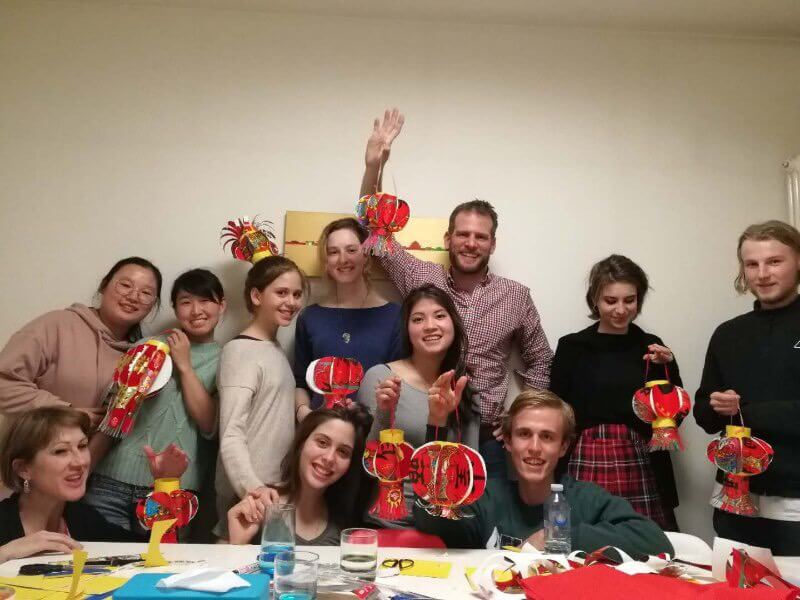
Tang Yuan (汤圆), sweet glutinous rice balls served in broth, are the signature food of the evening, symbolising family unity and the full circle of the festival.
In some cities, dragon dances and lion dances make a final appearance, sending off the new year in style.
TIP💡 If you’re studying in Beijing or Shanghai during the February to March window, the Lantern Festival is genuinely worth staying for. The public displays in cities like Chengdu and Xi’an are spectacular.
In the evening of the Lantern Festival, people like to go for a walk outside, which is said to bring good health for the year ahead and signifies the end of the Spring Festival. These are the traditions for celebrating New Year as a Beijinger. Happy Spring Festival!
Planning a trip to China around the Spring Festival or other major celebrations?
Check out Chinese National Holidays for a full calendar of dates to plan your study trip around.

Chinese Teachers from LTL Told Me The Most Beautiful Chinese Girl Names (for 2026)
I spoke to 17 Chinese teachers from all over China to get the best Chinese girl names for 2025. Here is the final result.
Chinese New Year Food Traditions // What to Eat and Why
Food is at the heart of the Spring Festival, and every dish on the table has a meaning. Here are the ones you’ll find at almost every Chinese New Year table:
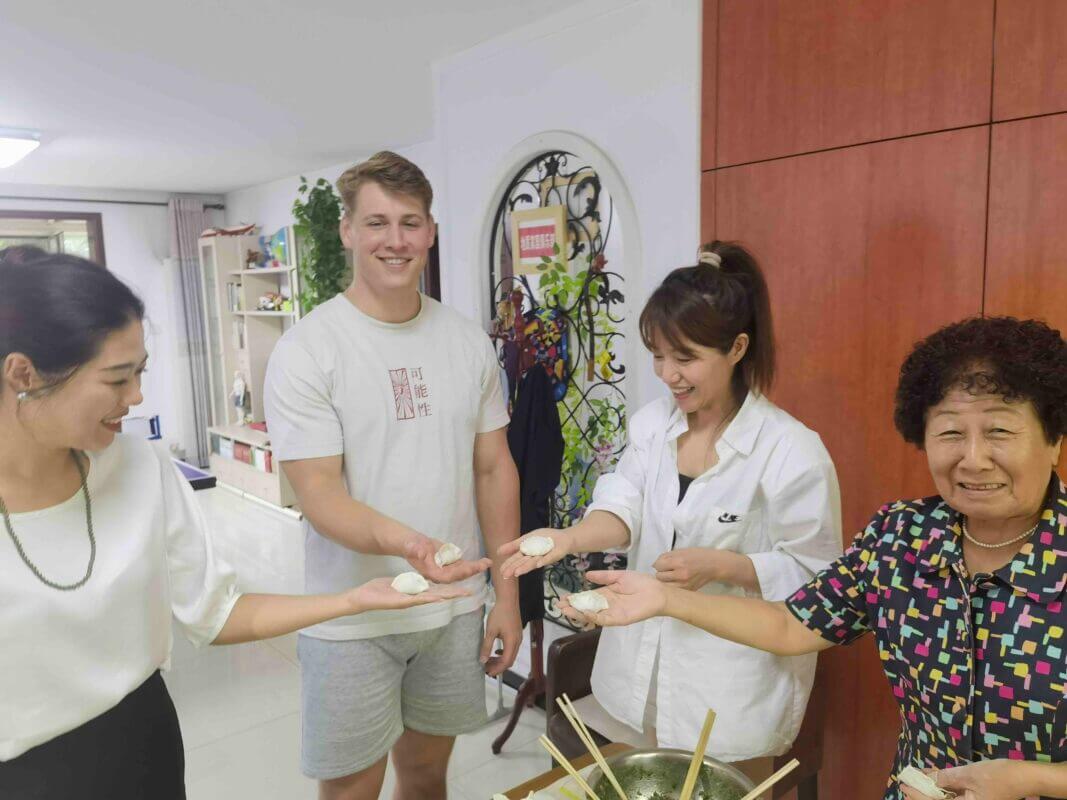
Dumplings (饺子 jiǎozi) are the number one New Year food in northern China. Their shape resembles ancient gold ingots, so eating them is said to bring wealth in the new year. Families often fold them together on New Year’s Eve, the process itself is part of the tradition.
Fish (鱼 yú) is served whole, head and tail intact. The word for fish sounds like the word for ‘surplus’ or ‘abundance’ (also 余 yú), so a whole fish on the table means you’ll have more than enough in the coming year. Custom says you leave some on the plate; finishing it entirely would ‘use up’ your good fortune.
Nian Gao (年糕) is the sticky rice cake Thomas mentions above. The name literally means ‘year high’, eating it signals that your prospects will rise year after year. It’s one of the most symbolic foods of the festival.
Longevity Noodles (长寿面 chángshòu miàn) are served uncut. The longer the noodle, the longer your life. Whatever you do, don’t cut them, it’s considered very bad luck.
Tang Yuan (汤圆) are glutinous rice balls filled with sesame, peanut, or sweet red bean paste, served in a sweet broth. These appear especially at the Lantern Festival on the 15th day, symbolising family unity and wholeness.
Citrus fruits, especially tangerines and oranges, appear as gifts and table decorations. Their golden colour represents gold and good fortune. Mandarin oranges in particular are exchanged as gifts, especially in southern China and Singapore.
TIP💡 If you’re visiting a Chinese family during the New Year period, bringing a box of tangerines or a red-packaged tin of New Year cookies is always well received. It’s a small gesture with a big meaning.
Dragon and Lion Dances // The Street Performances of Spring Festival
If you’ve ever seen Chinese New Year celebrations in person, you’ve probably seen the dragon and lion dances. They’re hard to miss.
Dragon Dance (舞龙 wǔ lóng): A team of performers carries a long, colourful dragon puppet on poles, moving in flowing waves to drumbeats and cymbals. The dragon can be anywhere from 10 to over 100 metres long. In Chinese culture, dragons are symbols of power, dignity, and good luck, the opposite of their Western counterparts. The longer and more vigorous the dance, the more luck it brings.
Lion Dance (舞狮 wǔ shī): Two performers inside a single lion costume, one operating the head, one the body, mimic a lion’s movements, jumping, rolling, and responding to the rhythm of percussion.
The lion ‘wakes up’, ‘eats’ a head of lettuce hung above a shop entrance (symbolising wealth and green prosperity), and spits the leaves back out as a blessing.
Business owners often pay for lion dance troupes to visit their shops during the New Year period for exactly this reason.
The sounds of drums and cymbals are deliberate: loud noise is part of the tradition going back to the Legend of Nian. The performances aren’t just entertainment; they’re a way of driving away bad spirits and welcoming good fortune.
TIP💡 Dragon and lion dances happen all over China during the Spring Festival, but Guangdong province and cities like Foshan have some of the most impressive lion dance troupes in the world. In Singapore, lion dance competitions draw teams from across Asia.
Honouring Ancestors // A Tradition Often Overlooked
For many Chinese families, particularly in southern China, Fujian, Guangdong, and overseas communities in Singapore and Malaysia, Chinese New Year is also a time to honour ancestors.
Before the Reunion Dinner, or on New Year’s Day itself, families set out offerings of food, incense, and paper items at ancestral shrines or gravesites.
The purpose is to invite the spirits of deceased relatives to share in the New Year celebrations and to ask for their blessing and protection in the year ahead.
This practice reflects the deep Confucian value of filial piety (孝 xiào), respect for parents and ancestors, that runs through Chinese culture. It’s a quieter, more private tradition than the firecrackers and red lanterns, but no less meaningful to the families who observe it.
23 Wonderful Ways to Say Thank You in Chinese
Thank You in Chinese is 谢谢 // It’s great to understand different ways to thank someone, there are always different contexts, formal or informal etc.
How to Say Happy New Year in Chinese
Knowing how to greet people in Chinese during the New Year is one of the most useful things you can learn before visiting, or before the celebrations start in your city.
In Mandarin:
新年快乐 (Xīn Nián Kuài Lè), ‘Happy New Year’. Literally: new year, happy/joyful. This is the most universally understood greeting and works throughout the New Year period.
恭喜发财 (Gōng Xǐ Fā Cái), ‘Wishing you prosperity’. Literally: respectfully wishing you wealth. You’ll hear this constantly in southern China and among overseas Chinese communities. The short reply is 红包拿来 (hóngbāo ná lái), ‘now hand over the red envelope!’, which always gets a laugh.
新年好 (Xīn Nián Hǎo), ‘Happy New Year’ (casual). A slightly less formal option, common in Beijing and northern China. Good for everyday greetings with neighbours or shopkeepers.
万事如意 (Wàn Shì Rú Yì), ‘May all your wishes come true’. A slightly more formal blessing, often written on cards or couplets.
In Cantonese:
新年快樂 (San Nin Faai Lok), the Cantonese equivalent of Xīn Nián Kuài Lè.
恭喜發財 (Gūng Héi Fāt Chòi), probably the most famous Chinese New Year phrase globally, thanks to Cantonese communities in Hong Kong, Malaysia, Singapore, and across the diaspora.
TIP💡 In Beijing and northern cities, 新年好 (Xīn Nián Hǎo) is more common than 恭喜发财. Use the latter when visiting families from Guangdong, Hong Kong, or Singapore and you’ll impress them immediately.
10 Chinese New Year Superstitions
So, we’ve learnt about what Chinese people like to do with their Chinese New Year, but the festival runs much deeper than this.
They say to understand a language you must also understand the culture. So we want to dig deeper into Chinese New Year and study some of the superstitions that Chinese deal with during the holidays.
SO let’s get stuck into some rather wacky Chinese New Year superstitions starting with…
The Chinese believe it’s crucial to start the year on the right foot because whatever you do on the first day, week, even month, of the lunar New Year will affect how your year will turn out.
With that said, there are many Chinese New Year superstitions that the Chinese follow to have a lucky and auspicious start to the year.
1. Waking Up On the Right Side of the Bed
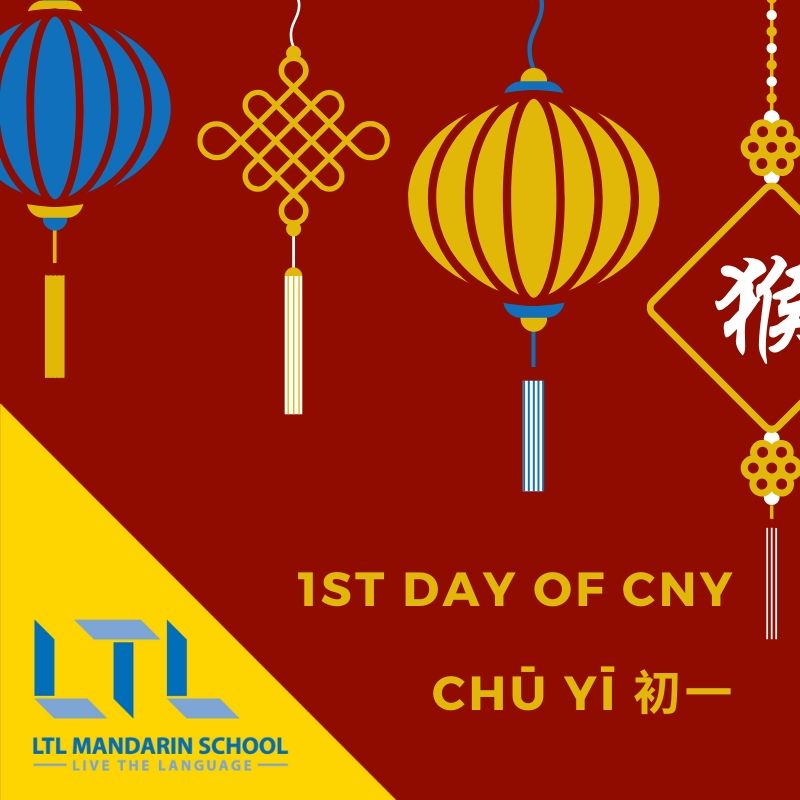
On the morning of Chinese New Year, members of a Chinese family usually wake up by themselves naturally.
You should not tell someone to wake up or visit someone who has not woken up.
This is bad luck for the person still in bed.
If you go to wake someone up, then they will be rushed and bossed around for the year.
If you visit someone who has not woken up, they will be bed-ridden for the entire year. So it’s better to let everyone wake up on their own schedule. What a perfect opportunity to catch up on some snooze!
Once you do wake up, remind yourself to open the windows, and doors.
Not only will the fresh air help you wake up, leaving the doors and windows open on the first day of Chinese New Year, or 初一 (Chū Yī), allows good fortune and prosperity to enter the house.
The Chinese refers to the first day of a lunar month as 初一 (Chū Yī), and the second day as 初二 (Chū èr), so on and so forth until 初十 (Chū Shí), after which the days are simply referred to as numbers.
2. What’s For Breakfast?
When the family is ready for breakfast, they should find the rice jar, or 米缸 (Mǐ Gāng) filled.
The rice jar should not be allowed to be empty during Chinese New Year.
An empty rice jar causes anxiety in the family because it’s a bad omen that the family will starve that year. So if you have a rice jar, remember to fill it up before the Chinese New Year!
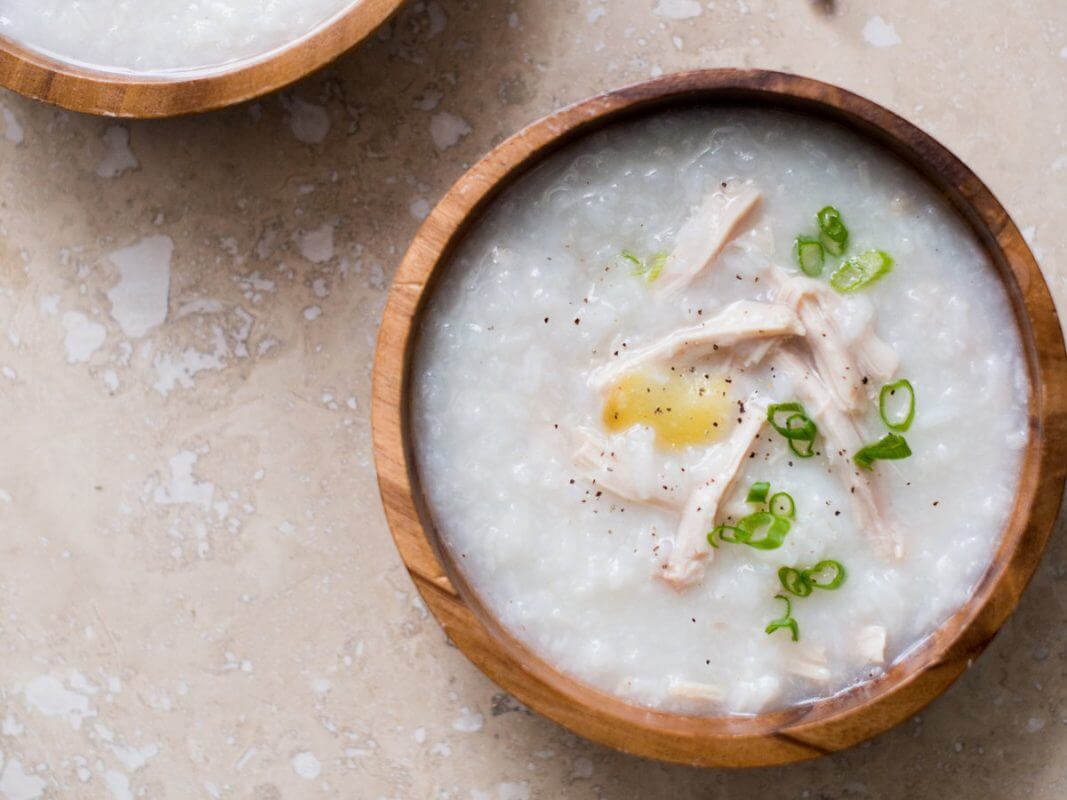
While congee, also known as porridge, is a common breakfast in China; the porridge should not be served for breakfast on Chinese New Year.
This is because in the past, porridge were usually consumed by the poor.
Having it for breakfast on Chinese New Year means that you will be poor and hungry the whole year.
Maybe you want to have your usual bacon and eggs. Not today.
One should not eat meat for breakfast on Chinese New Year. There are two possible explanations for this taboo. One explanation has its root in Buddhism.
Many religious families believe that not having meat for breakfast on the morning of CNY will help you accumulate good virtue, or 积德 (Jī Dé); and doing so will bring good karma for the entire year.
Another explanation to not eat meat is a reminder for the family to not be wasteful.
So what can you eat?
汤圆 (Tāng Yuán), or sticky rice balls, and 饺子 (Jiǎo Zi), or dumplings, are some popular choices. Vegetarian rice buns, or 菜包 (Cài Bāo) with soy milk are also okay.
When you’re done with breakfast, be careful while you put the dishes away. Breaking dishes on Chinese New Year is bad luck.
Because broken, or 碎 (Suì) is a negative word and therefore breaking dishes is another bad omen for the rest of the year.
If someone does accidentally drop a bowl or a plate, immediately wrap it with red paper and say a few lucky phrases to make amends. You can say phrases such as 岁岁平安 (Suì Suì Píng Ān), which means peace and security every year, or 大发 (Dà Fā), meaning great wealth.
3. Dressing For Success- And Luck!

After breakfast, it’s time to change out of your pajamas and get dressed for the day.
Oh the struggle! Before you throw in the towel and put on your usual comfy white jeans and a black sweater, think again.
Black and white clothes should be avoided on Chinese New Year because those colours are associated with mourning and death in Chinese culture.
Instead, opt for something more colourful.
If you can’t decide on what to wear, you can never go wrong with red, an auspicious and festive, or喜庆 (Xǐ Qìng) color, and the perfect one to ring in the lunar New Year.
4. To Clean or Not to Clean
While you have some free time, you might think it’s a good idea to do some cleaning. Stop! You should not sweep or take out the rubbish until the 5th day of the New Year.
The Chinese believe any waste we produce from the first till the fourth day of the New Year is 财气 (Cái Qì), or money luck; whereas those produced from 5th day on is 穷气 (Qióng Qì), which is “poor luck” that causes you to lose money.
So by not taking out the trash or doing any cleaning until the 5th day, you are actually accumulating wealth, or 聚财 (Jù Cái). Yes please!
Speaking of cleaning, you also should not wash any clothes on the first and second day of Chinese New Year.
It’s believed that the first two days of CNY are the celebrations for the birthday of Water God, 水神 (Shuǐ Shén). And doing your laundry might offend the deity.
So if you don’t want to risk catching bad luck as a result, better wait a few more days. What is there to complain?
5. New Year, No New Hairstyle!
Similar to the no-washing-clothes rule, hair must also remain unwashed and uncut on Chinese New Year.
This, similar to other Chinese New Year superstitions, is related to pronunciation.
In Mandarin Chinese, the characters for hair, 头发 are pronounced tóufa. The ‘fa’ is similar to the ‘fa’ in 发财 (fācái), which means to become wealthy.
Therefore, cutting your hair on this day is akin to cutting your chances of becoming wealthy!
However, if you want a new ‘do to bring in the new year, more and more Chinese people are now switching up their hairstyles before Chinese New Year, with some even thinking this new look will bring in new wealth- bonus!

6. When to Make Visits
Traditionally, the first day of the New Year is when we start to visit relatives to send them good wishes, or 拜年 (Bài Nián).
For the kiddos, this is their annual chance to collect red packets from the adults. The visiting of the relatives usually start on the first day of CNY.
However, women are not allowed to visit the relatives until the second day.
Women should especially avoid visiting their parent’s family 娘家 (Niáng Jiā) on the first, fourth, or the fifth days of the New Year.
Doing so will bring bad fortune to their parent’s family.
Before you go knocking on the doors of your relatives, bear in mind that you should not make visits on the third day of Chinese New Year.
Because it’s the day of the Red Dog, or 赤狗日 (Chì Gǒu Rì). The Red Dog is the God of Blazing Wrath. Visiting on this day is believed to bring quarrel and fights.
To avoid the Red Dog and maintain harmony, the Chinese usually refrain from making visits to the relatives on the third day of the CNY.
Speaking of fights, avoid any arguments during Chinese New year, especially on the first day.
According to Chinese folk tale, the first day of CNY is when the deities makes visits to the families on Earth to delivery good wishes and lucks. If they hear arguments from a household, they will deem this family to be ill-mannered, undeserving of any good wishes, and leave with disdain.
The family would then miss out on their yearly portion of good luck from the deities. What a pity!
Not all CNY visits are created the same. While it’s perfectly okay to visit relatives in their homes, avoid visits to the hospital unless absolutely necessary; visits to the hospital during the CNY can bring illness for the year ahead.
You should also avoid taking medication if you can.
Taking medicine on CNY can mean that you will be ill and be needing of medication for the entire year. Perhaps drink more hot water instead?
7. The Art of Gifting
Let’s say you decide to visit the relatives on the second day of the New Year, or 初二 (Chū èr) with the whole family.
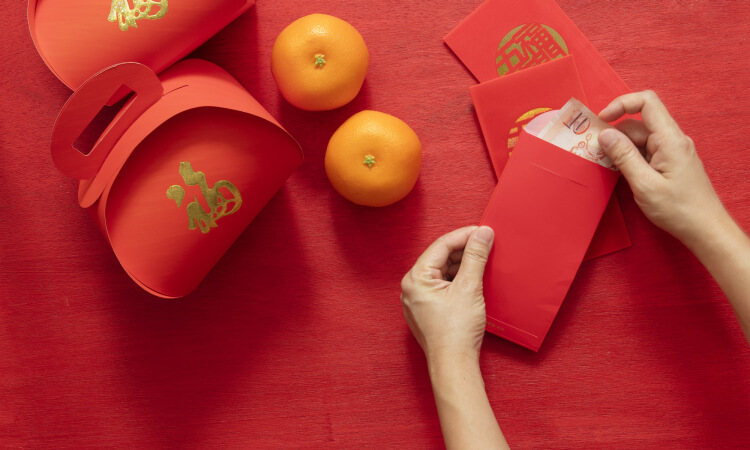
You’ve wrapped all the gifts with bright red gift wraps and stashed enough cash in the Red Envelopes for the children.
Do a last minute check to make sure you won’t inadvertently offend your relatives with an inappropriate gift.
You should avoid gifting clocks or watches, sandals, pears, umbrellas, mirrors, as well as things that are white and black.
Because all of them either sound negative or have a negative omen. For example, clock, 钟 (Zhōng), sounds like the word 终 (Zhōng), which means the end.
So when you’re gifting someone a clock, it seems like you bidding them farewell from this earth, 送终 (Sòng Zhōng).
Another common gift you should avoid is pear, 梨 (Lí),which sounds like 离 (Lí),to separate.
You certainly do not want to wish your relatives any kind of separation.
However, do educate yourself on local taboos. For example, in Mandarin, apple, 苹果 is pronounced Píng Guǒ.
But in Shanghainese, it is Bīng Gu, which sounds like passed away from sickness. If you’re in Shanghai, best avoid gifting apples.
Most other fruits are general okay and some are favored for their auspicious sounding names.
For example, apple, 苹果 (Píng Guǒ), sounds like safety, sound and peace, or 平安 (Píng Ān); tangerine sounds like good luck, 吉 (Jí); orange, 橙 (Chéng), sounds like dreams come true, or 成 (Chéng) and peaches 桃 (Táo) stand for long life.
Check also the amount of money you put in the red packets. Generally speaking, all even numbers are acceptable, except those with the number 4 of course. Avoid giving out red packets in odd numbers.

Chinese Gift Giving Etiquette 🎁 Top 5 Must Follow Tips (& Taboos)
Must Follow Rules for Chinese Gift Giving. Are thinking about buying a present for a Chinese person? These 5 golden rules (and taboos) will help you
8. Watch What You Say
Okay so you’re now at your relatives’ house. The spirit is high and everyone is sharing stories, laughing, cracking a joke or two occasionally.
Be careful not to get too carried away with what you say.
While wishes are generally safe, you should avoid saying inauspicious, and negative words.
Words like 破 (Pò), 坏 (Huài), 没 (Méi), 死 (Sǐ), 光 (Guāng), 鬼 (Guǐ), 杀 (Shā), 病 (Bìng), 穷 (Qióng) etc. are taboos during Chinese New Year.
They certainly do not go with the festive occasion.
Best to save that really good dark joke for next time.
Chinese Jokes // Puns, Wordplay & Memes That Actually Land
Chinese jokes can be a fun way to learn new vocabulary and cultural nuance. Time to unlock the secrets to learning Chinese with this hilarious list.
Usually during these visits, multiple generations gather under one roof. Try your best to make sure the children don’t cry. Crying on CNY can bring back luck to the family.
Even if the child caused trouble, the adults should avoid reprimanding him/her to prevent he/she from crying and attracting bad luck to the family.
While at the relatives’ place, you suddenly remember that your cousin still hasn’t paid you back for the hot pot dinner last week.
Think twice before you ask him for your money back; because lending or borrowing money on CNY is bad luck for both of you, especially your cousin.
Paying back debt on CNY will bring him economics losses all year. Let him celebrate in peace, you can ask him after the celebration is over.
9. You Are What You Eat
It’s finally dinner time.
The most important dinner in a year to the Chinese is without a doubt the reunion dinner, 年夜饭 (Nián Yè Fàn) on the eve of Chinese New Year.
Chinese families usually prepare a lot of food during CNY, because the abundance of food on the table signifies abundance in the New Year.
You will notice that most of the meat or seafood ingredients used for to prepare for dinner on Chinese New Year were killed a day or days in advance.
This is because no killing of animals is allowed on Chinese New Year.
Chinese Animal Names: 172 Translations 😼 (Zodiac, Sea, Land, Birds & More)
Learn the Names of 172 Animals in Chinese 🙉 Animal in Chinese is 动物 (dòngwù). This guide lists 172 animal names in Mandarin Chinese with characters, pinyin, and literal translations, organised into 13 categories: zodiac animals, sea creatures, land mammals,…
The Chinese consider killing and the sight of blood on CNY to be an ill omen.
It will bring bloody misfortunes such as a knife wound, car accident etc. To avoid them, all of the animals were killed beforehand.

Besides meat and seafood, other ingredients may also likely to be prepared ahead of time.
This is to avoid using knives, scissors or other sharp objects in Chinese New Year. These things will cut your luck for the next year.
You will likely see fish being served often in the first few weeks of the Chinese New Year.
This is because fish, 鱼( (Yú), sounds similar to “left over”; and serving fish signifies the family will 年年有余 (Nián Nián Yǒu Yú), meaning having leftovers every year, which basically also means abundance.
However, don’t eat the head and the tail of the fish from the first till the fifth day of the Chinese New Year. You gotta leave some extra to have leftovers every year!
Another taboo on the dinner table is to avoid cutting 常年菜 (Cháng Nián Cài), which is a popular vegetable to serve during Chinese New Year because of its long stem and leaves, signifying longevity.
Cutting the vegetable will cut the length of your life. For the sake of living a long life, the Chinese always cook the vegetable whole for Chinese New Year.
10. Getting Ready for Bed
It’s been a long day. You are ready to take a hot shower then jump into bed. Not so fast.
You have been accumulating luck all day, showering might just wash all that luck away! In fact, you might want to skip your daily personal hygiene routine for today.
Not only are you not allowed to shower, you are also not allowed to wash your hair on Chinese New Year.
This is because hair, 发 (Fā) has the same pronunciation and character as ‘Fā ‘ in 发财 (Fā Cái), which means ‘to become wealthy’.
Washing your hair might wash away all your wealth.
On the same note, you should not cut your hair during Chinese New Year either; you don’t want to to cut your wealth! Hair cutting is taboo and forbidden until Lunar February 2, when all festivities are over.
What a day!
Despite all the taboos, you still had a great day with delicious food and fun times with the fam. Best all of, you might even managed to collect some red packets! Not a bad start to the lunar New Year!
New Year Resolutions in Chinese
So to finish, let’s teach you some popular and common New Year resolutions which we can all use to turn over a new leaf!
The beginning of a New Year is a time when, after days of excessive food intake and alcohol consumption, we turn our attentions on our true goals and life purpose with New Year resolutions.
Putting aside the fact they don’t have a good reputation and that we make them know they’re likely to fail, every year, the New Year inspires us to become better versions of ourselves…!
So let’s start our New Year by learning something new with our Top 10 list of New Year’s Resolutions in Mandarin!
- What’s your New Year’s Resolution?
- 你的新年新希望是什么呢?(Nǐ de xīnnián xīn xīwàng shì shénme ne?)
- I hope this year I can
- 我希望今年可以。。。 (Wǒ xīwàng jīnnián kěyǐ)
- Lose weight – 减肥 (jiǎnféi)
- Quit smoking – 戒烟 (jièyān)
- Join a gym – 加入健身房会员 (jiārù jiànshēnfáng huìyuán)
- Finish your studies – 完成学业 (wánchéng xuéyè)
- Get a boyfriend or a girlfriend – 交男/女朋友 (jiāo nán/nǚ péngyǒu)
- Travel More – 多多出外旅游 (duōduō chūwài lǚyóu)
- Stop eating junk food – 不要再吃垃圾食物 (bùyào zài chī lājī shíwù)
- Spend less time on social media – 少花时间在社会媒体上 (shǎo huā shíjiān zài shèhuì méitǐ shàng)
- Get a good (better) job – 找一个(更)好的工作 (Zhǎo yī fèn hǎo de gōngzuò)
- Go to more concerts – 多听些音乐会 (duō tīng xiē yīnyuè huì)
Now that your New Year’s Resolutions list is ready to go, all that’s left to do is to pick one (or more) and stick with it.
We have a good feeling about the coming year, but if anything goes wrong with the pursuit of your goals, at least you will be able to say you know how to lie in Chinese!
We hope you enjoyed learning about Chinese New Year traditions, superstitions and resolutions with us today!

I Spoke To 17 Chinese Teachers || Here Are Their Top 49 Chinese Boy Names
I spoke to 17 of LTL’s Mandarin teachers about the best Chinese boy names for 2025. Here is what they said.
Chinese New Year as a Foreigner // Sonia’s Story
Written by Sonia Kurniawan of Indonesia.
This year, I purposely decided to spend the Spring Festival with my host family in Beijing, China.
Sonia’s Chinese New Year in Pictures:
Disclaimer: Prepare to salivate
1:00 pm: We arrived at 姥姥 (lao3 lao)’s house. In English, a grandmother is considered as a person’s mother’s mom or father’s mom; but in Chinese, grandmother have different names depending on which side of the family they are on. 姥姥 refers to the mother’s mother, while 奶奶 (nai3 nai) refers to the father’s mother.
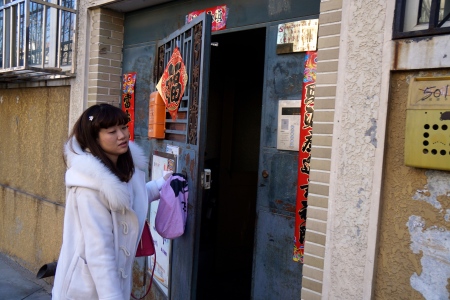
Thankfully, we can skip the complicated Chinese family labels in this post. Sorry, I digress, this shall happen a lot.
Upon arriving you’d notice that the door posts are decorated with Spring couplets or New Year couplets (春联: Chun1 Lian2).
Spring couplets are paired phrases, typically of seven Chinese characters each, written on red paper in black ink. New Year couplets are filled with best wishes and is thought to keep evil away.
It also acts as a nod to the legend of the Nian.
1:30 pm: Having greeted the elders, my host family and her relatives took down the old Spring couplets and replaced them with new ones as it is the New Year. Cleaning the house before the New Year is a tradition among the Chinese.
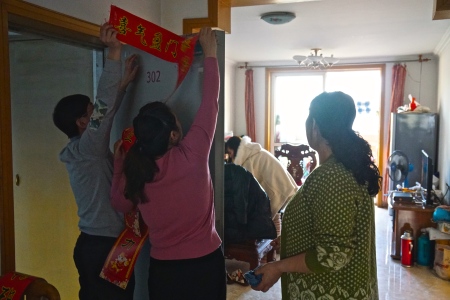
The act of cleaning is representative with putting old things away, bidding farewell to the old year, and welcoming the new year.
Besides putting up Spring couplets, it’s also very popular to paste paper cutouts. The subjects and themes of paper cutouts are rich, and most of them are characteristic of rural life.
Therefore, paper cutouts about farming, weaving, fishing, tending sheep, feeding pigs, or raising chickens are common. Paper cutouts sometimes depict myths and legends and Chinese operas.
Also flowers, birds, and Chinese Zodiac creatures are popular paper cutout designs. As this is the year of the goat, we bought goat cutouts.

Happy New Year in Chinese 🎉 Don’t Say The Obvious, These Ways Are Better!
How to say Happy New Year in Chinese? Opt for something more elaborate and personalized with some of these alternate ways of wishing in the new year.
To the Chinese, paper cutouts express the hopes of people looking forward to a better life, and they give a merry and prosperous atmosphere to the festival.
2:00 pm: My host mum poses as she pasted the Spring couplets. The 福 (fu2= prosperity) is hung upside-down to symbolize that good-luck and prosperity is arriving.
The character for “upside-down”, “倒” (dao4), is a homonym of the character for “to arrive”, “到” (dao4). So this means that “福” (happiness, good fortune, etc.) is “arriving” when hung upside-down.
2:10 pm: As my aunt finishes decorating the door, a relative pasted a paper cutout on the window facing South. In the past, the Chinese pasted paper cutouts on windows facing South and North before the Spring Festival. So, this is to adhere to the tradition.
Decorating can get tiring, thankfully we had these to snack on, I devoured those Dove chocolates and am not ashamed to admit.
3:00 pm: Finally finished with the house chores, yet still too early to eat and prepare food, we decided to relax and enjoy some Chinese TV and snacks.
The snacks consisted of sunflower seeds, peanuts and chocolate! And, boy, did I snack on those chocolates.Veni, Vidi, Vici, O’ Chocolate!
It’s a bit late but here is a picture of the hosts, 姥姥 (lao3 lao) and 姥爷(lao3 ye). They were so sweet and 姥姥 really enjoyed posing for pictures, which tickles me to the bone.
I think she is just adorable.
4:30 pm: As late-afternoon hits, I was growing a tad hungry, so we ordered KFC. BAD DECISION.
Never eat before a New Year’s meal. These families seriously know how to whip up a feast! I was a huge walrus by the time dinner was over. In fact, if circumstances persisted I could have easily rolled home.
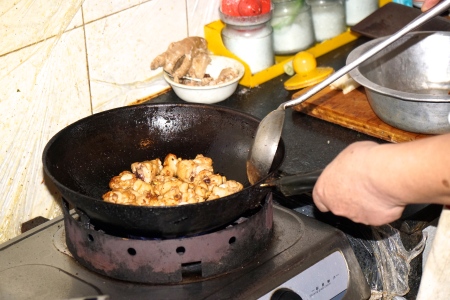
5:30 pm: Commencing the New Year’s cooking extravaganza.

6:00-7:00 pm: Dish after dish was dished out by 舅舅 (jiùjiu, uncle). I was in awe of his cooking wizardry.
This guy single handedly, somehow, managed to whip up 12 dishes under 90 minutes! That’s skills right there!
I was told that 舅舅 was once a chef before having to close down his restaurant and pick up a normal job because of grandfather’s health complications.
On a more serious note, FISH is a must during every New Year meal due to the Chinese saying: 年年有余 (Nian2 Nian2 You3 Yu2, May every year end with ample surplus).
Based on the Chinese language, the character “余” (yu2, surplus) shares the same pronunciation with “鱼” (yu2, fish), thus making fish a must-have dish on Chinese dining tables every new year.
7:30 pm: The long awaited feast and the highlight of the New Year is finally done!

To the Chinese, the reunion dinner, also known as 團年 (tuan2 nian2), is considered to be the most important part of the celebration.
Children are supposed to return to their families and married couples are expected to go to the male’s relatives house (and to the female’s relatives house on the second day of the festival).
If a family member couldn’t participate in the grand feasting, his or her presence is usually symbolized by placing an empty seat at the banquet. In our case, we were all present!
“羊年到,祝三羊开泰,喜气羊羊,” on behalf of all of us as the as the year of the goat arrives, I wish you peace, luck, and joy.
9:00-12:00 pm: I was in a food coma by this time. To end the night, my host family and I watched the Chinese New Year program on CCTV 1 and admired the fireworks.
Lighting firecrackers is one of the most important customs of the Chinese New Year celebration.
Thanks to this custom, I have been deprived of sleep due to the blaring and booming sounds that firecrackers and fireworks produce. Remind me to invest in a pair of ear plugs the next time I celebrate CNY in Beijing.
According to the locals, Jing Shan Park is the best place for firework viewing due to it’s high elevation in the middle of the city.
And that wraps up my CNY experience in Beijing.

Chinese New Year as a Foreigner // Noah’s Story
Written by Noah Nugel of Germany.
I have been living in China for four months now and this week the most important Chinese festival took place:
Chinese New Year!
Chinese New Year is not only a thing in China, but all over the world, due to the huge numbers of Chinese immigrants in many countries.
My parents and friends from Germany told me that even there it was all over in the news.
Globalization and Chinese expansion is really a thing!
Chinese New Year is coming…
The first time I realized that a big Chinese holiday was coming up, was when suddenly many shops and restaurants in Shanghai closed.
Actually this is nothing too unusual but after being in China for four months and being completely used to shops being open every single day from 8am to 10pm, I was a little surprised.
That is also due to most people returning to their hometowns on the weekend before Chinese New Year.
In fact, nearly 400 million Chinese move across the country.
DID YOU KNOW – This is widely considered the biggest annual human migration wave in the world!

Important: Clean your house
Living in a Chinese homestay, which I chose to get an authentic insight into how Chinese people are celebrating Chinese New Year in China, I was involved in preparing the big festival.
On the last day of the year my homestay and I cleaned our apartment and cleared out all the broken things.
This is considered getting the old and dirty spirits out of your home and also helping to prepare everything for the New Year.
Therefore it is important that you know some of the Do’s and Don’ts concerning Chinese New Year.
My Chinese family also told me that during the first days of the New Year no cleaning should be done.
In Chinese culture it is said that by cleaning on New Year, you will wash away the recently arrived good luck and fortune!
And of course I did not want to risk my future luck, right?!
Chinese New Year’s Eve
On New Year’s Eve in China, the whole Chinese family unites in order to eat and celebrate together.
My homestay father and his older sister were preparing food throughout the whole day and on smelling the Chinese food I started to get really excited about the evening dinner.
While we were watching the traditional CCTV New Year’s Gala (basically many Chinese celebrities singing, dancing and welcoming the New Year), more and more family members arrived.
Like this I got to know the extended family of my homestay, and they were are really welcoming and excited to share their Chinese New Year traditions with me.
So we got to eat and there was….
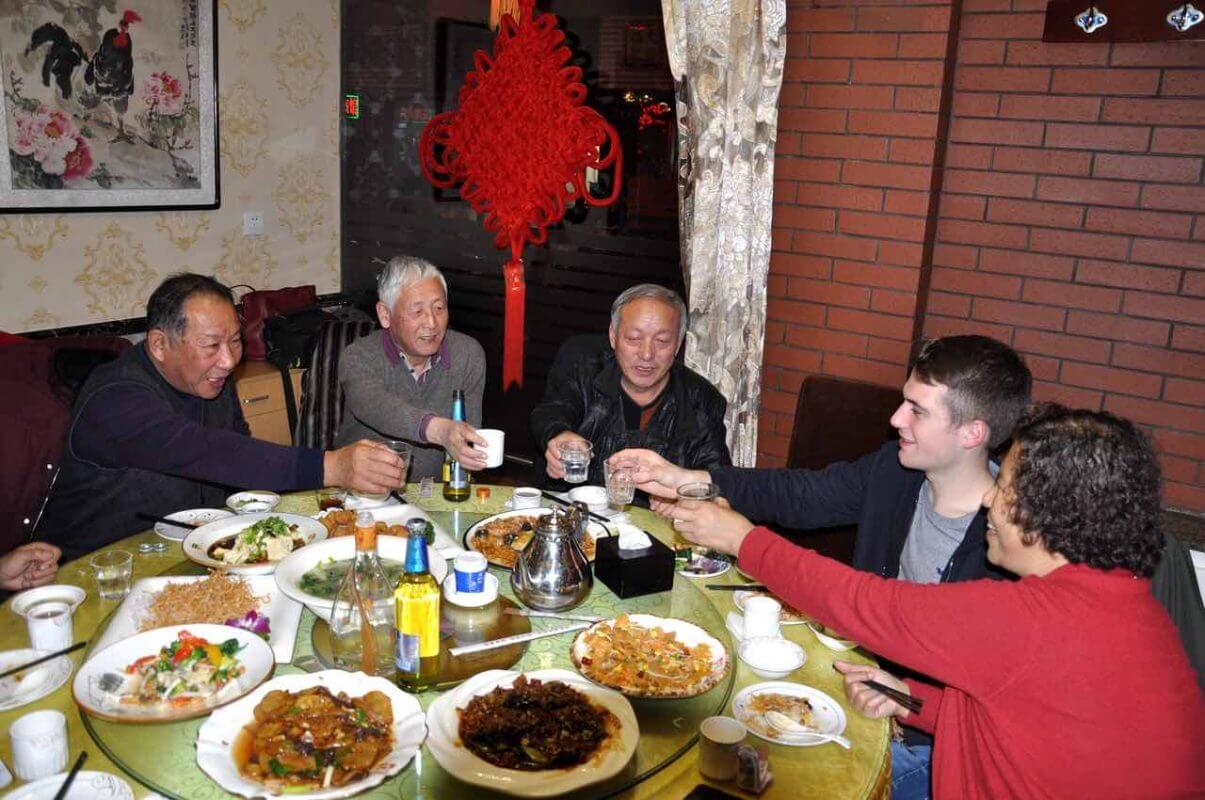
FOOD EVERYWHERE!
The table was full of food. Being a vegan in China at first I was a little bit scared of not finding many suitable dishes for me, but my Chinese family prepared a lot of dishes just for me. Chinese hospitality at its finest!
We ate loads of vegetables, spring rolls, rice, dumplings and for the all the non-vegetarians there was plenty of meat like beef, chicken and duck.
After the first round I was already quite stuffed… but this is not acceptable on Chinese New Year in China!
The empty plates were taken away, new dishes were brought and it all started again.
I have to admit that I was really surprised how much Chinese people can eat, considering that they are all so skinny!
Counting calories is definitely not a part of the Chinese New Year’s Eve dinner.
My favourite food was the 八宝饭 (bā bǎo fàn), a traditional rice cake made of sticky rice and topped with eight dates.
I was told there are eight dates on the cake because eight is an important lucky number in Chinese.
Sweet and delicious!
And of course: We 干杯 (gān bēi) a lot of times (this means to down your drink, literally dry glass).
After dinner we were all sitting together, exchanging the traditional red packets, in Chinese 红包 (hóng bāo), and chatting.
And a great side effect: this evening really helped me to improve my Chinese! After four hours of chatting in Mandarin all my thinking was in Chinese.
At first it was quite hard, as most of the older family members speak either Shanghai Hua or Mandarin with a Shanghainese accent, but the nieces of my homestay father helped me a lot with understanding what was being said.
I did not only learn a lot about Chinese New Year, but I also had to answer many questions about Germany, our traditions, food etc.
A true mix of cultures!
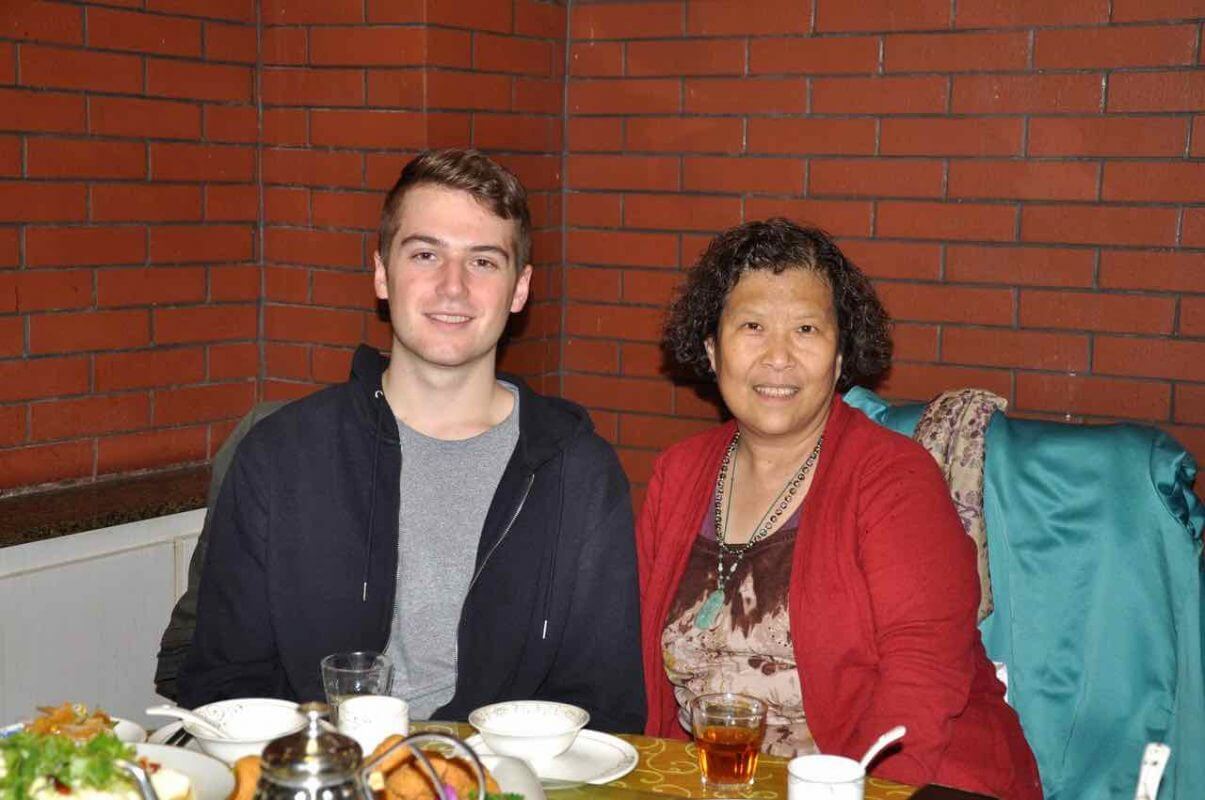
Chinese New Year in China: The First Day of the New Year
The first day of Chinese New Year was more relaxed, we had lunch and dinner together again, but only my homestay father, his mother and me.
At this point I also took the chance and gave them my Chinese New Year present, some German sweets which I brought with me to China.
Of course I did not only wrap it in red paper, but offered it with two hands to my Chinese family, and I said the traditional Chinese New Year greetings:
新年快乐 (Happy New Year) and 恭喜发财 (Wishing you wealth and prosperity)!
What I can say after experiencing the Chinese New Year in China: it was an incredible experience, especially because I was living in a Chinese homestay.
I was part of their family during this traditional Chinese festival and I discovered a new side of China!
Inspired by Sonia and Noah’s stories? If you want to experience Chinese New Year and Chinese culture from the inside, not just as a visitor, LTL’s immersive programs put you in Beijing, Shanghai, Chengdu, or Xi’an with a host family and native-speaker teachers. Build your dream Gap Year and make the Spring Festival one you’ll never forget.
What is your Chinese Zodiac?
Want to discover your Chinese Zodiac?
Use our calendar below to discover which of the 12 zodiacs you. If you want to go one step further and find out a few other surprise details you may not know about, check out our Chinese Zodiac Calculator page.

LOVE DISCOVERING ABOUT DIFFERENT NEW YEAR TRADITIONS? Why not check out what the Vietnamese New Year and Russian New Year entail.
Chinese New Year || FAQs
📆 When is Chinese New Year?
In 2024, Chinese New Year falls on February 10th.
The national Chinese New Year holidays lasts for 7 days, until February 17th.
🐍 What is the Zodiac for 2025?
2025 is the Year of the Snake.
🧧 Is Chinese New Year the biggest holiday in China?
Yes, this is the most important time of the year for Chinese families.
🎉 How many days off do Chinese get for Chinese New Year?
The short answer is 3, but the government, to cater for long journeys home, extends this to 7 days. However, due to this weekend days must be worked before and after Chinese New Year.
How long is Chinese New Year 2026?
The official public holiday in China for Chinese New Year 2026 runs for 7 days, starting on Tuesday 17 February.
The full Spring Festival celebration period lasts 15 days, ending with the Lantern Festival on Wednesday 4 March 2026. Many families start preparations, deep cleaning, cooking, shopping, in the week before the new year begins.
What is the Chinese New Year animal for 2026?
Chinese New Year 2026 is the Year of the Horse (马年, Mǎ Nián).
The Horse is the seventh animal in the 12-year Chinese zodiac cycle. Horse years are associated with energy, independence, and enthusiasm. If you were born in 1942, 1954, 1966, 1978, 1990, 2002, or 2014, 2026 is your zodiac year.
What not to do on 17 February, Chinese New Year 2026?
On New Year’s Day (17 February 2026), tradition says you should avoid: sweeping or taking out rubbish (sweeps away good luck), washing your hair (washes away prosperity), using sharp objects like scissors or knives (cuts your luck), wearing black or white (mourning colours), breaking anything (bad omen for the year), crying or arguing, and lending or borrowing money. If you do accidentally break something, say 岁岁平安 (suì suì píng ān) immediately to turn the mishap into a blessing.
Is it wrong to call it Chinese New Year?
No. ‘Chinese New Year’ is a widely used, accurate, and accepted term in English.
In mainland China, the festival is officially called 春节 (Chūn Jié, Spring Festival).
The term ‘Chinese New Year’ is used globally and by Chinese communities themselves, particularly in the diaspora.
‘Lunar New Year’ is a broader, more inclusive term that also covers the related celebrations in Korea (Seollal) and Vietnam (Tet), among others.
Using either term respectfully is completely appropriate.
Why is Chinese New Year called the Spring Festival?
In Chinese, the festival is called 春节 (Chūn Jié), meaning ‘Spring Festival’.
This name reflects the holiday’s agricultural origins: it marks the end of winter and the start of the spring planting season in the traditional Chinese lunar calendar.
The name ‘Chinese New Year’ is more common in English-speaking contexts and international media, while ‘Spring Festival’ is the official and everyday name used in mainland China.
Want more from LTL?
If you wish to hear more from LTL Mandarin School why not join our mailing list? We give plenty of handy information on learning Chinese, useful apps to learn the language and everything going on at our LTL schools!
Sign up below and become part of our ever-growing community!







18 comments
[…] this year (2018) it is on September 24th. Since it belongs to the “Three major festivals” – Lunar New Year, Dragon Boat Festival and Moon Festival – people always have a day off, either employees or […]
[…] steamed, boiled or pan fried. In China its traditional to make and eat jiaozi as a family on Chinese New Year’s Eve. Although this type of dumpling can be found all over China and even in other parts of East Asia, […]
[…] you a Chinese New Year Beijing […]
[…] So, before we greet the New Year on February 5th, we need to know all the dos and don’ts of the lunar traditions. […]
[…] Tradições do Ano Novo Chinês – Emma […]
[…] to Chinese New Year, wedding customs in China dictate that there should be certain dishes with special significance […]
[…] is a great park to visit during Chinese New Year when they have their annual temple fair. Autumn is also a good time to visit to view the beautiful […]
[…] October 1st – 7th Chinese are given time off and this is commonly used to travel (with Chinese New Year the time to spend with loved ones and […]
Great summary, thanks!
Our pleasure!
this was a fantastic summary and really insightful.
I wanted to know more about the first day of lunar new year (初一) - are people allowed to cook on this day? if so, what about all the pots, pans, dishes and cutlery used if you can't clean?
also with friends and family visiting, I guess the trash stays in the house and thrown outside the next day?
Thanks for your kind words Yumi.
Typically all cooking takes place before the New Year itself. No cooking takes place during the first five days of the New Year. It's a very good question about the cleaning. I think pots and pans is fine, more just the rest of the house that applies.
[…] New Year Migration usually begins 15 days ahead of the Chinese New Year and 25 days after, lasting for 40 […]
[…] design of Suzhou IFS Tower is inspired by a fish, a symbol of prosperity in China. This is also in-keeping with the canals and lakes that surround […]
[…] “…When he was paying a New Year’s courtesy call to Elder Fang” – here’s an introduction to the Chinese New Year traditions (New Year’s visits in “When to Make Visits” part): Chinese New Year Traditions and Superstitions. […]
[…] If you want to find out more about Chinese New Year apart from just the vocab make sure to have a look at our Complete Guide to Chinese New Year. […]
[…] can be rented there for a very reasonable price. However, prices do go up significantly during the Chinese New Year […]
[…] 2022 Chinese New Year falls on 1st February, the official celebration period starts on Chinese New Year’s Eve […]