
Happy New Year in Chinese // 新年快乐 and Better Ways To Wish It
How do you say Happy New Year in Chinese? The standard way is 新年快乐 (xīnnián kuàilè), which works on January 1st and at Chinese New Year.
But as always we want to go one step further and teach you what the natives actually say, from casual 新年好 to the four-character blessings people text each other at midnight!
Get ready to say goodbye to the 2026 year of the Horse and welcome in the 2027 year of the Goat on Saturday February 6th, 2027

If 2027 is your zodiac year (本命年, běnmìngnián), you’ll wear red underwear for luck. Either way, you’ll noisily pop champagne corks and, as tradition requires, exchange greetings for the New Year.
First of all it should be clarified that in China there are two different “New Years” celebrations: the first is the so-called “Spring Festival” 春节 (chūnjié 春节 ), which usually falls between the last two weeks of January and the first two of February.
The second New Year is the one celebrated worldwide that is on January 1st, which in Chinese is called 元旦 (yuán dàn 元旦 ).
There is, however, an interchangeable and usable term for both events: 新年 (xīn nián 新年 ) literally “New Year”.
To best prepare yourself, you need to learn how to wish your friends a Happy Chinese New Year in Chinese! And be warned, there are many many ways to do this.
However, it’s a great way to pick up some new Chinese vocab.
So let’s start at the very beginning…
Happy Spring Festival in Chinese
Happiness and Prosperity in the New Year

Happy New Year In Chinese – The Generic One

新年快乐 (xīnnián kuàilè) is probably the easiest and most literal way of wishing your friends a Happy New Year:
Chinese Characters: 新年快乐
Pinyin Pronunciation: xīnnián kuàilè 新年快乐
Meaning: 新年 literally means ‘New Year’ and 快乐 means ‘Happy’.
This phrase is used interchangeably both at Chinese New Year and on the 1st of January at the start of the solar New Year.
In person, though, you’ll often hear a shorter, more casual version. Here’s how the everyday greetings compare:
| Chinese | Pinyin | English | When to use it |
|---|---|---|---|
| 新年快乐 | xīnnián kuàilè | Happy New Year | The all-rounder: cards, WeChat messages, January 1st and Chinese New Year |
| 新年好 | xīnnián hǎo | “New Year good” | Spoken and casual, when you bump into neighbours, friends or colleagues over the holiday |
| 过年好 | guònián hǎo | Happy (Spring Festival) New Year | Spring Festival only, especially when visiting relatives |
新年快乐 vs 新年好: both are fine with anyone. 新年快乐 is the fuller, slightly more standard wish and the one you’ll write. 新年好 works like a festive ‘hello’, so it’s what most people actually say face to face.
If you read Chinese in Taipei, Hong Kong or Macau, you’ll see the traditional characters 新年快樂. Only the last character changes (乐 becomes 樂), and the pronunciation is the same.
TIP💡 When someone wishes you a Happy New Year, you can simply say it back (新年快乐! or 新年好!). Or reply 也祝你新年快乐 (yě zhù nǐ xīnnián kuàilè), ‘I wish you a Happy New Year too’.
But if we only learnt how to say this version of Happy New Year in Chinese, we’d have barely hit the tip of the iceberg…
Read on for more New Year Greetings and Wishes…
TIP💡 Tones are the hard part here: kuàilè is two falling tones in a row, and many beginners say it flat. Listen to the audio above, then practice your Chinese pronunciation until 新年快乐 sounds natural.

Chinese New Year 🐉 The Complete Guide to China’s Biggest Holiday
Chinese New Year Guide | Traditions, Superstitions, Vocab and Experiences. A complete guide to Chinese New Year from different perspectives.
Happy Spring Festival in Chinese

春节快乐 (chūnjié kuàilè) is also a very literal way of wishing your friends a Happy Spring Festival.
Chinese Characters: 春节快乐
Pinyin Pronunciation: chūnjié kuàilè 春节快乐
Meaning: 春节 literally means ‘Spring Festival’ and 快乐 means ‘Happy’. So Happy Spring Festival!
Unlike xīnnián kuàilè, the phrase chūnjié kuàilè would only be used for Chinese New Year or Spring Festival, rather than during Western New Year.
In English, this phrase is often just translated as ‘Happy Chinese New Year’, since we rarely call it Spring Festival.
DOWNLOAD OUR FREE EBOOK
Looking for reliable tools to boost your Mandarin? We’ve gathered our favourite websites, extensions, and learning platforms into one handy ebook, completely free! It’s perfect for beginners or anyone looking to refresh their skills.
👉 Get your free Mandarin Resource Pack and take your studies to the next level.
Happiness and Prosperity in the New Year
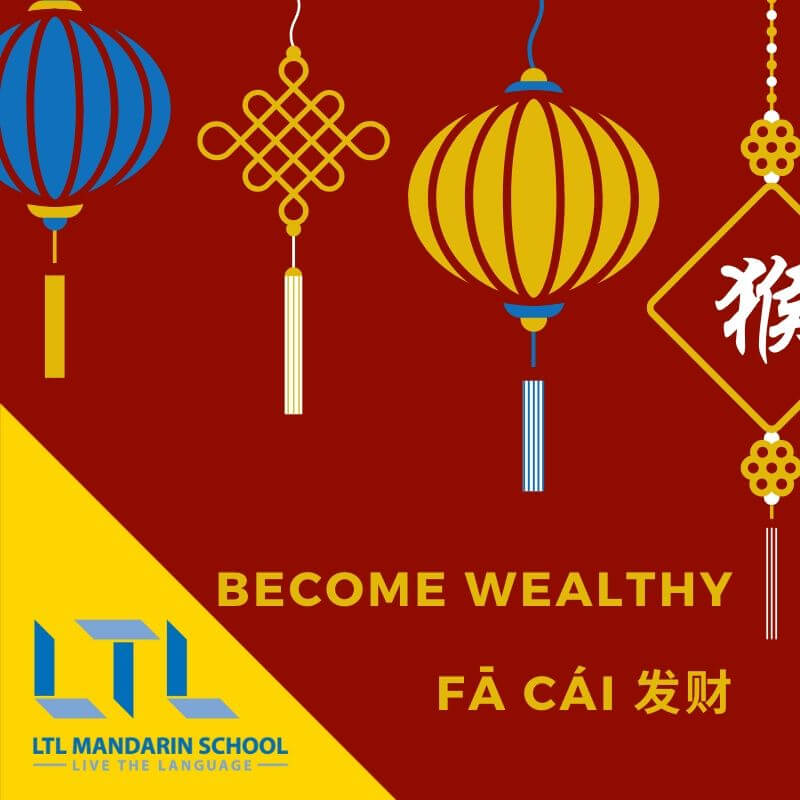
Chinese Characters: 恭喜发财
Pinyin Pronunciation: gōngxǐ fācái 恭喜发财
Meaning: ‘Happiness and Prosperity in the New Year’.
恭喜发财 is a little difficult to translate concisely into English.
恭喜 literally means respectful congratulations, and 发财 means to get rich or to prosper.
The phrase is a blessing for prosperity and wealth in the coming year and is used all over China. But in the South of China, Cantonese-speaking regions in particular, it is used as a general greeting for Chinese New Year.
This is why in English letters the phrase is often written as ‘Kung Hei Fat Choi’, following the Cantonese pronunciation.
If you’re celebrating with Cantonese speakers in Hong Kong, Guangzhou or a US Chinatown, here’s how the main greetings sound side by side:
| Chinese (traditional) | Mandarin pinyin | Cantonese (Jyutping) | English |
|---|---|---|---|
| 恭喜發財 | gōngxǐ fācái | gung1 hei2 faat3 coi4 | Wishing you prosperity |
| 新年快樂 | xīnnián kuàilè | san1 nin4 faai3 lok6 | Happy New Year |
| 新年好 | xīnnián hǎo | san1 nin4 hou2 | Happy New Year (casual) |
The characters are the same in both. Only the sound changes, which is why ‘Sun Nin Fai Lok’ and ‘Kung Hei Fat Choi’ are the spellings you’ll see on US storefronts.
Remember not to cut your hair after Chinese New Year, as the word for hair in Chinese uses the same character as 发 in 发财 (to prosper).
The belief is that by cutting or washing your hair in the new year, you might be washing away some of the prosperity.
Colours follow the same logic. Red (红, hóng) is the lucky colour of the festival, while white and black are traditionally linked with funerals and mourning. So skip the all-black or all-white outfit when you go visiting, and never wrap a gift or red envelope in white.

Chinese Proverbs Quiz
Chinese Proverbs Quiz: Horses, Tigers, and Mediocrity? Chinese proverbs, sayings, and idioms: there’s practically one for every imaginable scenario (here are 12 different proverbs that mention chickens). One covers why you should (or shouldn’t?) play music for a cow, and…
LEVEL UP – Alternative Ways to Wish Happy New Year in Chinese
Why not opt for something more elaborate and personalized with some of these alternate ways of wishing in the new year!
TIP💡 Most of these wishes start with 祝你 (zhù nǐ), ‘I wish you’. For grandparents, teachers, your boss or a client, swap 你 for the polite 您 (nín): 祝您新年快乐 (zhù nín xīnnián kuàilè). It’s a small change that native speakers really notice.
Here is a list of 10 ways to wish happy New Year in Chinese:
1. Best Wishes
Chinese Characters: 祝新年快乐,并致以良好的祝福。
Pinyin Pronunciation: zhù xīnnián kuàilè 祝新年快乐 , bìng zhì yǐ liánghǎo de zhùfú 并致以良好的祝福
Meaning: Best wishes for a happy New Year!
2. Good Health and Good Luck
Chinese Characters: 祝你在新的一年里身体健康,多福多寿。
Pinyin Pronunciation: zhù nǐ zài xīn de yī nián lǐ shēntǐ jiànkāng 祝你在新的一年里身体健康 , duō fú duō shòu 多福多寿
Meaning: I wish you good health and good luck in the New Year!
3. Luck, Happiness and Joy
Chinese Characters: 恭祝新年吉祥,幸福和欢乐与你同在。
Pinyin Pronunciation: gōng zhù xīnnián jíxiáng 恭祝新年吉祥 , xìngfú hé huānlè yǔ nǐ tóng zài 幸福和欢乐与你同在 .
Meaning: I wish that luck, happiness and joy accompany you throughout the New Year!
4. Good Health and A Successful Career
Chinese Characters: 恭贺新禧,祝身体健康、事业发达。
Pinyin Pronunciation: gōnghè xīnxǐ 恭贺新禧 , zhù shēntǐ jiànkāng 祝身体健康 , shìyè fādá 事业发达
Meaning: Happy New Year with wishes of good health and a successful career
5. Best Wishes to Your Family
Chinese Characters: 请接受我对你及你全家的美好祝福,祝你们新年快乐。
Pinyin Pronunciation: qǐng jiēshòu wǒ duì nǐ jí nǐ quánjiā de měihǎo zhùfú 请接受我对你及你全家的美好祝福 , zhù nǐmen xīnnián kuàilè 祝你们新年快乐
Meaning: Please accept my best wishes for a happy New Year to you and your family!
6. Joy and Happiness
Chinese Characters: 愿快乐幸福永伴你左右。
Pinyin Pronunciation: yuàn kuàilè xìngfú yǒng bàn nǐ zuǒyòu 愿快乐幸福永伴你左右 .
Meaning: May joy and happiness always stay with you.
7. Hope to be Together Soon

Chinese Characters: 在这特殊的日子,向你致以新年的祝福,希望不久我们能相聚在一起。
Pinyin Pronunciation: zài zhè tèshū de rìzi 在这特殊的日子 , xiàng nǐ zhì yǐ xīnnián de zhùfú 向你致以新年的祝福 , xīwàng bùjiǔ wǒmen néng xiāngjù zài yīqǐ 希望不久我们能相聚在一起
Meaning: On this special day, I want to wish you a Happy New Year with the hope that we will soon be together.
8. All Your Wishes Come True
Chinese Characters: 愿你所有的新年愿望都成真!
Pinyin Pronunciation: yuàn nǐ suǒyǒu de xīnnián yuànwàng dōu chéngzhēn! 愿你所有的新年想都成真
Meaning: I wish that all that you want for this New Year comes true!
9. Great New Year
Chinese Characters: 愿你度过最美好的新年!
Pinyin Pronunciation: yuàn nǐ dùguò zuì měihǎo de xīnnián! 愿你度过最美好的新年
Meaning: May you have a great New Year!
10. Bright and Splendid!
Chinese Characters: 愿你的新年光彩夺目,愿你的新年灿烂辉煌!佳节快乐!
Pinyin Pronunciation: yuàn nǐ de xīnnián guāngcǎi duómù 愿你的新年光彩夺目 , yuàn nǐ de xīnnián cànlàn huīhuáng! 愿你的新年灿烂辉煌 Jiājié kuàilè! 佳节快乐
Meaning: May this New Year be bright and splendid! Happy Holidays!
Short New Year Blessings by Theme // Four-Character Wishes
Long sentences are lovely in a card, but in a WeChat message or at the dinner table, natives reach for snappy four-character phrases. Pair one with your greeting, for example 新年快乐,万事如意! For more holiday vocab, see our Chinese New Year words and phrases.
| Chinese | Pinyin | English | Best for |
|---|---|---|---|
| 万事如意 | wànshì rúyì | May everything go as you wish | Anyone |
| 心想事成 | xīn xiǎng shì chéng | May all your wishes come true | Friends, students |
| 吉祥如意 | jíxiáng rúyì | Good fortune as you wish | Anyone, cards |
| 大吉大利 | dàjí dàlì | Great luck and great profit | Luck, anyone |
| 阖家幸福 | héjiā xìngfú | Happiness to your whole family | Families |
| 岁岁平安 | suìsuì píng’ān | Peace and safety year after year | Families, elders |
| 年年有余 | niánnián yǒu yú | Abundance year after year | Wealth, family dinner |
| 财源广进 | cáiyuán guǎng jìn | May wealth flow in from all sides | Business |
| 生意兴隆 | shēngyì xīnglóng | May your business boom | Shop owners, clients |
| 马到成功 | mǎ dào chénggōng | Instant success | Career, new projects |
| 步步高升 | bùbù gāoshēng | Rise step by step | Career, promotions |
| 龙马精神 | lóngmǎ jīngshén | The vigour of a dragon horse | Health, elders |
| 学业进步 | xuéyè jìnbù | Progress in your studies | Students |
| 金榜题名 | jīnbǎng tímíng | Top marks in your exams | Exam candidates |
💡 Two of these hide puns. 余 (yú, surplus) sounds like 鱼 (yú, fish), which is why fish is served at the New Year’s Eve dinner. And if someone breaks a bowl, people quickly say 碎碎平安 (suìsuì píng’ān): 碎 (suì, to shatter) sounds like 岁 (suì, year), turning bad luck into a blessing.
Year of the Goat Greetings for 2027
The 2027 Year of the Goat brings its own wordplay, because 羊 (yáng, goat) sounds like 阳 (yáng, sun) and 洋 (yáng, overflowing).
| Chinese | Pinyin | English |
|---|---|---|
| 三阳开泰 | sān yáng kāi tài | Three suns bring peace and prosperity (the classic Goat-year wish) |
| 喜气洋洋 | xǐqì yángyáng | Overflowing with joy |
As we have seen, the happy new year wishes in Chinese are closely linked to the concepts of luck, health, longevity and success.
So what are you waiting for?!
Level up and don’t just go with the generic 新年快乐!
Know anymore ways to wish a Happy New Year in Mandarin?

When You’ll Use These Greetings // New Year Customs
Greetings aren’t just words at Chinese New Year: they’re tied to customs that run for about two weeks. In 2027, festivities start on New Year’s Eve, Friday February 5th, and run until the Lantern Festival on Saturday February 20th.
| Chinese | Pinyin | English | Greeting you’ll use |
|---|---|---|---|
| 除夕 | chúxī | Chinese New Year’s Eve | 新年快乐 at the reunion dinner and at midnight |
| 拜年 | bàinián | New Year visits to relatives and friends | 过年好 and 新年好 at the door |
| 红包 | hóngbāo | Red envelopes of lucky money | 恭喜发财 |
| 春联 | chūnlián | Spring Festival couplets on the doorframe | Written wishes such as 万事如意 |
| 元宵节 | Yuánxiāojié | Lantern Festival, the 15th and final day | 元宵节快乐 |
Kids have a cheeky version for 红包 time: 恭喜发财,红包拿来!(gōngxǐ fācái, hóngbāo ná lái), ‘Happy New Year, now hand over the red envelope!’ Read more about lucky red envelope traditions, or see our complete Chinese New Year guide.
Want to hear these greetings at a real family 拜年? Come and learn Chinese in China and live, breathe and dream the language.
BONUS || Love learning how to send your greetings and wishes in other languages? Why not learn how to say happy new year in Russian whilst you’re at it!
Happy New Year || FAQs
When is Chinese New Year?
Chinese New Year falls in February typically although it can also fall in late January and early March on some rare occasions.
The next Chinese New Year is Saturday February 6th, 2027 (the Year of the Goat), followed by Wednesday January 26th, 2028. Here are recent years for reference:
2026 – Tuesday Feb 17th (public holiday Sunday Feb 15th – Monday Feb 23rd)
2027 – Saturday February 6th
What is Chinese New Year?
Chinese New Year is the celebration of the start of the new Lunar Calendar year.
This festival is commonly referred to as Spring Festival in China.
Is Chinese New Year the biggest holiday in China?
Yes.
China does not celebrate Christmas, and National Day Golden Week (usually October 1st-7th, sometimes longer), although big, is more often celebrated by travelling.
Chinese New Year is commonly the time families get to spend together more than any other time in the year, especially if they live and work in different cities.
What does 恭喜发财 mean?
“Happiness and prosperity in the New Year.”
How do you say New Year in Chinese?
新年 (xīn nián) is new year in Chinese.
How do you say “Happy Chinese New Year” in Mandarin?
The most common way is 新年快乐 (xīnnián kuàilè), which works both at Chinese New Year and on January 1st.
If you want a greeting that only refers to the Lunar New Year, say 春节快乐 (chūnjié kuàilè), ‘Happy Spring Festival’. In person, people often use the casual 过年好 (guònián hǎo) or 新年好 (xīnnián hǎo).
How do you pronounce “gong xi fa cai”?
In Mandarin, 恭喜发财 is pronounced gōngxǐ fācái: a high flat tone, a dipping tone, another high flat tone and a rising tone.
In Cantonese it sounds like gung1 hei2 faat3 coi4. That is why you’ll often see it written as ‘Kung Hei Fat Choi’ in Hong Kong and US Chinatowns.
What are some good New Year’s wishes?
Short four-character blessings are what native speakers use most. Popular ones include 万事如意 (wànshì rúyì), ‘may everything go as you wish’, and 心想事成 (xīn xiǎng shì chéng), ‘may all your wishes come true’.
For families, try 阖家幸福 (héjiā xìngfú), and for business contacts, 生意兴隆 (shēngyì xīnglóng). You can pair any of them with a greeting, for example 新年快乐,万事如意!
Where is Chinese New Year celebrated?
Chinese New Year is celebrated across mainland China, Taiwan, Hong Kong and Macau, where it is the biggest holiday of the year.
It is also widely celebrated in countries with large Chinese communities, such as Singapore and Malaysia, and in Chinatowns around the world, including in the US.
What is the forbidden colour for Chinese New Year?
White and black are the colours to avoid, because they are traditionally linked with funerals and mourning.
Red is the lucky colour of the festival. Skip all-black or all-white outfits when visiting, and never wrap a gift or red envelope in white.
Want more from LTL?
If you wish to hear more from LTL Mandarin School why not join our mailing list? We give plenty of handy information on learning Chinese, useful apps to learn the language and everything going on at our LTL schools!
Sign up below and become part of our ever-growing community!






4 comments
[…] Happy New Year in Chinese is 新年快乐 Xīnnián kuàilè. […]
[…] are many ways to wish someone a Happy New Year in Chinese, along with many greetings and […]
[…] occur as numerous countless individuals make their means to celebrate with family in China. Prev how to wish someone happy chinese new year in cantonese here. Things will most certainly look different this year, because of the ongoing […]
[…] Happy New Year in Chinese is 新年快乐 Xīnnián kuàilè. […]