
I Love You In Chinese 💕 37 Phrases to Learn about Love
How do you say I Love You in Chinese?

我爱你 – Wǒ ài nǐ
- 我 – I, Me
- 爱 – to love
- 你 – you
我爱你 (Wǒ ài nǐ) is one of the most searched Chinese phrases on Google, and for good reason!
Rather than just giving you the translation, we are going one step further and to create a guide with some excellent alternatives, giving you the perfect back catalogue to not just express your love in Chinese, but much more!
I Love You in Chinese || How do you say I Love You in Chinese?
I Love You in Chinese || How do you say I Like You in Chinese?
I Love You in Chinese || How do you say Beautiful Girl in Chinese?
I Love You in Chinese || How do you say Handsome Man in Chinese?
I Love You in Chinese || Other Ways of Expressing Liking and Love in Chinese
I Love You in Chinese || What does 520 in Chinese mean?
I Love You in Chinese || How to Break Up with Someone in Chinese?
I Love You in Chinese || How do you say Will You Marry Me in Chinese?
I Love You in Chinese || How do you talk about the Friendzone in Chinese?
I Love You in Chinese || FAQs
Before we start, here’s a brilliant insight into how NOT to chat someone up in Chinese, and the top tip for winning that special someone. Thanks to our wonderful friend Keren at Unconventional Chinese for the video…

How do you say I Love You in Chinese?
We already know this, but just to make sure…!
我爱你 – Wǒ ài nǐ
The direct translation matches the English word for word, which is not always the case between Chinese and English.
| Chinese | Pinyin | Where you’ll see it |
|---|---|---|
| 我爱你 | Wǒ ài nǐ | Simplified characters, used in Beijing, Shanghai and Singapore |
| 我愛你 | Wǒ ài nǐ | Traditional characters, used in Taipei, Kaohsiung and Hong Kong |
The only difference is the character for love. Traditional 愛 keeps 心 (xīn, heart) in the middle, while Simplified 爱 drops it, so our teachers like to joke that Simplified love has no heart! Both versions sound exactly the same.
TIP💡 It sounds roughly like “waw eye nee”. 我 is a third tone, but before the fourth tone of 爱 it becomes a short, low dip rather than a full dip and rise, so keep it relaxed.
It is worth noting that although the word love is banded around in English a lot, in China this might not be the case.
In English we have a habit of telling our parents we love them, our friends we love them, our dog we love them, even our pizza we love it!
Not in Chinese – love is a strong word to use so only say it if you really mean it. You tell a Chinese person you love them, there’s no going back!
How do you say I Like You in Chinese?

我喜欢你 – Wǒ xǐhuān nǐ
Again, the translation is the literal from English with 喜欢 representing to like something/someone.
- 我喜欢他 – I like him
- 我喜欢她 – I like her
- Note that the pinyin for both him and her is the same – Wǒ xǐhuān tā. Easy to remember and no embarrassing moments like non-native English speakers sometimes have with him and her!
- 我喜欢她的眼睛 – I like her eyes
- 我喜欢她的性格 – I like her personality
Plenty of uses for 喜欢 (xǐhuān). Remember, as love is not so widely used in Chinese, it might be best to start with using like instead of love.
Don’t believe us…
Check out our guide to dating in China.
How do you say Beautiful Girl in Chinese?
美女 – Měi nǚ
美女 (Měi nǚ) is one you’ll hear quite a lot. Situations like browsing the markets looking for a bargain are a prime example.
In English, the equivalent might be calling someone darling/love/honey etc. You hear them, you respond to them, but it’s just what we are used to.
It’s always nice to be called a beautiful girl because that’s what the translation is… but it is generic and said to many people!
How do you say Handsome Man in Chinese?

帅哥 – Shuài gē
Like 美女, 帅哥 (Shuài gē) is widely used, but also still a compliment.
The literal meaning is Handsome Brother (哥哥 meaning older brother).
It is used to state Handsome Man or Cute Boy.
So, remember, as nice as it is to receive these compliments, there’s probably a lot of other people who have heard the same!
Other Ways of Expressing Liking and Love in Chinese
Of course sometimes you need to go beyond the Love and Like and vary it up a bit, so why not learn these to add a bit of variation to your armour.
How do you say I’m Interested In You in Chinese?
我对你感兴趣。
I’m fond of you / I’m interested in you
We use the 对 here to confirm the relationship between two things, in this case 我 and 你 (me and you).
After this the 感兴趣 simply translates to interested in and can be used for other things like:
- 我对足球感兴趣
- I’m interested in football
- 我儿子对学外语很感兴趣
- My son is really interested in learning foreign languages
How do you say I Really Like You in Chinese?
我非常喜欢你。
I like you very much.If you are somewhere in between liking someone a bit, and dropping the L bomb, you might want to say you really like someone. It’s nice and simple.
We take what we learnt earlier and just add 非常 which means very/extremely/really. 非常好 meaning very good, 非常有意思 meaning very interesting.
How do you say You Mean So Much to Me in Chinese?
No one will ever tire of hearing a sentence like this after all!
你对我而言如此重要
You mean so much to meNotice we’ve used the 对 grammar structure again to show the relationship between two things (you and your partner once again).
重要 is a useful word to learn and means important.
How do you say I Love You Too in Chinese?
我也爱你。
I love you, too.我也爱你 (Wǒ yě ài nǐ) is a very simple one, with just one addition from what we’ve already learnt.
也 means also so the translation is quite simple – I also love you.
Similarly 我也喜欢你 means I also like you/I like you too.
How do you say I’m Happy With You in Chinese?
Cranking it up a notch here, but it’s very manageable once you break it down and practice your Chinese pronunciation.
跟你在一起的时候好开心。
When I’m with you I feel very happy
The sentence starts “with you” – 跟你
在一起 meaning “together“
的时候 meaning “when“
好开心 meaning “so happy“
The main grammatical thing to note is that when in Chinese (when used as a statement, and not a question), does not appear at the start of the sentence.
In a question, when appears at the start of the sentence as 什么时候, but in a statement, as above, 的时候 appears later in the sentence. Sounds confusing, but after a few examples you get used to it.
This is particularly awkward for English native speakers as the concept of using when later in a sentence is unheard of.
How do you say You’ve Stolen My Heart in Chinese?
你偷走了我的心。
You have stolen my heartGetting into super smooth talking territory now! If this is your style, you’ll love our cheesy Chinese chat-up lines.
The translation is very simple because it matches the English!
- 你 – You
- 偷走了 – Stole
- 我的心 – My Heart
What does 520 in Chinese mean?
Confused? Let us explain
Chinese culture is incredibly interesting in many ways. The obsession with smart phones, although a worldwide thing, is particularly strong in China.
…and just to prove to you this obsession exists, here are some examples of “number slang” (strings of numbers whose Chinese pronunciation sounds like a phrase), because typing “I Love You” is too much effort anyway.

In fact, the diagnosis for this obsession is so strong, that the Chinese themselves have a name for this group of smart phone addicts which is a good one to teach you:
低头族 Dītóu zú
Now you plug that into Google Translate and this is what you’ll get.
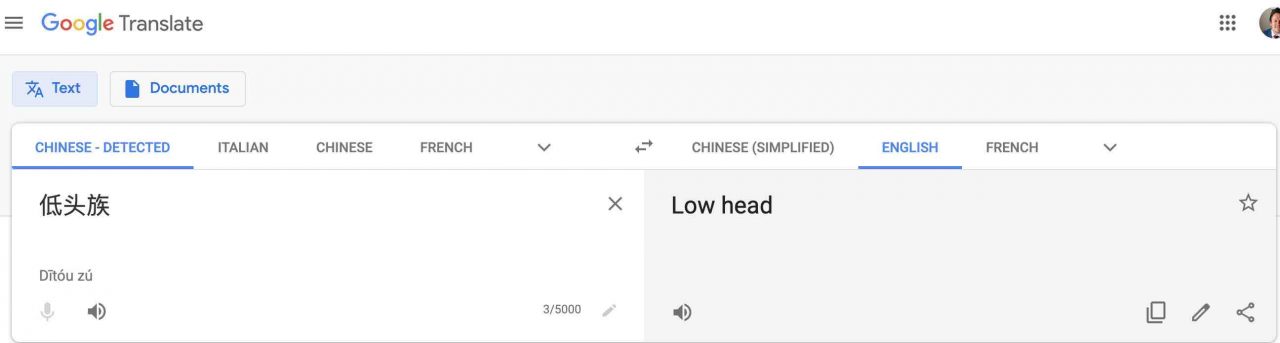
Doesn’t really shed much light does it. Let’s try one character at a time:
- 低 – Low/Hang down
- 头 – Head
- 族 – Clan/Race
Ok, makes a bit more sense now! It literally means the head bowing gang, a nickname for smartphone addicts that has been in everyday use for well over a decade. Look around any Beijing or Shanghai subway carriage and you’ll see why!
Why are we telling you this?
We tell you this because these terms below are all used via message in place of words (via WeChat/Text/Whatsapp/Online etc).
They have been coined by Chinese and taken off, very much like when LOL, LMAO and ROFL came to prominence years ago (feeling old yet)!
Let’s discover some examples

- 520 because wǔ èr líng sounds like wǒ ài nǐ
- Meaning – I love you 我爱你
- 530 because wǔ sān líng sounds like wǒ xiǎng nǐ
- Meaning – I miss you 我想你
- 1314 because yī sān yī sì sounds like yī shēng yī shì
- Meaning – Forever 一生一世
- EXTRA TIP: Combine it with 520 to make 5201314, I love you forever. Smart bunch aren’t they! When you want to say it out loud rather than type it, use the full sentence in the table just below this list.
- 770 because qī qī líng sounds like qīn qīn nǐ
- Meaning – Kiss You 亲亲你
- 880 because bā bā líng sounds like bào bào nǐ
- Meaning – Hug you 抱抱你
| Chinese | Pinyin | English |
|---|---|---|
| 我永远爱你 | Wǒ yǒngyuǎn ài nǐ | I will love you forever |
| 永远 | yǒngyuǎn | forever, always |
永远 goes before the verb 爱, in the same spot as 也 in 我也爱你 (I love you too).
What does 67 slang mean in Chinese?
You might have seen “67” (six seven) all over social media lately. That one is an English-language internet meme with no fixed meaning, and it isn’t part of Chinese number slang like 520 or 1314.
TIP💡 Read out in Chinese, 67 is just liù qī, which doesn’t sound like a romantic phrase. If you want to send love by numbers, stick with 520 (I love you) or 5201314 (I love you forever).
So remember, when feeling that typing I love you forever is too much effort, you can express it via numbers!
Discover the luckiest numbers in China here.
How to Break Up with Someone in Chinese?
Love isn’t all a bed of roses after all.

There may well be a day where you have to roll out the break up lines in Chinese – let’s hope for your sake you don’t need to use these!
First and foremost the key vocab to get in your head if you are ready to pull the plug is:
分手 Fēnshǒu – To break up/part ways
So putting that into a sentence, we’d say:
我想和你分手
I want to break up with youBut what if you want to go into a bit more detail about why you are breaking up?
Here’s our guide…
How do you say We Need To Talk in Chinese?
我想和你谈一谈。
We need to talk.我们需要谈谈。
We need to talk.
Ah the writing is on the wall when you hear this one.
Four words no one wants to ever hear!
The grammar is pretty simple and either of the above suffices. The second example is probably the more simplistic of the two because the direct translation is:
We – Need – Talk
The first example holds the same meaning and if you drop either of these out, your partner’s heart will sink no slower!
Approach with caution!
How do you say It’s Not You It’s Me in Chinese?
It always feels a bit of a cop-out this one doesn’t it. As if there’s nothing more you could’ve done. It just wasn’t meant to be.
不是你,是我。
It’s not you. It’s me.Again, it’s a simple translation this one, with no complicated grammar structures or things to note.
是我 simply means it’s me. Adding the 不 in front of this makes it a negative. Job done.
How do you say Let’s Just Be Friends in Chinese?
A kick in the proverbials, they want you to hang around, but not for reasons you’d hoped. Never easy and almost certainly it never ends well.
我们只做朋友吧。
Let’s just be friends.One little bit of grammar to pick up here is the 吧 which you might see and hear quite often.
吧 means OK, but not as a question, as a statement. So in effect you are saying, let’s just be friends, OK. No rhetorical question, just a simple, “that’s the situation, deal with it”.
Harsh!
How do you say I think we need a break in Chinese
Similar to that famous line that Ross drops on Friends. WE WERE ON A BREAK!
我认为我们需要冷静。
I think we need a break.
Again the translation is literal from English so it’s nice and easy to remember when you have the vocab nailed!
- 认为 – Believe/Think
- 我们 – We
- 需要 – Need
- 冷静 – Calm/Cool
How do you say I need my space in Chinese
A bit too full on? Need your partner to back off a bit, this is the perfect line for that awkward situation.
我需要自己的空间。
I need my spaceKey words to pick up here are:
- 空间 – Space
- 自己 – Yourself
SPREAD THAT LOVE WORLDWIDE 🌍 Learn How to Flirt in Spanish and Say Beautiful in Japanese
How do you say Will You Marry Me in Chinese?

Not breaking up? Then the chances are you’ll be tying the knot one day in the future!
How do you propose in Chinese though?
你愿意嫁给我吗
Will you marry me愿意 meaning wish/want/like and 嫁 meaning to marry (a woman). This statement assumes it’s the male proposing!
If the female decides to make the bold move then she would say:
你愿意娶我吗
The 娶 means to take a wife.
Of course these aren’t the only ways to drop the bomb, you would also suffice using:
和我结婚,好吗?
Literally “Marry me, OK?”A more presumptuous way would be to use:
我们结婚吧
Let’s get marriedThis might be used if perhaps you both know it’s coming, with zero element of surprise and you know the chance of rejection is very slim to nothing!
How do you talk about the Friendzone in Chinese?
When you like the person who is laying bare his heart (表白 Biǎobái) to you it’s wonderful, but what to do when this happens and you’re just not feeling it?
The answer is in the awkward purgatory of the FRIENDZONE.
Explaining to the other person you don’t see him/her in a romantic context, ideally without hurting their feelings any more than necessary is not easy.
It’s already a real challenge when speaking your mother tongue, so how to friendzone someone in Chinese?
The literal translation for the term “Friendzone” in Chinese is:
- 朋友区 (朋友 Péngyǒu = friend 区 qū = area).
Therefore, if you want to say “I’ve been friendzoned ” you’d say:
- 我被放到了朋友区里面 (wǒ bèi fàng dàole péngyǒu qū lǐmiàn)
Or “I’m stuck in the Friend zone” you’d say:
- 我卡在朋友区 (wǒ kǎ zài péngyǒu qū).
Then, you might also need to say you want to get out of the friend-zone:
- 我要逃脱朋友区 (wǒ yào táotuō péngyǒu qū)
Or you want to escape the friend-zone:
- 我要走出朋友区 (wǒ yào zǒuchū péngyǒu qū).
Young people in cities like Beijing and Shanghai will understand “friendzone” (朋友区), but there’s another expression for this situation that you’ll hear just as often:
- 发好人卡 (Fā hǎorén kǎ). Literally – to give someone the “nice-person card”
As you can easily imagine it came from the typical scenario of someone turning down an admirer by saying:
-
你是个好人,我们还是当朋友吧!
Nǐ shìgè hǎorén, wǒmen háishì dāng péngyǒu ba!
You are a nice guy, but …we’d better remain friends”.
I Love You In Chinese – Conclusion
So there you have it: I Love You in Chinese and so much more! Here’s your roundup to save for later:
| Chinese | Pinyin | English |
|---|---|---|
| 我爱你 | Wǒ ài nǐ | I love you |
| 我喜欢你 | Wǒ xǐhuān nǐ | I like you |
| 我对你感兴趣 | Wǒ duì nǐ gǎn xìngqù | I’m interested in you |
| 我非常喜欢你 | Wǒ fēicháng xǐhuān nǐ | I really like you |
| 你对我很重要 | Nǐ duì wǒ hěn zhòngyào | You mean so much to me |
| 我也爱你 | Wǒ yě ài nǐ | I love you too |
| 跟你在一起的时候好开心 | Gēn nǐ zài yīqǐ de shíhou hǎo kāixīn | I’m so happy when I’m with you |
| 你偷走了我的心 | Nǐ tōu zǒu le wǒ de xīn | You’ve stolen my heart |
| 我永远爱你 | Wǒ yǒngyuǎn ài nǐ | I will love you forever |
| 分手 | Fēnshǒu | To break up |
| 不是你,是我 | Bú shì nǐ, shì wǒ | It’s not you, it’s me |
| 我需要自己的空间 | Wǒ xūyào zìjǐ de kōngjiān | I need my own space |
| 一见钟情 | Yī jiàn zhōng qíng | Love at first sight |
… and just to finally round it all off, another guide on what NOT to do when chatting up.
Lesson here, don’t trust your friends!

And last but certainly not least, why not take your language skills to a whole new level and find out how to express your love and affection in Vietnamese, Spanish, Korean and Japanese as well!
Love in China || FAQs
How do you say “Love at first sight” in Chinese?
yī jiàn zhōng qíng 一见钟情
For example you could say:
你相信一见钟情吗?
Nǐ xiāngxìn yījiànzhōngqíng ma?
… which means do you believe in love at first sight?
Is dating in China different to the west?
There will be cultural differences that you should be aware of when dating a Chinese national in China. It’s important to respect these cultural differences as certain behaviours can be very different to that of the western world.
For example, many couples say 我爱你 far less often than people do in English, and lean on 我喜欢你 or a quick 520 by message instead. Wearing matching clothes is also common with couples in China.
There are many differences worth getting familiar with, and our dating in China tips are a good place to start.
Can I get married in China?
According to the US Embassy in China, from April 1st 2019 two foreigners are not allowed to register their marriage at Civil Affairs offices in China. Some provincial government pages still describe registration for two foreign residents, so always check with the local Civil Affairs Bureau (民政局 Mínzhèngjú) before you make plans.
However, a marriage between a foreigner and a Chinese national are allowed.
How do you say “did it hurt when you fell out of heaven” in Chinese?
你从天而降的时候, 有没有受伤?
Nǐ cóngtiān’érjiàng de shíhou, yǒu méiyǒu shòushāng?
Are wedding ceremonies in China like the west?
Chinese weddings are generally very different to western weddings.
An example of this is photographs. In the west, the photographs take place just before or after the ceremony, on the same day. In China usually the couple will have a wedding album prepared before their wedding. This will include pictures of the couple around some famous hotspots or places that mean something to them. This album is then on show for guests at the wedding.
What are the common colours at a Chinese wedding?
Gold is one of the most commonly used colours because it represents wealth and fortune. However the most common colour at a Chinese wedding is Red.
Red plays a crucial role in Chinese weddings. Red is associated with success, honour and loyalty to name but a few.
White is to be avoided. White is actually associated with funerals. Dark colours like black, gray, and dark blue, are also not included.
Do you often see Chinese/Foreign couples in China?
In the bigger cities especially these couples are becoming more and more common.
Gone are the days when you’d be stared at for dating someone from a different background. In smaller cities you may still attract a bit of attention, but in Shanghai, Shenzhen, Beijing and Guangzhou, mixed couples are a normal part of everyday life.
Can a foreigner become a Chinese citizen?
Yes they can. To apply a foreigner must satisfy some/all of the following criteria:
1 – Have close relatives who are Chinese nationals.
2 – Have settled in China
3 – Have other genuine reasons for applying for citizenship.
What do we call “I love you” in Chinese?
“I love you” in Chinese is 我爱你 (wǒ ài nǐ), which matches the English word for word: 我 means I, 爱 means to love and 你 means you. In Traditional characters, used in Taiwan and Hong Kong, it is written 我愛你 and sounds exactly the same.
Love is a strong word in Chinese, so people say it far less casually than in English. Many learners start with 我喜欢你 (wǒ xǐhuān nǐ), meaning I like you.
Why does 520 mean I love you?
520 means I love you because the numbers wǔ èr líng sound like wǒ ài nǐ (我爱你). This kind of number slang is popular in text messages and on apps like WeChat.
May 20th (5/20) has even become an unofficial online Valentine’s Day in China, when couples swap 520 messages and gifts.
What does “I love you” 1314 mean?
1314 (yī sān yī sì) sounds like yī shēng yī shì, 一生一世, which means forever or a whole lifetime. On its own it is number slang for forever.
Combined with 520 it becomes 5201314, meaning I love you forever. To say it out loud instead, use 我永远爱你 (wǒ yǒngyuǎn ài nǐ).
Want more from LTL?
If you wish to hear more from LTL Language School why not join our mailing list? We give plenty of handy information on learning Chinese, useful apps to learn the language and everything going on at our LTL schools!
Sign up below and become part of our ever-growing community!
⭐ Download our free ebook, your starter pack of essential Mandarin learning resources!
BONUS || Want to study Chinese with us in China? Why not check out our group and individual classes here







9 comments
[…] Do you believe in love at first sight? […]
[…] using this structure, if we want to say thank you for your attention, we just remove the word for love, and replace it with attention […]
[…] I Love You In Chinese – The Ultimate Guide […]
[…] do 520 (wǔ’èrlíng) đại diện cho我 爱 你 wǒ ài nǐ trong tiếng Trung có nghĩa là “Anh yêu […]
We should always keep learning in life, this sort of stuff is what I love to read
Thanks Mahi
Very well presented. Every quote was awesome and thanks for sharing the content. Keep sharing and keep motivating others.
Thank you Lily 🙂
[…] Master these expressions to unlock romantic communication. It’s perfect for language lovers or those seeking a special connection2. […]