
How to Write a Chinese Resume (CV) // Templates & Examples
A Chinese resume (简历 jiǎnlì) is a one-page document that combines personal details, a headshot photo, education, work experience, awards, skills, and a self-evaluation section, formatted in reverse chronological order with year-month-day (年月日) dates.
It differs from a Western CV by requiring a professional photo, more personal information (date of birth, nationality, sometimes marital status), and a short self-evaluation paragraph. Below is the full structure, vocabulary, and a free template download.

When writing a resume, it can be hard to stand out from the crowd.
And it can be even harder in a second language.
So that’s why we’re here to tell you everything you need to know about writing your resume in Chinese.
Whether you’re studying Chinese and want to secure that dream internship, or you’re already working and are looking for something new, we’ve got you covered.
We’ll cover some important ground like how to structure your resume and some key vocabulary to help make you stand out against your candidates.
This guide is especially useful if you plan to work or live in China and want to apply to work for a Chinese company.
First things first: the Chinese word for resume is 简历 (jiǎnlì).
The character 简 (jiǎn) means ‘simple’ or ‘brief’, and 历 (lì) means ‘experience’ or ‘history’, so literally, a brief record of your experience. You’ll see it written as 简历 on every job listing and application form across Beijing, Shanghai, and beyond.
Resume in Chinese – Where to Start?
It’s important to understand a few key differences between Chinese and Western resumes before you start typing.
Here’s what the layout comparison looks like at a glance, and then we’ll explain the ones that trip people up most.
| Layout | Western Resume | Chinese Resume |
|---|---|---|
| Length | One to two pages | One page (at most two pages) |
| Date | Time duration – “day-month- year” | Time duration must be included – “year-month-day” |
| Self-Portrait | Not required | Typically required – headshot image |
| Order of experience | Chronological – most recent to earliest | Chronological – most recent to earliest |
Photo norms 📸
Unlike in most Western countries where adding a photo is discouraged (or even legally restricted), a professional headshot is standard on Chinese resumes. Use a recent, formal photo against a plain background, ideally white or light blue. Avoid casual selfies.
Length expectations
Aim for one page. Two pages is acceptable for senior professionals with extensive experience, but fresh graduates and anyone with under five years’ experience should keep it to a single page. Chinese recruiters move fast.
Date format
China uses the year-month-day (年月日) format. So 1 March 2023 becomes 2023年3月1日. Use this consistently throughout your resume.
Personal data
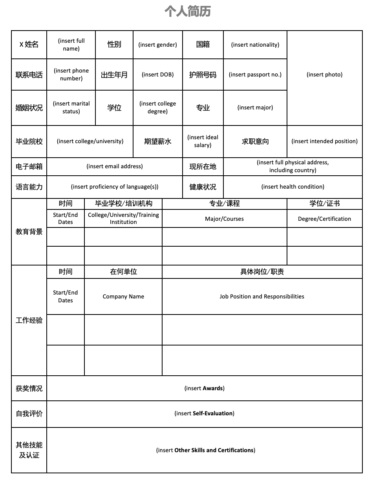
Some Chinese application forms request information that would be unusual or even prohibited on a Western resume: date of birth (出生日期), nationality (国籍), gender (性别), marital status (婚姻状况), and even health status (健康状况). You’re not legally required to provide all of it, but leaving fields blank on a structured form may stand out. Use your judgement based on the company and role.
Quite often you will find that Chinese resumes resemble an application form, like the one to the right.
However, you can absolutely still exercise freedom and creativity, as long as it’s done tastefully, like these examples.
If you’d like to go for the more standard version, however, you can download our free template:
👉 As with any resume in any country, it’s important to play to your strengths and highlight the skills and experience that make you suitable for the position.
FREE DOWNLOAD ALERT – Download a CV template here.
CV in Chinese – Structure & What to Include?

In this section we’ll look at each part of the resume in greater depth.
Remember that this is a generalized approach and you can adapt this format to whichever way best showcases your skills.
Feel feel to click through to the section that you need help with ✅
Personal Information – 个人信息 (gèrén xìnxī)

As to be expected, you’ll be expected to provide some standard personal and contact information, including:
| English | Chinese | Pinyin |
|---|---|---|
| First and last name | 姓名 | xìng míng |
| Email address | 邮箱 | yóu xiāng |
| Phone number | 电话 | diàn huà |
| Address | 地址 | dì zhǐ |
However, whilst the trend in western countries is leaning more towards privacy and more anonymous style resumes to avoid discrimination, you might notice that some Chinese application forms may request the following information:
| English | Chinese | Pinyin |
|---|---|---|
| Academic credentials | 学历 | xué lì |
| Gender | 性别 | xìng bié |
| Date of birth | 出生日期 | chū shēng rì qī |
| Nationality | 国籍 | guó jí |
| Passport number | 护照号码 | hùzhào hàomǎ |
| Academic degree | 学位 | xué wèi |
| Language ability | 语言能力 | yǔ yán néng lì |
| Salary expectations | 期望薪水 | qī wàng xīn shuǐ |
| Health status | 健康状况 | jiàn kāng zhuàng kuàng |
| Marriage status | 婚姻状况 | hūn yīn zhuàng kuàng |
Psst… Do you have a Chinese name to put on your resume yet? If not, check out our Chinese name generator!
You might (rightly) think this information is private, but it’s not unusual in China and some people even include their height and weight on their resumes!
If faced with prying questions on an application form, you can leave some sensitive information out, but this may come up in the interview and it’s best to be prepared.
Note: Expected salary tends to be written in terms of monthly (not annual) salary. Make sure to write the expected figure in RMB to avoid confusion.
Job Search Objective – 求职意向 (qiúzhí yìxiàng)
Unlike most Western CVs, Chinese resumes often include a short ‘Job Search Objective’ section near the top. This tells the recruiter at a glance what role you’re targeting and where you want to be in your career.
Keep it to two or three sentences. Mention the position you’re applying for, your key strengths, and your availability.
| English | Chinese | Pinyin |
|---|---|---|
| Job search objective | 求职意向 | qiúzhí yìxiàng |
| Desired position | 应聘职位 | yìngpìn zhíwèi |
| Expected salary | 期望薪资 | qīwàng xīnzī |
| Availability / Start date | 到岗时间 | dàogǎng shíjiān |
| Work location | 工作地点 | gōngzuò dìdiǎn |
TIP💡 If you’re applying to companies in a specific city, say Beijing or Shanghai, it’s worth naming it here. Recruiters scan hundreds of applications; showing you’re committed to their location helps you stand out.

Complete Guide to Chinese Universities || Which Are The Very Best
With over 2,500 Chinese universities, there is plenty to choose from, but which are the best? We reveal the top Chinese Uni’s and how to get into them.
Educational Background – 教育背景 (jiàoyù bèijǐng)
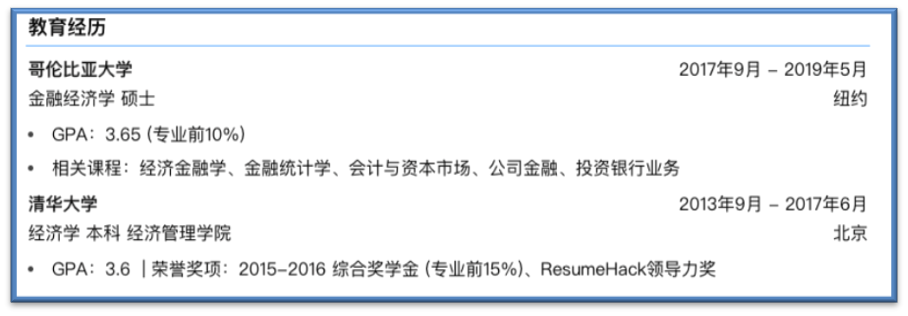
List your educational experiences from newest to oldest, just as you would on a Western CV. Most recent at the top, working backwards.
For each entry include: the institution name, your degree or qualification, your dates of study (in year-month-day format: 年月日), and your major or field of study.
Here’s the vocabulary you’ll need:
| English | Chinese | Pinyin |
|---|---|---|
| Educational background | 教育背景 | jiàoyù bèijǐng |
| University / College | 大学 | dàxué |
| Major / Field of study | 专业 | zhuānyè |
| Degree | 学位 | xuéwèi |
| Bachelor’s degree | 学士学位 | xuéshì xuéwèi |
| Master’s degree | 硕士学位 | shuòshì xuéwèi |
| PhD | 博士学位 | bóshì xuéwèi |
| GPA / Academic results | 成绩 | chéngjì |
| Graduation | 毕业 | bìyè |
| Exchange program | 交换生项目 | jiāohuàn shēng xiàngmù |
TIP💡 If you studied Chinese at a recognised institution or completed an exchange program in Beijing, Shanghai, or another Chinese city, make sure to highlight it. It signals genuine commitment to the language and culture.
As for GPA, this can be simply written as ‘GPA’, it’s used in China too.
Tip: Align the name of your University to the left and attending dates to the right. See the photo as an example.
If you are still studying at University, put the date you started and the end date as 至今 (zhìjīn). This simply means until the present time.
Work & Internship Experience – 工作经历 (gōngzuò jīnglì)
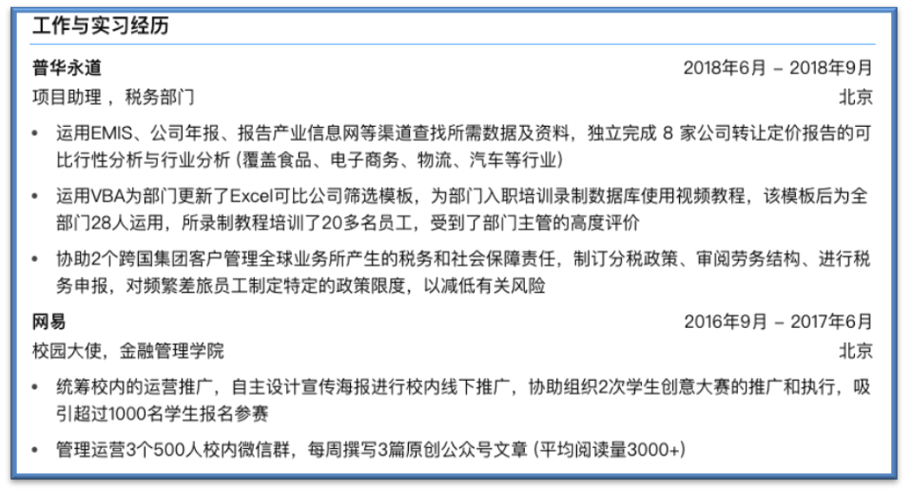
This is usually the most important section of your 简历. List roles from most recent to oldest, including company name, your job title, the dates you worked there, and a short description of your responsibilities.
Work and internship experience can often be a deciding factor in who gets to the interview stage, especially if you apply for a job that requires industry knowledge and know-how, so it’s important this section is up-to-scratch.
| English | Chinese | Pinyin |
|---|---|---|
| Work experience | 工作经历 | gōngzuò jīnglì |
| Company / Organisation | 公司 / 单位 | gōngsī / dānwèi |
| Job title | 职位 | zhíwèi |
| Department | 部门 | bùmén |
| Responsibilities | 工作职责 | gōngzuò zhízé |
| Full-time | 全职 | quánzhí |
| Part-time | 兼职 | jiānzhí |
| Internship | 实习 | shíxí |
| Resigned / Left | 离职 | lízhí |
| Promoted | 晋升 | jìnshēng |
TIP💡 Chinese employers often appreciate quantified achievements. If you increased sales by 30% or managed a team of 10, say so clearly with numbers.
| English | Chinese | Pinyin |
|---|---|---|
| Company name | 公司 | gōng sī |
| Duration of employment | 就职时间 | jiù zhí shí jiān |
| Company location | 地点 | dì diǎn |
| Department | 部门 | bù mén |
| Position title | 职位 | zhí wèi |
| Job Responsibilities | 职责 | zhí zé |
| Accomplishments | 业绩 | yè jì |
Remember, if you give the exact address of a previous work location, give the address in the order of biggest to smallest, meaning country, province, city, street address, etc.
With each workplace listed, you’ll need to elaborate on are your responsibilities and accomplishments from relevant tasks. Whilst this can be quite the challenge in Chinese, the best strategy after writing your resume is to get a Chinese friend or teacher to proof read it for you.
Tip: Cover letters are less common in China so try to concisely sum up the experience you’ve had.
Use sub-headers such as “position” (职位), “responsibilities” (职责), and “accomplishments” (业绩) for a structured and polished style with clear indications as to where the information lies.

How to Apply for Jobs in Chinese || Words And Phrases You Need to Know
Check out this step-by-step language guide to finding and applying for a job in China. Includes all the Chinese words and phrases you’ll need.
Awards and Honours – 奖励/荣誉 (jiǎnglì / róngyù)

Chinese resumes, especially for graduate applicants, typically include a dedicated awards section. Scholarships, academic prizes, and competition results are all worth listing here.
This section might not always be necessary, but it is good to list any awards or scholarships you have gained at your University or work, including any competitions you participated in and trophies you were awarded.
| English | Chinese | Pinyin |
|---|---|---|
| Awards / Prizes | 奖励 | jiǎnglì |
| Honours | 荣誉 | róngyù |
| Scholarship | 奖学金 | jiǎngxuéjīn |
| First prize | 一等奖 | yīděng jiǎng |
| Second prize | 二等奖 | èrděng jiǎng |
| Third prize | 三等奖 | sānděng jiǎng |
| Merit award | 优秀奖 | yōuxiù jiǎng |
| Competition | 比赛 | bǐsài |
TIP💡 Even if your awards aren’t from a Chinese institution, include them, and add a brief English-to-Chinese translation of the awarding body so recruiters can understand the context.
Some additional useful words:
| English | Chinese | Pinyin |
|---|---|---|
| Awards | 奖 | jiǎng |
| Scholarships | 奖学金 | jiǎng xué jīn |
| Competition | 比赛 | bǐ sài |
| 3rd place | 三等奖 | sān děng jiǎng |
Skills and Certifications – 技能/认证 (jìnéng / rènzhèng)
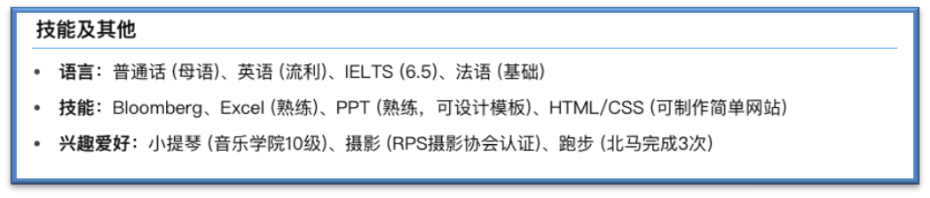
Skills are highly important to list!
List technical skills, software proficiencies, and any formal certifications here. In China, language certifications like HSK are particularly valued.
| English | Chinese | Pinyin |
|---|---|---|
| Skills | 技能 | jìnéng |
| Certification | 认证 / 证书 | rènzhèng / zhèngshū |
| Computer skills | 计算机技能 | jìsuànjī jìnéng |
| Language ability | 语言能力 | yǔyán nénglì |
| HSK (Chinese proficiency) | 汉语水平考试 | Hànyǔ Shuǐpíng Kǎoshì |
| Driving licence | 驾驶证 | jiàshǐ zhèng |
| Professional qualification | 职业资格 | zhíyè zīgé |
TIP💡 If you hold an HSK certificate, note the level clearly: e.g., ‘HSK 5 – 210/300’. Chinese recruiters know exactly what each level means.
Some things to include in this section are other foreign languages you are proficient in. It is useful to state any standardized exams you have taken such as HSK and the level of test taken or level you think are at.
You might also want to include in this section any software programs you are highly familiar with such as Canva or WordPress.
Some useful vocabulary that might help include:
| English | Chinese | Pinyin |
|---|---|---|
| Foreign Language | 外语 | wài yǔ |
| Language Ability | 语言能力 | yǔ yán néng lì |
| Beginner | 初级 | chū jí |
| Intermediate | 中级 | zhōng jí |
| Advanced | 高级 | gāo jí |
| Proficient in | 熟练 | shú liàn |
| Software | 软件 | ruǎn jiàn |
| To use (formal) | 使用 | shǐ yòng |
| Website | 网站 | wǎng zhàn |
Language Proficiency on Your Chinese Resume
If you’re a non-native speaker applying to a Chinese company, how you present your language ability matters.
Chinese resumes typically use a tiered scale for language skills:
| Level description | Chinese | Pinyin |
|---|---|---|
| Mother tongue / Native | 母语 | mǔyǔ |
| Proficient / Fluent | 精通 | jīngtōng |
| Skilled / Working proficiency | 熟练 | shúliàn |
| Basic / Conversational | 一般 | yībān |
If you hold an HSK certificate, list it explicitly with your score: e.g., 汉语水平考试 HSK 5级 (210/300). This is far more meaningful to a Chinese recruiter than writing ‘intermediate Mandarin’.
Not sure which HSK level to claim on your resume? Test your HSK knowledge with our free quiz and find out where you stand right now. And if you want to push your level before applying, our Chinese language programs in China are designed to get you there as fast as possible.

Self Evaluation – 自我评价 (zìwǒ píngjià)
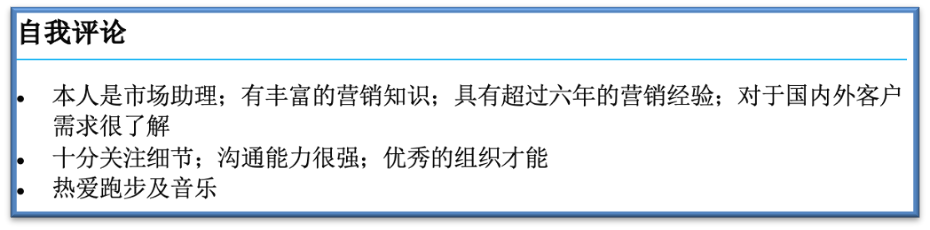
This section is more common on Chinese resumes than Western ones. It’s a short paragraph (3-5 sentences) where you summarise your personality, work ethic, and what makes you a strong candidate.
Avoid generic phrases. Be specific: mention your communication style, your approach to teamwork, and any relevant personal qualities.
| English | Chinese | Pinyin |
|---|---|---|
| Self evaluation | 自我评价 | zìwǒ píngjià |
| Hardworking | 勤奋 | qínfèn |
| Team player | 团队合作精神 | tuánduì hézuò jīngshén |
| Strong communication skills | 沟通能力强 | gōutōng nénglì qiáng |
| Careful / Detail-oriented | 细心 | xìxīn |
| Responsible | 负责任 | fùzérèn |
| Adaptable | 适应能力强 | shìyìng nénglì qiáng |
In some Chinese resumés this section is called “hobbies and interests” (兴趣爱好: àihào xìngqu).
This last section normally outlines why you think you are a good fit for the company or position in question through your interests, experiences and skills.
In this way, and unlike in western resumes, this section is much more informal and personal.
Typical things to list here include:
| English | Chinese | Pinyin |
|---|---|---|
| Hobbies | 爱好 | ài hào |
| Interests | 兴趣 | xìng qù |
| Personal characteristics | 个人特点 | gè rén tè diǎn |
| Personal experiences | 个人经验 | gè rén jīng yàn |
List your interests in a way that the company you are applying for might find appealing and remember to put a positive spin on things, such as describing how boxing taught you the importance of self-discipline.
Hobbies and interests are also a great way to advertise the fact that you possess certain characteristics the company is looking for, such as:

Strong ability to solve problems
解决问题能力较强jiě jué wèn tí néng lì jiào qiáng
Strong communication skills
沟通能力很强gōu tōng néng lì hěn qiáng

Strong ability to adapt
具备较强的适应能力jù bèi jiào qiáng de shì yìng néng lì
Excellent organization abilities
优秀的组织才能yōu xiù de zǔ zhī cái néng
Pays close attention to detail
十分关注细节shí fēn guān zhù xì jié
Try and point out your strengths to the company that you might think will be useful for the position you want to apply to.
👉 For students with little work experience, this might be a great time to mention any volunteering experience or clubs or sports you’ve participated in over the years.
Tips for Foreigners Applying to Chinese Companies
If Chinese isn’t your first language, here’s what will help you stand out, rather than blend into the pile. 🤔
- Have your resume reviewed by a native speaker. Even small grammar errors in Chinese can signal carelessness. If you’re studying with us, ask your teacher to check it.
- Use simplified characters for mainland roles (北京, 上海, etc.), and traditional characters for roles in Taipei or Hong Kong.
- Show your HSK level prominently. As mentioned above, list your certificate level and score. It’s the clearest signal of your language ability.
- Explain your China connection. Have you studied, lived, or worked in China? Say where. Recruiters appreciate applicants who’ve made a real commitment.
- Don’t over-translate your foreign experience. It’s fine to write company names and university names in English, just add the Chinese name in brackets where you can find it.
- Match the tone of the industry. Tech companies in Beijing tend to accept more creative formats; state-owned enterprises (SOEs) or traditional firms typically expect the standard form-style layout.
TIP💡 City matters. If you’re applying to companies in Beijing or Shanghai, use simplified Chinese characters (简体字).
If you’re targeting companies in Taipei, switch to traditional characters (繁體字). Getting this wrong is an easy mistake that’s immediately noticeable to any recruiter.
TIP💡 If your Chinese still needs work before you’re ready to apply, immersing yourself in the language is the fastest route. Our Chinese language program in China puts you in small-group classes with native teachers from day one, and you’ll live with a host family so you’re practising around the clock.
If you’re planning to work in Beijing specifically, nothing beats being on the ground. You can study Chinese in Beijing with LTL and build both the language skills and the local network you’ll need to compete in the job market.
Ready to get your Chinese to job-application level? Find your perfect Mandarin program at LTL, with schools across Beijing, Shanghai, Chengdu, and more, we’ll help you become fluent as fast as possible. 🎯

Sports in Chinese 🥎 The Complete Guide To All Your Favourites
Your Definitive Guide to 32 Sports in Chinese In our never ending quest to bring you the best content on the web when it comes to studying Mandarin, we continue today as we teach you 32 sports in Chinese. Of…
Resume in Chinese – Helpful Resources
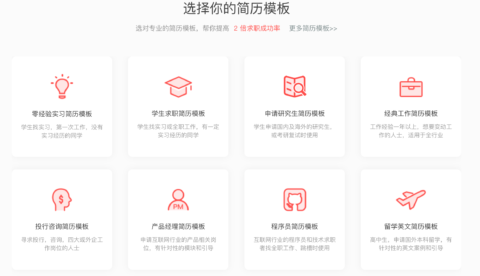
If you are still struggling to write your resume and you don’t know how to structure it, we’d recommend visiting the website WonderCV.
Although it is in Chinese, it was recommended to us by a local and is a great way to get started.
WonderCV is a platform that helps you build your resume according to your experience and requirements.
You can create an account using your WeChat and use their templates to create a resume. Bear in mind, you only get one free choice, if you would like to use another template you might have to pay.
We’ve also written some guides for cover letters, emails and what it’s like working in a Chinese company ⬇️
- HOW TO – Write the perfect email in Chinese
- HOW TO – Write a killer cover letter in Chinese
- EXPLAINER – Work for a Chinese company
- HOW TO – Write professional emails in Business Chinese
Resume in Chinese – Is It Worth It?
Ultimately, if you are looking for a job in China, having a resume in Chinese will enhance your chances in bringing you closer to the interview stage – it is definitely worth it!
Having your resume in English and Chinese can impress your employers and increase your chances that HR or headhunters will find you- who wouldn’t want a multilingual pro like you?
Although it can be a bit daunting to prepare, even if you are at beginner’s level it is worth having a go. 加油!
So there we have it – your complete guide on how to write a CV in Chinese – feeling confident?
If not – drop us a comment below with any questions or concerns, but first and foremost, download our templates below and get practicing!
Resume Quiz

Resume in Chinese || FAQs
How do you write a resume in Chinese?
Hopefully this guide will help you!
If you are still not sure feel free to pop a comment down below to ask any of your questions.
How do you say resume in Chinese?
Resume in Chinese is 简历 (jiǎnlì)
Is the format the same as a Western resumes?
Not quite! Chinese resumes are more direct, and brief – ideally no more than two pages.
Hopefully this guide will help you identify the key differences!
Another difference is instead of reference letters, the self-evaluation section is more popular and common in China.
If I’m a beginner can I still write a resume in Chinese?
Yes! – have a go, it is a good way to practice and learn Chinese as you are describing yourself.
Is it necessary to have a resume in Chinese?
Yes – if you want to apply for a job in China it will definitely be beneficial to your career!
Should I ask my Chinese friend or teacher to review it?
If you are unsure of any word or sentence structure, we would totally recommend asking your friend or teacher for advice.
Want more from LTL?
If you wish to hear more from LTL Language School why not join our mailing list? We give plenty of handy information on learning Chinese, useful apps to learn the language and everything going on at our LTL schools!
Sign up below and become part of our ever-growing community!
⭐ Download our free ebook, your starter pack of essential Mandarin learning resources!
BONUS || Want to study Chinese with us in China? Why not check out our group and individual classes here







9 comments
Thanks for the templates 🙂 Hoping to get a job in China next year
Thanks Graham! Good luck! We're happy to hear you like the templates.
LTL
Thanks for your helping
This is super helpful - thank you so much for the FREE templates
No problem! Happy to hear you like the templates 🙂
LTL
I have never seen a Chinese CV before, great resource thanks. Do they usually ask for a cover letter?
Hi Aubry, thank you for asking. Usually Chinese company do not ask for a cover letter, they will mostly be interested in your CV. However if you are applying for a job in a foreign company in China they could ask for one.
how can i work in China
Broad question there Tim, get yourself on LinkedIn and set the filters to China. There are loads of teaching jobs in China which is an easy route in. Start networking and building contacts.
Good luck 🙂
LTL