
Pass the HSK 6 (and Get Ready for HSK 7-9) | 10 Tips To Pass With Flying Colours in 2027
To pass HSK 6, you need a total of 180 out of 300, the pass mark most test centres quote, across three sections: listening, reading and writing. The surest route is a study plan built on an early practice test, weekly timed mock exams, vocabulary learned in context, and a clear strategy for the summary-writing task. Kathryn’s ten tips below cover each section in turn.
The following post has been brilliantly put together by Kathryn Miles, a U.S student who spent time studying with LTL. Her progress in this time was impressive. Below she gives ten expert tips on how to pass the HSK 6 exam.

I studied intensive Mandarin 1-on-1 at LTL Beijing during the Fall and decided to take the HSK 6 at the end of my time there.
Although the HSK 6 wasn’t the main focus of my studies at LTL, my teachers were incredibly helpful in preparing me for it.
Here are a handful of tips I learned along the way.
Before taking a look at Kathryn’s top tips, we’ve also got another HSK 6 successor for you. Anthea gives her story with LTL and her thoughts on the HSK 6 Exam.

HSK 6 Exam Format // Sections, Timing and Pass Mark
Which HSK 6 Are You Sitting? // HSK 2.0 vs HSK 3.0
Quick Scan the Listening Section
Save Weak Sections Until the End
How to Pass HSK 6: #6 – Practice Reading a Wide Range of Topics Before the Test
How to Pass HSK 6: #8 – Create a Strategy for the Writing Summary: Remember the Sequence of Events
Pay Attention to the Writing Conclusion Section
HSK 6 Exam Format // Sections, Timing and Pass Mark
The HSK (Hànyǔ Shuǐpíng Kǎoshì, 汉语水平考试) is the standardised Chinese proficiency test for non-native speakers, organised by Chinese Testing International (CTI). Universities in China use it for admission and scholarships, and employers use it as proof of your level.
The table shows the HSK 2.0 format that Kathryn sat, which is used for sittings before 13 December 2026. HSK 3.0 changes it, as the next section explains.
| Section | Questions | Time | What it tests |
|---|---|---|---|
| Listening (听力 tīnglì) | 50 | About 35 minutes | Short passages, interviews and longer talks, each played once |
| Reading (阅读 yuèdú) | 50 | 50 minutes | Spotting sentence errors (语病 yǔbìng), filling gaps and long passages |
| Writing (书写 shūxiě) | 1 | 45 minutes | Summarising a story of about 1,000 characters in about 400 characters |
| Total | 101 | About 135 minutes, plus a few minutes for your personal details | Listening, reading and writing |
What is the passing score for HSK 6?
Each section is scored out of 100, so the full score is 300. Most test centres and teachers quote 180 out of 300 (60%) as the pass mark, and only your total counts.
CTI’s HSK 6 page gives the 300-point total but does not print a pass mark, and many universities set their own minimum above 180. Check the score your university, scholarship or employer asks for before you book.
Validity, registration and speaking
HSK scores are valid for two years from the exam date. You register on chinesetest.cn, where you choose your level, test centre and paper or computer format. Fees are set locally, so check the current fee with your test centre.
HSK 6 itself has no speaking section. Speaking is tested in the separate HSKK, and HSKK Advanced is the level that matches HSK 5 and 6. Check whether your test centre or university also needs an HSKK result.
For more on every level, the length of each exam and what each test includes, see our complete HSK exam guide.
How hard is HSK 6 compared with HSK 5?
Honestly, it’s a big jump. Under HSK 2.0, HSK 5 asks for about 2,500 words and HSK 6 for about 5,000, so your vocabulary doubles while the texts get longer, faster and more formal.
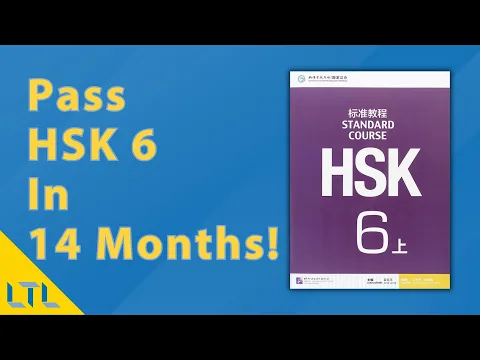
If you’ve only just passed HSK 5, plan for many months of steady study, not a few weeks. Emma, whose story is in the video further down, passed HSK 6 after 14 months of study, mostly online. You mainly need HSK 6 for demanding university programmes in China, translation work, or jobs where you read and write Chinese every day.
Which HSK 6 Are You Sitting? // HSK 2.0 vs HSK 3.0
The HSK is changing. HSK 3.0 launches worldwide on 13 December 2026, according to Chinese Testing International. Regular sittings before that date use HSK 2.0, which is the format Kathryn sat and the one her tips describe.
Some test centres set their own transition dates, so check which version your registration shows. HSK 3.0 moves from six levels to a ‘Three Stages, Nine Levels’ system: elementary (HSK 1-3), intermediate (HSK 4-6) and advanced (HSK 7-9). HSK 6 is no longer the top of the ladder.
| HSK 2.0 HSK 6 | HSK 3.0 HSK 6 | |
|---|---|---|
| Where it sits | The highest of six levels | The top of the intermediate stage, below HSK 7-9 |
| Skills framework | Listening, reading and writing | Part of a system assessing listening, speaking, reading, writing and, at advanced levels, translation |
| Syllabus | About 5,000 words | A new syllabus covering tasks, topics, vocabulary, grammar and characters, with its own word lists |
| Exam format | 101 questions with a summary-writing task | Revised question types, number of questions, timing and listening speed |
What does this mean for your preparation? The core skills in the tips below still matter: fast listening, quick reading, formal vocabulary and accurate writing. The details are different, though.
If you’re sitting HSK 3.0, check the official syllabus and sample questions on chinesetest.cn before you buy materials, because older HSK 6 books and past papers follow the old format. For more background, read our guide to the New HSK.
How to Pass HSK 6: #1 – Create a Study Plan. Stick To It

I recommend doing a practice test to see what your weaknesses are well in advance of the test, then creating a study plan based on that.
For example, I added time spent on HSK 6 prep books to my regular study routine and tried to do one practice test per week during the last two months before the test.
You can also use HSK practice exam sites to help you drill vocabulary.
TIP💡 We suggest a simple split: spend about 60% of your study time building real Chinese (reading, listening and vocabulary) and 40% on exam questions, then move closer to 50/50 in the final month.
If you can study for two hours a day, a typical day might look like this:
| Activity | Time |
|---|---|
| Vocabulary review with spaced repetition | 20 minutes |
| Listening and shadowing | 30 minutes |
| Timed reading | 30 minutes |
| Grammar and formal sentence patterns | 15 minutes |
| Writing practice | 15 minutes |
| Reviewing your mistakes | 10 minutes |
If you’re already comfortable at HSK 5, a 12-week plan could run like this:
| Weeks | Focus |
|---|---|
| 1-2 | Take a practice test, find your weak spots and review vocabulary |
| 3-4 | Build listening and reading speed |
| 5-6 | Advanced vocabulary, idioms and grammar |
| 7-8 | Weekly timed writing summaries with teacher feedback |
| 9-10 | One full timed mock test a week |
| 11-12 | Review your mistakes and rehearse exam conditions |
Keep an error log (错题本 cuòtíběn) for every mock test. Write down each wrong answer, why you chose it and the correct version. Patterns show up quickly, especially in sentence errors and word collocations.
It’s also important to have a teacher look at your Writing samples and give you feedback.
How to Pass HSK 6: #2 – Quickly Scan the Listening Section Answers
Before you listen to the audio scan over the answers and mark what you think the answers are as you hear things in the passage.
If you can scan the answer choices before the audio passage begins, and if you are familiar with the types of questions that are usually asked on the Listening section, you might be able to anticipate the answers to the longer passages.
(Of course, be careful not to focus so much on reading the answer choices that you forget to listen to the passage, and make sure you actually listen to the questions to confirm what you predicted would be asked!)
TIP💡 The audio plays only once, so build your listening stamina every day, not just in mock tests. Try 30 minutes a day: 10 minutes of Chinese news, 10 minutes of a podcast or interview, 5 minutes of shadowing (repeating straight after the speaker) and 5 minutes summarising what you heard, out loud or in writing.
How to Pass HSK 6: #3 – Don’t Second Guess On The Listening Section
In the HSK 2.0 format, you get 5 minutes at the end of the Listening section to go back over your answers. HSK 3.0 adjusts question types and timing, so check the format for your sitting on chinesetest.cn.
You should be sure to not leave any questions blank, but try to resist the urge to change the answers you’ve already chosen.
You can’t listen to the passages again and you might not even remember what the question was.

How to Pass HSK 6: #4 – Pay Close Attention To Word Usage & Idioms
Knowing the meaning of a word is not enough. You must know how to use it!
Knowing how to use a word includes knowing which part of speech it is, as well as knowing how it differs from synonyms.
Learn words in context. Twenty to thirty new words a day, each with an example sentence and its usual collocations, beats 100 words you’ve forgotten by Friday. Review them in a spaced repetition app such as Anki or Pleco’s flashcards so the whole HSK 6 list stays fresh.
Not sure where your gaps are? Test your HSK 6 vocabulary to see how much of the list you already know. The official word list is part of the HSK syllabus published on chinesetest.cn.
Idioms in Chinese appear a lot, know them.
How to Pass HSK 6: #5 – Save Your Weaker Sections For The End
If there is a sub-section you find particularly difficult, it’s better to do sections you are stronger at first, and then go back to that other sub-section.
I think the 语病 section of the test is the most difficult part of the Reading section for me, so I did that section last.
In 语病 (yǔbìng) questions you pick the one sentence out of four that contains an error. Strip each sentence down to its subject, verb and object first. Most mistakes show up once the extra phrases are gone. These are the error types to drill:
| Error type | Pinyin | What to look for |
|---|---|---|
| 成分残缺 | chéngfèn cánquē | A missing subject, verb or object |
| 成分赘余 | chéngfèn zhuìyú | Redundant words that repeat the same meaning |
| 搭配不当 | dāpèi bùdàng | Words that don’t go together, such as the wrong verb for a noun |
| 语序不当 | yǔxù bùdàng | Words in the wrong order |
| 关联词误用 | guānliáncí wùyòng | Paired conjunctions that don’t match |

From 0 to HSK 5 in a Year (How On Earth Did He Do It)
How to Pass HSK 5 (in UNDER a Year) || Karim’s Story I did not know a single word in Chinese when I first came to Beijing in July 2013 to study Mandarin. After finishing high school I decided to…
How to Pass HSK 6: #6 – Practice Reading a Wide Range of Topics Before the Test
I found practice test subjects to be similar to the subjects on the actual test… and I realized I rarely read things about bacteria and other scientific topics, so I had to start familiarizing myself with those topics in Chinese!
TIP💡 Read something outside your comfort zone every day: Chinese news sites, popular science articles, magazine essays, and graded readers such as The Chairman’s Bao or Du Chinese. Time yourself, and aim to get the main point of a long article without stopping for every new word.
How to Pass HSK 6: #7 – Do Not Read Everything in The Reading Section!
Time is way too short to read the entire passage.
Read the multiple-choice questions first, then go back and find the answers in the longer article.
How to Pass HSK 6: #8 – Create a Strategy for the Writing Summary: Remember the Sequence of Events
In the HSK 2.0 writing task, used for sittings before 13 December 2026, you get 10 minutes to read a story of about 1,000 characters. The text is then taken away, and you have 35 minutes to rewrite it as a summary of about 400 characters. Give it a title, and don’t add your own opinions.
HSK 3.0 changes the writing tasks, so check the official sample papers on chinesetest.cn if you’re sitting the new version.
After reading the Writing passage once, I use my fingers to count the sequence of events and try to memorize them in order.

For example:
- 1 = setting/characters/main theme
- 2 = some point of action that happens next,
- 3 = the next location they’re at/what happened there, and so on.
Before the timer ticks down I review these points in my head.
I use this to jog my memory of the other, smaller details.
One of my teachers suggested a similar strategy, which is to simultaneously read and create a picture or movie in your head so that you can remember the sequence of events and details.
How to Pass HSK 6: #9 – Pay Attention to The Conclusion of The Writing Section
What is the story trying to teach us? What’s the point of the story?
The point of the story is important! You might even want to look at the conclusion before you read the rest of the passage.
Formal connectors help you link the events clearly in your summary, and they turn up all over the Reading section too:
| Chinese | Pinyin | Meaning |
|---|---|---|
| 然而 | rán’ér | however |
| 尽管 | jǐnguǎn | although |
| 于是 | yúshì | so, and then |
| 从而 | cóng’ér | thus, thereby |
| 以便 | yǐbiàn | so that, in order to |
| 鉴于 | jiànyú | in view of |
| 与其…不如… | yǔqí… bùrú… | rather than…, it’s better to… |
| 总而言之 | zǒng ér yán zhī | all in all |

12 Untranslatable Words in Chinese You Never Knew 🤔
12 Useful Chinese Words With No English Equivalent Learning Chinese is often quite challenging. But those who have reached fluency in the language can confirm that it’s totally worth it. 16% of the global population speaks a variety of Chinese,…
How to Pass HSK 6: #10 – Be Prepared For The Test to be Harder Than Practice Papers
I found the computer test to be harder than any of the practice tests I’d taken.
The real test may feel harder than practice papers for a few reasons.
First, I think that some of the content was actually harder on the real test.
Secondly, I think doing the reading and listening sections on the computer is a bit harder than using paper because you can’t make any markings, underline things, or make notes.
The Writing section changes too. On the paper test you handwrite every character from memory. On the computer test you type your summary with a pinyin keyboard, so you need to pick out the right character from the list rather than write it stroke by stroke. Practise in the format you’ve booked.
I strongly recommend doing a practice run for the computer test if your testing site allows it.
Third, I was more nervous on the actual test day!
How to Pass HSK 6: So, did I pass the HSK 6?
I reached my goal of passing the HSK 6!
However, I could still improve my score, so I might take the test again in the future.
Overall, studying for the HSK 6 helped me increase my vocabulary and improve my reading speed, and I’m glad I took this test.
I would also encourage HSK 6 test-takers to never neglect other aspects of language study.
Don’t forget to challenge yourself to improve real-life Mandarin communication skills in addition to preparing for the HSK!
So is HSK 6 fluent? It proves strong reading and listening, a large vocabulary and solid formal writing. It doesn’t test speaking at all, so conversational fluency still takes plenty of real conversation practice.
You’ll often see HSK 6 matched to CEFR C2. Many teachers disagree: the German and French associations of Chinese language teachers, for example, place it closer to B2 or C1. Treat it as a serious advanced credential, not proof of near-native Chinese.
Passed already? Here’s what to do after passing.
DID YOU KNOW – you can study the HSK exam online with LTL. Check out our preparation courses designed solely to help you pass the HSK.
Our complete HSK exam guide gives further information on every level, the lengths of the exams and what exactly is included in each test.

I Learnt 55 Swear Words From Native Chinese Speakers
Chinese swear words are the most exciting thing for newbies is learning how to say bad things. Here are 55 I learnt from native speakers.
What About HSK 7, 8 and 9?
Passed HSK 6 and want more? HSK 7-9 is one exam, not three. You sit a single advanced paper, and your result places you at HSK 7, HSK 8 or HSK 9, or below HSK 7.
Your score report gives five scores: listening, reading, writing, translation and speaking. Translation and speaking have no counterpart in HSK 6, so they need their own preparation. It is also a much longer sitting than HSK 6, so check the current timing on chinesetest.cn before you book.
CTI aims HSK 7-9 at master’s and doctoral students in China, students majoring in Chinese, and professionals who work in Chinese in research, business, culture or technology. If you don’t need it for one of those, a high HSK 6 score is still a strong advanced credential.
If you do go for it, adjust your HSK 6 routine:
- Translate a short paragraph every week, both into and out of Chinese, and get a teacher to mark it.
- Record yourself answering speaking prompts against a timer, then listen back.
- Read long-form material on law, economics, media and public health, not just stories.
- Sit at least one full mock exam from start to finish, so the length doesn’t surprise you on the day.
Our guide to the New HSK explains how the advanced levels fit into HSK 3.0.
How to Pass HSK 6: Resources You Need
Inspired to take the HSK yourself?
TIP💡 Want a teacher to build your HSK 6 or HSK 7-9 study plan, mark your writing and run mock tests with you? LTL students have a 98% HSK pass rate. Prepare for your language proficiency exam with us.
You can study with us online. We have plenty of online Mandarin courses including a course solely focused on passing the HSK.
Want an app to help you pass the HSK? Look no further than HSK Online.
For realistic practice, start with the official HSK 6 sample papers and mock tests from Chinese Testing International on chinesetest.cn. If you’re sitting HSK 3.0, use its HSK 3.0 sample questions, because the format differs from older past papers.

How to Pass HSK 6 – FAQ’s
How many Chinese characters do I need to know to pass HSK 6?
Under HSK 2.0, used for sittings before 13 December 2026, you need around 5,000 Chinese words, built from a little over 2,600 characters. HSK 3.0 uses a new syllabus with its own word, character and handwriting lists, so check the official HSK 3.0 syllabus on chinesetest.cn for the current figures.
For a full breakdown on all levels from HSK 1 to HSK 6 see our guide to HSK Levels.
How long is the HSK 6 exam?
The HSK 2.0 HSK 6 exam lasts about 135 minutes across 101 questions in Listening, Reading and Writing, plus a few minutes to fill in your personal details. It’s no longer the longest HSK exam: HSK 7-9 adds translation and speaking sections and runs longer. HSK 3.0 changes the timing, so check your level’s page on chinesetest.cn.
Can I study the HSK 6 with LTL?
Yes you can take our course specifically designed to help you pass the HSK.
Is there any pinyin in the HSK 6 exam?
No, the HSK 6 exam is all in Chinese characters.
Only HSK 1 and HSK 2 exams include pinyin. HSK3, 4, 5 and 6 are only in Chinese characters.
How often can I take the HSK 6 exam?
The HSK runs several times a year, on dates set in CTI’s official test calendar on chinesetest.cn.
Depending on your location the dates will vary.
You can take the HSK exam in Beijing with LTL if you are based in Beijing.
If not, check availability in your nearest HSK accredited centre.
Do all HSK Exams cost the same amount?
No, as the HSK levels get higher, the cost for the exam increases slightly.
Is there a higher level than HSK 6?
Yes. HSK 7, 8 and 9 are taken as one advanced exam, HSK 7-9, and your result decides which of the three levels you reach.
You can find out more about the New HSK here.
Is HSK 6 equivalent to C2?
HSK 6 is often matched to CEFR C2, but many teachers disagree. The German and French associations of Chinese language teachers, for example, place it closer to B2 or C1.
Treat HSK 6 as a serious advanced credential, not proof of near-native Chinese.
Is HSK 6 considered fluent?
HSK 6 proves strong reading and listening, a large vocabulary and solid formal writing. It does not test speaking at all, so conversational fluency still takes plenty of real conversation practice.
Speaking is tested separately in the HSKK, where HSKK Advanced is the level that matches HSK 5 and 6.
What is the HSK Chinese proficiency test?
The HSK (Hanyu Shuiping Kaoshi) is the standardised Chinese proficiency test for non-native speakers, organised by Chinese Testing International (CTI). Universities in China use it for admission and scholarships, and employers use it as proof of your level.
You register on chinesetest.cn, and HSK scores are valid for two years from the exam date.
Where can I find the vocabulary list for HSK 6?
The official HSK 6 word list is part of the HSK syllabus published on chinesetest.cn. Under HSK 2.0, HSK 6 asks for about 5,000 words, while HSK 3.0 uses a new syllabus with its own word lists.
To see how much of the list you already know, you can take LTL’s HSK 6 vocabulary test.
Want more from LTL?
If you wish to hear more from LTL Mandarin School why not join our mailing list? We give plenty of handy information on learning Chinese, useful apps to learn the language and everything going on at our LTL schools!
Sign up below and become part of our ever-growing community!






2 comments
[…] Il livello più alto di HSK che puoi superare con il nuovo sistema è HSK 9 e questo richiede la conoscenza di 11.092 parole, più del doppio dell’attuale livello più alto(HSK6). […]
It is so good,I appreciate you keep it up.